


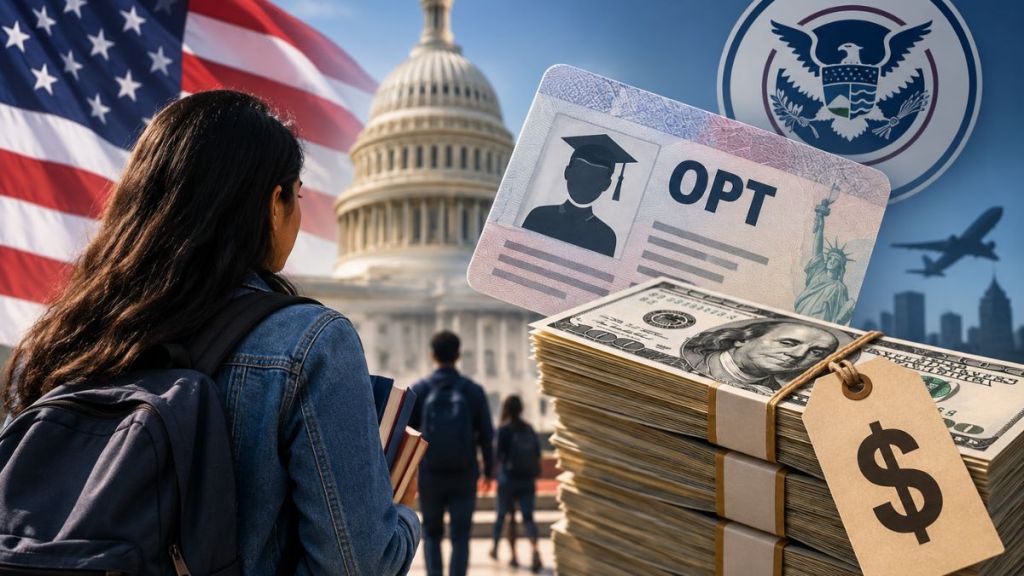

The US Department of Homeland Security has proposed a new fee of up to $100,000 for international students who want to work in the United States after completing their studies under the Optional Practical Training programme, or OPT.
Under the proposal, US colleges and universities would have to pay $70,000 for an F-1 international student’s initial OPT participation and another $30,000 for any subsequent OPT participation. DHS said this is to reduce fraud, strengthening the immigration system and protecting American workers.
The proposal was published by DHS on Wednesday and is scheduled to appear in the Federal Register on October 8, as per Bloomberg.
How the proposed fee would work
The $70,000 fee would apply when an F-1 student is recommended for OPT for the first time. The $30,000 fee would apply to any later OPT recommendation, including a STEM OPT extension.
The fee would be paid by the SEVP-certified educational institution, not directly by the student or the employer. The school would have to make the payment before its designated school official recommends the student for OPT in the Student and Exchange Visitor Information System, or SEVIS.
US Citizenship and Immigration Services would not grant employment authorisation if the required fee had not been paid. The school would also have to provide the student with an updated Form I-20 confirming the payment.
The fee would not be linked to a particular employer. A student changing employers would not automatically trigger another fee. However, a new OPT recommendation could trigger the $30,000 charge.
For example, a student who uses pre-completion OPT and later applies for post-completion OPT could result in the school paying $70,000 for the first period and $30,000 for the second. DHS said this could encourage schools and students to use post-completion OPT instead of splitting the 12-month period between pre-completion and post-completion OPT.
What is OPT?
OPT allows eligible F-1 students to work in jobs directly related to their field of study. Students can use it before completing their studies or after graduation.
Students are generally eligible for up to 12 months of OPT at each education level. Graduates in eligible science, technology, engineering and mathematics fields can receive an additional 24-month STEM OPT extension, allowing them to work for up to 36 months.
Many international graduates use this period to gain work experience while seeking an H-1B specialty occupation visa. The programme has grown significantly. DHS records show that 194,554 F-1 students participated in OPT in 2024, compared with 160,627 in 2023. There were also 95,384 STEM OPT participants in 2024. Bloomberg reported that about 418,000 students, more than a quarter of F-1 students, had work authorisation through OPT during the 2024 calendar year.
DHS cites fraud and concerns over US workers
DHS said the proposal follows investigations into alleged fraud and abuse in the OPT system. The agency said it had found problematic worksites, false employment claims, residential addresses being used as worksites and so-called “pay-to-stay” visa schemes.
A 2026 investigation identified more than 10,000 F-1 students working for employers considered highly suspect by DHS. DHS also said OPT participation has grown faster than its ability to review and investigate cases. The agency said there were about 6,186 SEVP-certified schools as of June 2026, with field representatives responsible for overseeing schools across their territories.
“Optional Practical Training was never meant to be a back door into the American workforce, a subsidy for cheap labor, or a prize for those who game the system,” said a DHS Spokesperson to Bloomberg.
“DHS is upskilling OPT to require foreign students to justify their worth to employers. American workers should not have to compete against a program that has been turned into a pipeline for cheap foreign labor,” spokesperson further added.
The agency said the proposed fees would encourage schools to scrutinise OPT recommendations more closely and discourage fraudulent applications. DHS also said fewer OPT workers could create more job opportunities for US workers and reduce possible wage pressure.
Proposal comes in the middle of various immigration changes
The proposed OPT fee is the latest major charge aimed at employment-based immigration under the Trump administration. DHS had earlier proposed a $103,265 fee for new H-1B workers. An earlier charge on H-1B hires from outside the US was blocked by a federal court.
DHS said the OPT proposal could also reduce the use of OPT as a way to avoid the numerical limits on H-1B visas. The agency noted that H-1B visas are subject to annual limits, while there is no similar statutory numerical cap on OPT participation.
When could the fee take effect?
The fee is not in effect yet. DHS is seeking public comments before deciding whether to finalise the rule. The proposed rule would take effect 60 days after publication of a final rule in the Federal Register. The $70,000 fee would apply to students receiving an OPT recommendation on or after that effective date. Subsequent OPT recommendations for those students would then be subject to the $30,000 fee.
The proposed rule also allows schools to seek refunds in certain cases if a student has not received an employment authorisation document. Once the document has been issued, however, the fee would not be refundable.
DHS estimates the proposed fees could generate between $8.4 billion and $16.5 billion annually, with a primary estimate of $12.4 billion.
The public comment period is expected to run for 30 days after publication, while the information collection section will have a separate 60-day comment period.
Disclaimer: This article is for general informational purposes only and does not constitute legal, immigration, or tax advice. Immigration laws and government policies are subject to frequent change without notice. While we strive to provide accurate updates, readers are strongly advised to verify the latest requirements with the official embassy, consulate, or government portal of the respective country. Financial Express is not responsible for any decisions made based on this information. For personalized guidance, please consult a qualified immigration attorney or a certified professional advisor.