


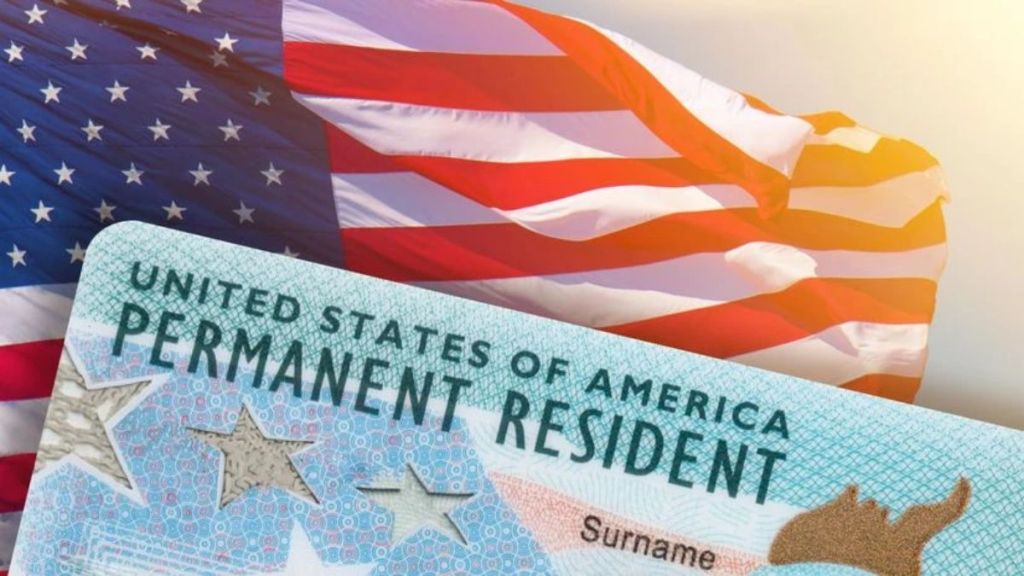

The Trump administration has clarified a new rule covering green cards for some children of foreign government employees who are born in the US, after an earlier policy document left some people unsure about the documents they would need.
The Department of Homeland Security (DHS) said the correction does not create a new immigration benefit. Instead, it restores details about the evidence applicants need to submit. Officials said some of those details were accidentally removed when the rule was added to the immigration regulations.
The clarification comes as the Trump administration continues its efforts to change how birthright citizenship works in the US.
Under the existing rules, children born in the US to foreign diplomats are generally treated differently from other children born in the country. The new DHS policy seeks to extend this treatment to a wider group of children whose parents work for foreign governments.
What the new green card rule says
The interim final rule changes existing immigration regulations that allow some children born in the US to foreign diplomatic officers to register as lawful permanent residents.
The new rule expands that route to certain children whose parents are foreign government employees. It applies when neither parent is a US citizen, and at least one parent was a foreign government employee when the child was born.
The rule was announced by USCIS on September 4 and formally published in the Federal Register on September 9 as 91 FR 57249. It applies to children born on or after September 4, 2026.
The rule replaces the narrower term “foreign diplomatic officer” with the broader term “foreign government employee”.
But not everyone working for a foreign government is covered.
The rule excludes personal attendants of foreign officials, certain employees of state-owned companies, third-country nationals working for foreign governments, certain contractors and foreign government officials who are visiting the US in a personal capacity
Why DHS had to issue a correction
DHS said the original amendment instructions for 8 CFR 264.2(c)(2) were not clear enough.
Because of this, several sub-paragraphs containing the evidence requirements were accidentally removed when the rule was added to the Code of Federal Regulations.
The September 16 correction puts those requirements back. DHS said it is essentially restoring language that was meant to be part of the original rule.
The correction also makes two points clearer.
First, children whose parents were foreign government employees but were not diplomatic officers may not have to file Form I-508, which is a waiver of certain rights, privileges, exemptions and immunities.
Second, those applicants must provide proof that their parent worked for a foreign government. They do not have to provide proof of their parent’s diplomatic classification if the parent was not a diplomatic officer.
DHS said these requirements were already included in the approved Form I-485 information collection linked to the rule. Because of this, the department said the correction does not make a substantive policy change and did not require another public-comment period.
USCIS spokesman Zach Kahler told Newsweek that the correction restores evidence language that was deleted while the rule was being added to the regulations. He also said some of the evidence requirements apply only to specific categories of foreign government employees.
What happens if the child does not apply for a green card?
The USCIS policy update also deals with children who do not choose the permanent residence route. Under the update, a child born in the US to a foreign government employee must be registered as an alien if the child remains in the US for 30 days or longer after birth.
If the child is under 14, a parent must complete the registration.
DHS is also updating Form G-325R, which collects biographic information, for children who do not acquire US citizenship at birth and do not choose to register for permanent residence.
USCIS says registration as a lawful permanent resident is voluntary. However, children covered by the rule can still have separate registration obligations under US immigration law.
The rule is likely to face continued legal scrutiny.
Adam Klein, a former senior DHS official and co-founder of Globali.ai, told Newsweek that there is currently no reliable estimate of how many people could be affected. He noted that DHS itself has acknowledged that it does not have enough data to provide such an estimate.
Klein also pointed out that getting a green card is not the same as getting US citizenship. A green card gives a person permanent resident status.
He said the question of whether the administration can make this change without Congress will ultimately have to be decided by the courts.
The USCIS policy update refers to the Supreme Court’s decisions in United States v. Wong Kim Ark and the 2026 ruling in Trump v. Barbara. USCIS interprets the latter as recognising certain exceptions to birthright citizenship, including the long-established exception involving children of ambassadors.
The new DHS rule says that when neither parent is a US citizen, one of the key questions is whether a parent was a foreign government employee at the time of the child’s birth.
What documents will applicants need?
Applicants seeking permanent residence under the rule will generally need to submit Form I-485 along with the required fee.
They must also provide Form G-325A, the child’s birth certificate and, where applicable, Form I-508.
Applicants must provide official proof of the parent’s foreign government employment. This should include the parent’s occupational title and, where relevant, diplomatic classification at the time of the child’s birth.
They must also provide a list of all arrivals into and departures from the US, proof of continuous residence in the country and two photographs.
An immigration officer may waive the photograph requirement for just cause.
Who is covered as a foreign government employee?
The rule covers several categories of foreign government workers.
These include accredited foreign diplomatic officers, certain embassy and consulate staff who are nationals of the country they represent, people employed by a foreign government in an official capacity and staff members of international organisations that have immunity.
The exact category matters because different evidence requirements can apply to different types of employees.
Disclaimer: This article is for general informational purposes only and does not constitute legal, immigration, or tax advice. Immigration laws and government policies are subject to frequent change without notice. While we strive to provide accurate updates, readers are strongly advised to verify the latest requirements with the official embassy, consulate, or government portal of the respective country. Financial Express is not responsible for any decisions made based on this information. For personalized guidance, please consult a qualified immigration attorney or a certified professional advisor.