


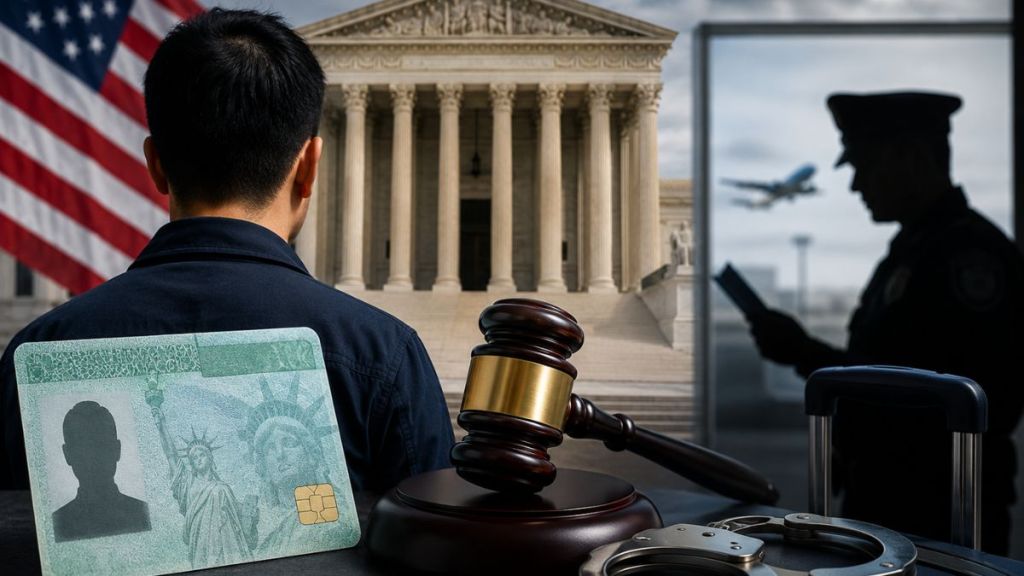

The US Supreme Court has ruled in favour of the Trump administration in a case that could make it easier for the government to begin deportation proceedings against some green card holders accused of crimes. In a 6-3 ruling, the Supreme Court said immigration officials do not need strong evidence of a crime before treating a returning green card holder differently at the US border.
What the case was about
The case involved Muk Choi Lau, a Chinese citizen who became a lawful permanent resident, or green card holder, in 2007. In May 2012, New Jersey authorities charged Lau with trademark counterfeiting. Though, the criminal case was still pending, he briefly traveled to China. When he returned to the United States through New York’s John F. Kennedy International Airport in June 2012, immigration officials did not admit him as a returning permanent resident. Instead, they allowed him into the country on immigration parole because of the pending criminal charge. More than a year later, Lau pleaded guilty to the counterfeiting charge and was sentenced to two years of probation.
How deportation proceedings began
After Lau’s conviction, the Department of Homeland Security started removal proceedings against him, arguing that he had been convicted of a crime involving moral turpitude, a category of offenses that can make non-citizens inadmissible to the United States.
Lau challenged the government’s actions. He argued that immigration officials should not have treated him as an applicant for admission when he returned to the country because, at that time, he had only been accused of a crime and had not been convicted.
The US Court of Appeals for the Second Circuit agreed with Lau. The court said the government did not have enough evidence at the time of his reentry to treat him as inadmissible and ordered that the removal proceedings under that ground be terminated.
What the Supreme Court decided
The Supreme Court reversed the lower court’s ruling. Writing for the majority, Justice Clarence Thomas said immigration officials did not need to prove that Lau had committed a crime before placing him on parole when he returned to the United States.
“Border officers did not have the burden to establish by clear and convincing evidence that Lau had committed a crime involving moral turpitude,” Thomas wrote.
The ruling means the government can rely on a pending criminal charge, rather than a conviction, when deciding whether a returning green card holder should be treated as an applicant for admission.
Liberal justices disagree
Justice Ketanji Brown Jackson wrote a dissent joined by Justices Sonia Sotomayor and Elena Kagan. Jackson argued that the government’s decision effectively placed Lau in legal uncertainty before he had been found guilty of any crime. “I worry that the Court has now handed the Government a massive blank check,” she wrote. She said the decision allowed immigration authorities to place lawful permanent residents in “immigration limbo” based on allegations alone.
The decision could have significant consequences for green card holders who leave the United States while facing certain criminal charges. Under the ruling, immigration officials may have authority to treat returning permanent residents as applicants for admission and later pursue deportation if they are convicted of offenses covered by immigration law. The case began years before Donald Trump returned to office, but it arrives as the Supreme Court is considering several major immigration disputes tied to his administration’s broader immigration agenda, including cases involving birthright citizenship, asylum policies and temporary protections for migrants.
Disclaimer: This article is for general informational purposes only and does not constitute legal, immigration, or tax advice. Immigration laws and government policies are subject to frequent change without notice. While we strive to provide accurate updates, readers are strongly advised to verify the latest requirements with the official embassy, consulate, or government portal of the respective country. Financial Express is not responsible for any decisions made based on this information. For personalised guidance, please consult a qualified immigration attorney or a certified professional advisor.