


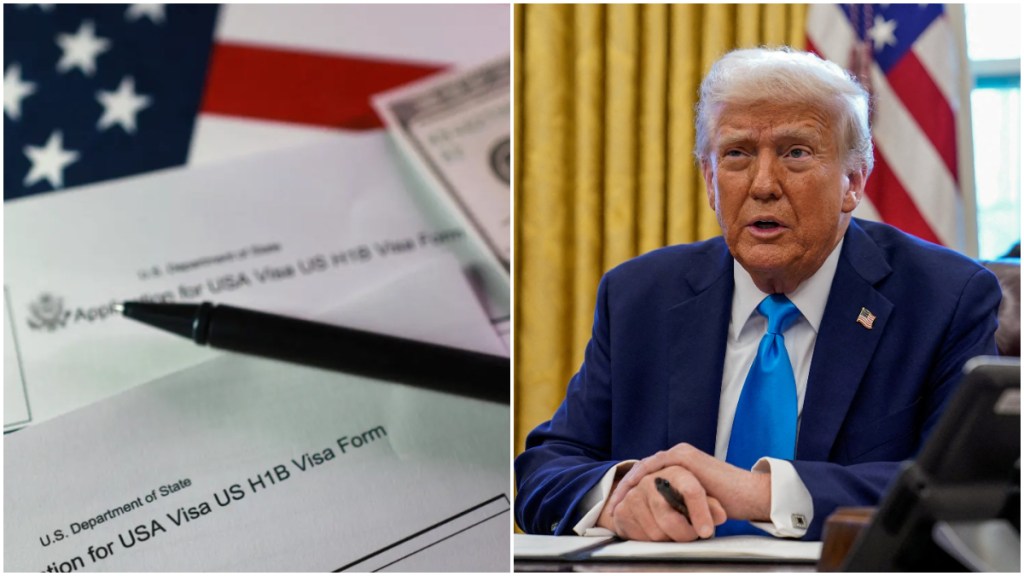

The Donald Trump administration is tirelessly working to secure a legal green light for the much-contested $100,000 fee the Republican president imposed on new H-1B visa applications in a proclamation signed last year. As the hefty levy on the non-immigrant work visa program continues to face multiple legal challenges in US courts, the MAGA leader’s government has appealed a court loss that blocked H-1B fee policies.
Trump admin’s latest move against H-1B
The notice of appeal in the ‘Global Nurse Force v Trump’ case states: “Notice is hereby given that Defendants appeal to the United States Court of Appeals for the Ninth Circuit from this Court’s Order of September 30, 2026 (Dkt No. 130) granting in part Plaintiffs’ Motion for Preliminary Injunction. Defendants have attached the Ninth Circuit Form 1 and 6 to this filing,” as seen in the official court document attached in a Bloomberg Law report.
The appeal to the US Court of Appeals for the Ninth Circuit, dated October 9, came over a week after a California court blocked the US Citizenship and Immigration Services (USCIS) and Customs and Border Protection (CBP) memo and guidance that shed light on issues, including how to pay the fee.
Additionally, government attorneys have requested a stay of Judge Gilliam’s order, stating that the First and District of Columbia circuits are currently hearing similar legal challenges raised against the fee. Officials said the dispute could reach the US Supreme Court and halting the order would save the court’s and the parties’ resources.
H-1B debate expands behind the scenes
In addition to the October 9 appeal to the Ninth Circuit, two other courts weighing the fee issue are the First Circuit in the ‘California v Mullin’ case and the DC Circuit in the ‘Chamber of Commerce v DHS’ case. While the First Circuit refused the administration a stay in July, the DC Circuit heard the argument in March.
On September 30, US District Judge Haywood Gilliam Jr. in California, the second federal judge to do so, ruled that the agencies and the US State Department failed to follow necessary rule-making protocol before implementing Trump’s H-1B fee.
The fee was already facing legal setbacks following a June decision when a federal judge in Boston temporarily blocked the $100,000 fee in a separate case brought by 20 states. Consequently, a Boston-based 1st US Circuit Court of Appeals declined the Trump administration’s bid to halt the lower court judge’s June 8 ruling.
In the meantime, the Department of Homeland Security (DHS) proposed a fee of $103,265 on each cap-subject H-1B petition in August. Although yet to be finalised, this too is expected to be questioned in court while the Trump administration continues to mount its efforts to block legal immigration pathways to the US.
Eight companies, including Microsoft, Adobe, Cognizant, HCL Technologies, Tata Consultancy Services (TCS), and Infosys, were recently suspended from the Permanent Labor Certification (PERM) program, a key stepping-stone in the employment-based green card process for foreign workers in the United States.
“We will not accept any new or process any pending permanent labor certification applications involving these companies,” US Labor Secretary Keith Sonderling said at the time of the major announcement.
Citing an ongoing federal investigation, Sonderling said that the companies flagged recently were among the biggest sponsors of the H-1B work visa program. He further claimed that these firms sought to hire almost 3 million international employees, received more than 230,000 H-1B visa approvals and obtained over 100,000 PERM certifications since 2009.
While Labor Department data through June 2026 shows Microsoft as the largest filer of PERM applications, Amazon was the biggest employer of approved H-1B applicants in FY26, according to official US immigration data. TCS, Infosys, Apple, and Microsoft followed suit.
Meanwhile, Amazon and Meta were the largest sponsors of the work visa program in FY25, according to the official immigration data. Neither company was black-listed from the PERM application process.
Disclaimer: This article is for general informational purposes only and does not constitute legal, immigration, or tax advice. Immigration laws and government policies are subject to frequent change without notice. While we strive to provide accurate updates, readers are strongly advised to verify the latest requirements with the official embassy, consulate, or government portal of the respective country. The views and opinions expressed by the experts quoted herein, if any, are their own and do not necessarily reflect the views of the publication. Financial Express is not responsible for any decisions made based on this information.
