


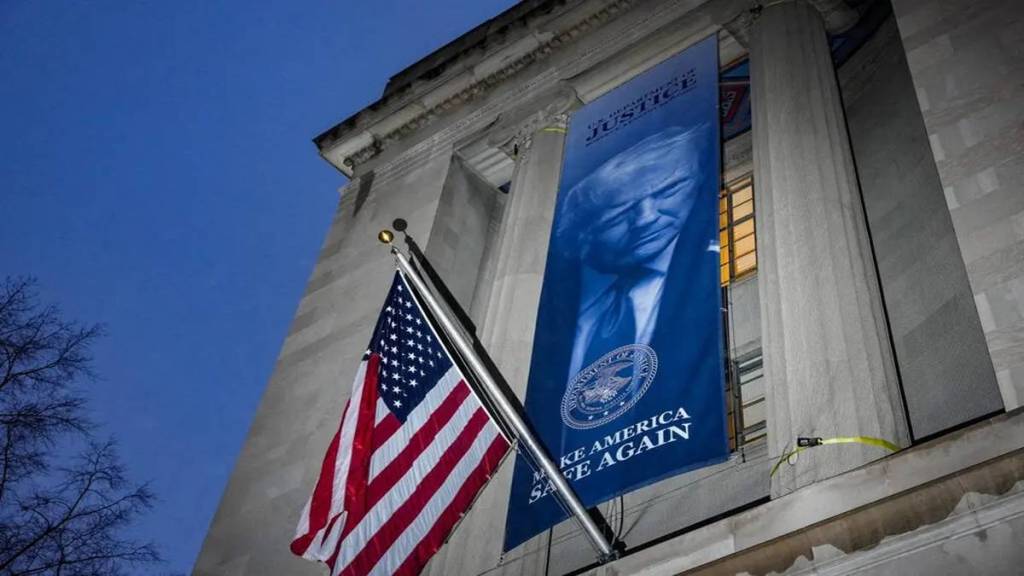

In yet another blow to the Trump administration’s immigration crackdown, a federal judge in the United States blocked the Republican leader and his government’s efforts to impose fines of up to $1.8 million on migrants who fail to self-deport after receiving final deportation orders. The major blow resulted from a 2025 class-action lawsuit filed by two of the thousands of immigrants facing the Department of Homeland Security-backed civil penalties.
Deportation-related fine against immigrants blocked
On Monday (US time), US District Judge George O’Toole, appointed by former Democratic President Bill Clinton, ruled: “The plaintiffs have shown a likelihood of success on the merits, irreparable harm, and that the balance of equities and the public interest support preliminary relief. The Court shall issue a stay under Section 705 of the APA in favor of the plaintiffs,” as seen in the official case document shared by Reuters.
Siding with the plaintiffs, including two individuals and the Immigrant Legal Resource Center, the US judge labelled the fines unlawful and in violation of the Administrative Procedure Act. O’Toole raised the issue that the forms failed to list specific allegations detailing why a penalty was warranted.
What is the immigration case about?
The class action revolves around the imposition of civil monetary penalties against non-citizens under the years-old Illegal Immigration Reform and Immigrant Responsibility Act of 1996. The U.S. Congress enacted IIRIRA in 1996 against non-citizens who purportedly violated immigration laws.
No other administration sought to impose the penalties by availing the act until Trump’s first and now second administrations revived the long-dormant provision and used it to impose fines when an immigrant voluntarily fails to leave the US in accordance with a voluntary departure order.
In a short-lived move, the Joe Biden administration reversed Executive Order 13768, titled “Enhancing Public Safety in the Interior of the United States,” signed by Trump during his first term. The order directed DHS to issue guidance and promulgate regulations to ensure the assessment and collection of civil fines and penalties against immigrants illegally present in the US. After returning to office last year, President Trump issued another executive order, “Protecting the American People Against Invasion” (E.O. 14159).
It directed the DHS Secretary to take “all appropriate action to ensure the assessment and collection of all fines and penalties that [DHS] is authorized by law to assess and collect from aliens unlawfully present in the United States, including aliens who unlawfully entered or unlawfully attempted to enter the United States, and from those who facilitate such aliens’ presence in the United States.” Consequently, US Immigration and Customs Enforcement (ICE) resumed the assessment of civil penalties.
Plaintiffs’ complaint argued that “tens of thousands of people” have been “exorbitantly fined for allegedly willfully or voluntarily failing to depart the country” with amounts up to $1.8 million each. They even challenged a June 2025 Interim Final Rule to impose civil penalties “swiftly and [] scale.”
In 2025, the Trump administration 2.0 started imposing levies of $998 per day for immigrants who fail to leave the US after receiving a deportation order, with plans to issue fines retroactively for up to five years and a maximum fine amount of $1.8 million. At the time, the administration said it would weigh another option if immigrants failed to pay the levies. That option was seizing their property.
A May 2025 Reuters report cited the example of Wendy Ortiz. The low-income-earning migrant made $13 an hour in her job at a meatpacking plant in Pennsylvania. After fleeing El Salvador to escape a violent ex-partner and gang threats, as also established in her immigration paperwork, she had been living in the US for a decade. While her meagre earnings barely covered rent and expenses for her autistic 6-year-old US citizen son, she had been hit with the whopping fine amount of $1.8 million.
To streamline the process of assessing these fines, the US Department of Justice (DOJ) and Homeland Security implemented a new measure in July 2025. It sought to eliminate a 30-day notice period and shorten the process for challenging penalties.
O’Toole’s decision on Monday, however, stated that the current administration’s actions didn’t comply with necessary rulemaking processes while adopting the streamlined measure of fine imposition, as it failed to provide the public a chance to comment on the amended policy first.
How Trump admin has repeatedly linked self-deportation to ‘exit bonuses’
In May 2025, Trump issued a proclamation and established “Project Homecoming,” which would “present illegal aliens with a choice: either leave the United States voluntarily, with the support and financial assistance of the Federal Government, or remain and face the consequences.”
It enabled agencies to notify the public about the consequences imposed against those who failed to leave the country, including “removal, prosecution, incarceration, and fines as consistent with applicable law for immigration-related crimes; the garnishment of wages; and the confiscation of savings and personal property, including homes and vehicles.”
The Trump administration has repeatedly reminded non-citizens that DHS is using the CBP Home Mobile App to “incentivise” the voluntary self-deportation of immigrants illegally present in the United States. Immigrants who register for voluntary self-departure through the app will receive “cost-free travel, a $3,000 exit bonus, and forgiveness of any failure to depart fines,” according to the official Homeland Security website.
While listing the incentives of using the CBP Home App for self-deportation, DHS also states on its website, “You will have civil fines for failure to depart after a final order of removal or a voluntary departure order in the U.S. forgiven. You will not have to pay these fines.”
Trump’s border czar Tom Homan recently said in a CBS News interview that if a non-citizen’s country of origin doesn’t accept the individual as its national, the US will find another place to send the person.
“Now, hopefully what will happen is that they take the opportunity to take the $3,000 and self-deport,” he said in the interview. “If you self-deport… you’re likely to go to your own country.” Meanwhile, the “other” option is that people in the US illegally would be sent to “third countries” in Africa.
Disclaimer: This article is intended for informational purposes only and is based on publicly available immigration guidance. Rules and deadlines are subject to change; readers should verify current requirements directly with USCIS or consult a qualified immigration attorney before making decisions based on this information. Financial Express is not responsible for any decisions made based on this information.