


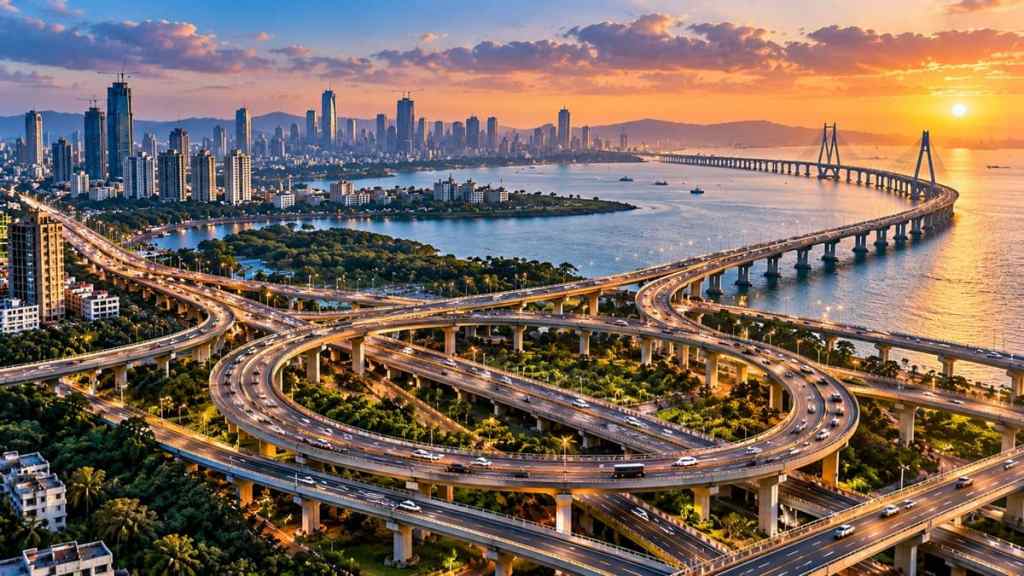

The Mumbai Metropolitan Region Development Authority (MMRDA) on Saturday (October 3) unveiled its 10 Ring Roads Master Plan, outlining a bigger approach to connecting Mumbai and its surrounding areas through an integrated network of roads, tunnels, sea links and expressways.
The authority said the plan marks a shift from developing individual transport projects to planning mobility infrastructure as part of a single, interconnected network across the Mumbai Metropolitan Region (MMR).
In a post on X, the MMRDA said Mumbai’s mobility has historically been shaped by the geography of the region, with much of the movement concentrated along a relatively narrow north-south corridor. The new master plan seeks to create multiple interconnected routes across the wider metropolitan region, giving commuters alternative ways to travel between different parts of MMR.
The Mumbai Ring Roads Master Plan: A New Way of Looking at Mobility
— MMRDA (@MMRDAOfficial) October 3, 2026
For decades, Mumbai’s mobility has been shaped by the geometry of a narrow north–south corridor.
Now, a new approach is taking shape, one that looks beyond individual infrastructure projects and sees the… pic.twitter.com/i4tF20zDOp
From standalone projects to integrated network
According to the MMRDA, the 10 Ring Roads will bring together several existing, ongoing and proposed infrastructure projects. The network will incorporate different forms of road infrastructure, including major roads, tunnels, sea links and expressways, with the objective of creating a more seamless regional transport system.
The authority said the approach moves away from treating individual projects as standalone interventions and instead looks at the Mumbai Metropolitan Region as a single, interconnected mobility network.
10 Ring Roads to create alternative routes
A key objective of the master plan is to provide motorists with multiple travel options across the region. By connecting different road corridors with tunnels, sea links and expressways, the network is intended to provide alternatives to existing routes and reduce dependence on a limited number of major north-south corridors.
The MMRDA said the objective is not simply to construct additional roads, but to create a network that allows traffic to move more efficiently across the region.
Focus on faster, more reliable journeys
The authority said improving travel times and the overall commuting experience is at the centre of the plan. “Because the goal is not simply to build more roads. It is to make travel faster, more reliable and more seamless,” the MMRDA said.
The plan is ultimately aimed at reducing the amount of time commuters spend travelling between different parts of the Mumbai Metropolitan Region. The authority has positioned time savings as one of the key outcomes of a more integrated mobility network.
Existing and upcoming infrastructure to be linked
The 10 Ring Roads framework will combine infrastructure that is already operational with projects under construction and those being planned, according to the MMRDA.
This approach is intended to ensure that individual road projects work together as part of a wider regional network rather than functioning in isolation.
The master plan could therefore provide a broader framework for integrating Mumbai’s expanding road infrastructure with connectivity projects across the metropolitan region.
’10 ring roads, multiple choices, one connected MMR’
The MMRDA has described the initiative as a long-term mobility vision for the Mumbai Metropolitan Region, with connectivity and route diversification at its core. The authority summed up the plan as: “10 ring roads, multiple choices and one connected Mumbai Metropolitan Region.”
The announcement comes as Mumbai and its surrounding areas continue to see rapid expansion of road, tunnel, sea-link and expressway infrastructure, making integration between individual projects an increasingly important part of regional mobility planning.