


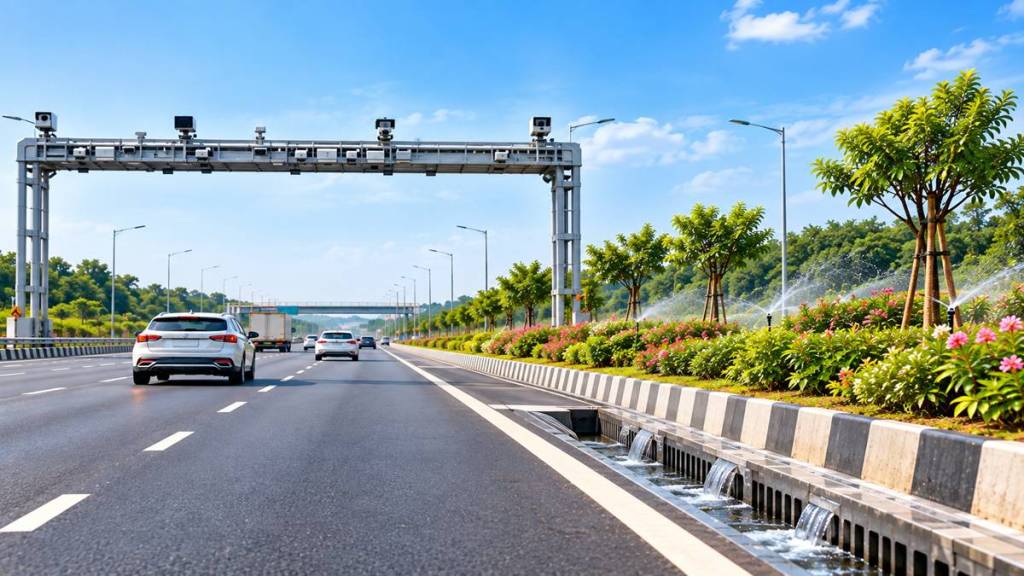

Upcoming high-speed National Highway corridors are set to get a new planning and design framework, with NHAI providing for Multi Lane Free Flow (MLFF) tolling, greenway highway infrastructure, better drainage system and technology-enabled construction.
The National Highways Authority of India (NHAI) has issued comprehensive guidelines for the plannings and designs of High-Speed Access-Controlled National Highways, other than Expressways. The guidelines will also be applicable to all upcoming four-and six lane greenfield and brownfield High-Speed Access-Controlled National Highways.
As per the official PIB release, the guidelines are aimed at making these highways better planned and designed, greener, safer and equipped to manage future traffic requirements.
MLFF tolling planned for high-speed corridors
A crucial provision links to toll collection on high-speed corridors. In line with the government’s vision, NHAI ‘s guidelines provide for a shift towards the Multi Lane Free Flow (MLFF) system of tolling. As per the official release, “provisions for implementation of MLFF shall be made accordingly.”
Technology plays an important role during the construction work. The guidelines provide for the use of Automated and Intelligent Machine-aided Construction (AI-MC) technology for building highway embankments and pavements. These will be conducted in accordance with applicable Ministry of Road Transport and Highways (MoRTH) guidelines.
These measures intend to enhance construction quality, consistency, accuracy and monitoring.
Better drainage and water management
The guidelines also mention providing greater importance to drainage planning, with comprehensive drainage measures set to become an integral part of the Detailed Project Report (DPR) process.
Planning will identify where rainwater should be discharged and how water coming from the highway as well as surrounding areas should be safely used. Water harvesting structures will be provided at loop areas and other suitable locations especially in places where rainwater does not have a natural outlet.
Special arrangements are also planned around underpasses, depressed medians, flyovers and other structures to help prevent waterlogging and damage to National Highway infrastructure.
Drainage plans will be needed to clearly identify water-disposal points and make suitable arrangements for managing rainwater.
Greener corridors with drip irrigation
Under the new guidelines, during the project-planning stage, landscaping and plantation will be incorporated.
Such measures will be planned at suitable locations, including spaces below flyovers and highway medians, and loop areas. Factors like local climate, topography, and environmental conditions will also be considered.
As per the official statement, guidelines for drip irrigation systems on National Highway medians to boost water use and make plantation maintenance easier are also provided.
Future traffic demand to shape highway planning
NHAI has also called for detailed traffic assessment and future-demand planning while developing high-speed corridors. Traffic projects will take into account existing traffic and vehicles projected to be diverted to the new corridors. Expected growth in freight movement arising from economic and commercial activities will also be considered.
Toll data and other reliable sources will be used to make traffic estimates more accurate. As per the official release, the guidelines are likely to contribute to the development of “safer, more sustainable and future-ready” High-Speed National Highway corridors across the country.