


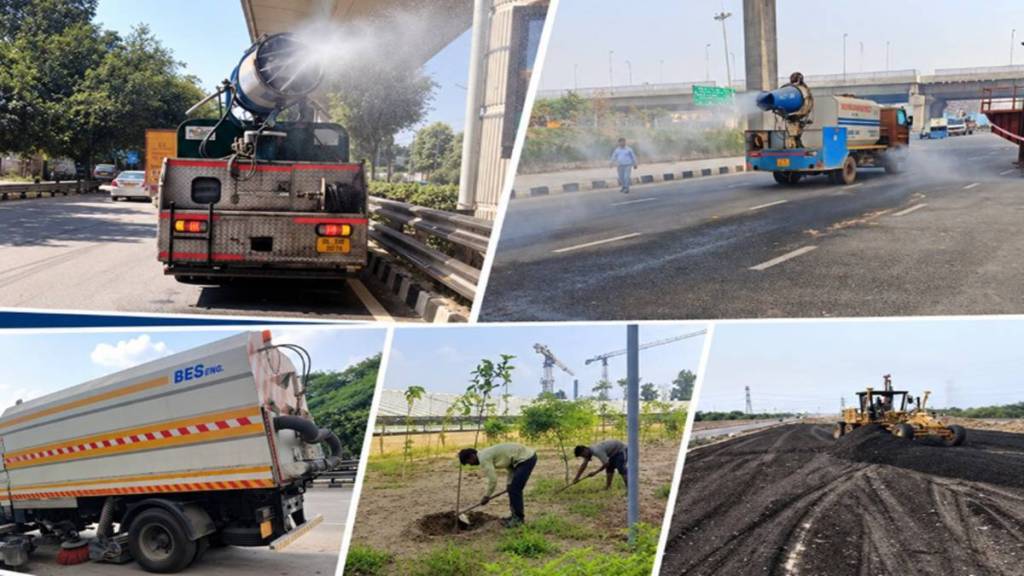

Delhi-NCR highway commuters could see more frequent road cleaning and dust-control activities as the National Highways Authority of India (NHAI) steps up measures to handle pollution ahead of winter.
The authority has developed water sprinklers, anti-smog guns, mechanical road sweepers and additional workers across national highways and expressways in the region to reduce dust generated by road traffic and construction activities.
What changes can Delhi-NCR commuters expect?
Motorists travelling on national highways and expressways in Delhi-NCR can witness intensified dust-control activities, including water sprinkling, operation of smog-guns and the mechanical sweeping.
The measures aim to prevent dust from accumulating on road surfaces and reduce its spread into the air.
NHAI has also directed its teams to ensure that construction materials are properly covered and road surfaces are maintained to minimise dust pollution. In its official X post, NHAI mentioned that the initiative intends to “help improve air quality and reduce road dust pollution.”
Key highlights of NHAI’s pollution-control measures
60 water sprinklers and tankers deployed for dust suppression.
23 mechanical road sweeping machines and two tractor-mounted brooms deployed.
14 anti-smog guns to support pollution-control activities.
13 additional road sweeping machines operating across 157 km of national highways.
Over 900 workers designated to dust-control operations.
How will NHAI monitor pollution-control work?
Alok Deepankar, Member (Technical), NHAI, analysed the arrangements and ordered field officials to ensure regular use of dust-control equipment and adequate deployment of workers.
As per the official release, he also asked teams to carry out daily mechanical sweeping, operate anti-smog guns on a regular basis and ensure water sprinkling on highway stretches.
Officials have also been told to abide by the guidelines of the Commission for Air Quality Management (CAQM) and intensify pollution-control activities as per the applicable stages of the Graded Response Action Plan (GRAP).
To boost monitoring, field teams must submit daily progress reports supported by geo-tagged photographs.
What is NHAI doing to reduce congestion?
Apart from controlling road dust, NHAI is also stressing highway projects that aim to enhance traffic movement and reduce civil emissions.
The authority also reviewed key corridors like Urban Extension Road-II UER-II), Dwarka Expressway, Delhi-Dehradun Expressway and DND-Sohna Expressway.
As per NHAI, these projects are likely to help ease congestion and improve traffic flow across Delhi-NCR. The authority also underlined faster development on proposed decongestion projects.
Plantation and waste recycling initiatives
NHAI has stated that it planted approximately 9.80 lakh plants across the NCR during the 2025-26 financial year, surpassing its target of 9.52 lakh plants. It also highlighted that around 13.58 lakh tonnes of inert material recovered from Delhi’s landfill sites had been utilised in embankment construction along the UER-II and DND-Sohna corridors.
How can commuters report pollution-related issues?
NHAI has also ordered officials to address public complaints received through the Green Delhi app and social media platforms without unnecessary delay. Commuters can use these channels to raise relevant road-dust and pollution concerns.
The authority stated that its efforts are concentrated on reducing dust pollution, improving air quality and supporting traffic movement during winter.