


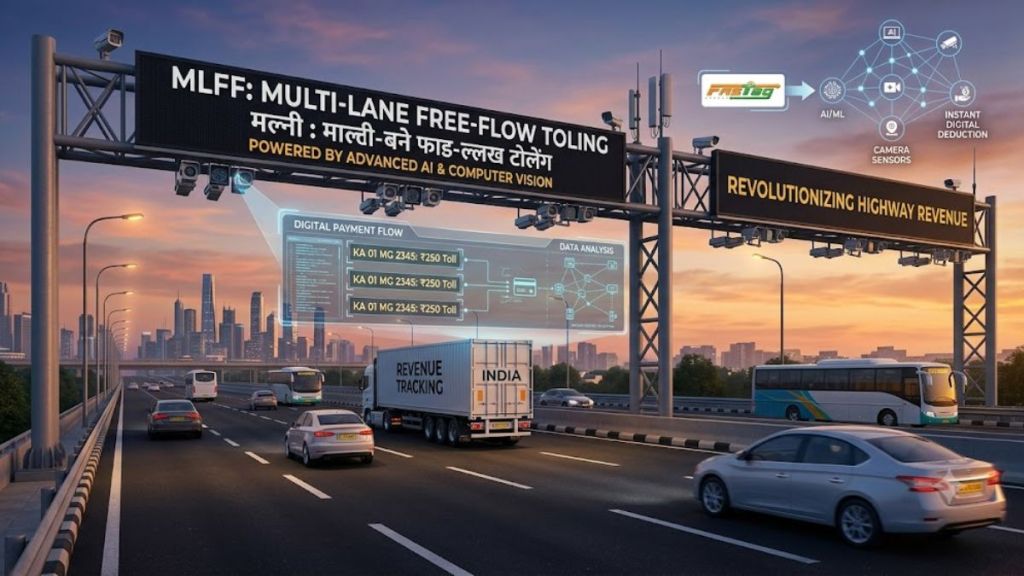

India’s highway tolling system is moving towards Multi-Lane Free Flow (MLFF), a barrier-free model that combines FASTag, automatic number plate recognition (ANPR) and artificial intelligence to collect tolls without vehicles stopping at plazas.
The shift could change more than the way motorists pay. Industry experts say MLFF could alter the cost structure of toll collection, improve revenue assurance, reduce congestion at toll plazas and change the economics of highway assets for operators, concessionaires and investors.
At the same time, experts say the transition will depend on reliable enforcement, interoperability between different systems, technology standards and clear arrangements for unpaid tolls. GPS/GNSS-based distance charging could eventually take road-user charging further, but it remains a longer-term possibility rather than an immediate replacement for MLFF.
How MLFF could change highway toll economics
Dr. Zafar Khan, Executive Director and Joint Chief Executive Officer at Vertis Infrastructure Trust and President of the Highways Investors Association (HIA), told FinancialExpress.com that the shift could move toll collection from a physical infrastructure-heavy model towards a digital operating platform.
Khan observed that the “biggest change” is that tolling moves from being a physical infrastructure business to increasingly becoming a digital operating platform. “Today, a traditional toll plaza carries a significant cost structure—land, civil infrastructure, lanes, booths, manpower, maintenance and, importantly, the inefficiency created by stopping traffic. With MLFF, you are replacing much of that physical infrastructure with overhead gantries and or with lane level free flow without any barrier, FASTag, ANPR, software and data. That should structurally reduce the cost of collection over time and improve toll collection efficiency,” he said.
Khan said operators could also gain from stronger revenue assurance because every vehicle passage can potentially be identified digitally, helping detect non-payment, leakage and anomalies.
“For a concessionaire, the immediate benefit is lower operating cost, potentially optimized lane throughput and improved revenue. The bigger opportunity is better revenue assurance. When every vehicle passage can be identified through FASTag and ANPR, the ability to detect leakage, non-payment and anomalies improves materially. India’s move towards electronic notices and integration with vehicle registration databases is an important part of making that possible,” Khan added.
For investors, he said the economic impact of MLFF should be assessed through collection costs, revenue assurance and the overall efficiency of tolling operations.
“For investors, therefore, I would look at MLFF through three lenses: cost-to-collect, revenue assurance and frictionless tolling operation. If you can collect the same or greater toll revenue with lower leakage and lower operating expenditure, the cashflow characteristics of the asset improve,” he noted.
Sanjay Kumar Sinha, Founder & Managing Director, Chaitanya Projects Consultancy, told Financialexpress.com that MLFF could also make highway cash flows more predictable by reducing physical bottlenecks and improving access to traffic data.
“Moving to Multi-Lane Free Flow (MLFF) fundamentally changes the operating and financial economics of running a highway. Today, operators spend heavily on toll plaza staff, cash management, physical booth upkeep and dealing with lane downtime. MLFF replaces many of these recurring operational costs with high-speed RFID readers, AI-enabled cameras and automated processing, bringing down the cost of collecting toll revenue. The absence of queues means vehicles do not need to stop at toll points, which reduces inefficiencies caused by congestion, as well as the likelihood of revenue leakage that is possible in manual processes, for concessionaires. It also gives real-time clean traffic data, which makes revenue forecasting much more precise.”
He said the scale of India’s digital tolling system could also make improvements in collection efficiency significant for infrastructure investors.
“For institutional investors investing in highway assets, predictability and consistency are essential. With toll collections for FY26 expected to surpass ₹70,000 crore and FASTag daily collections close to ₹209 crore per day, the large scale of India’s digital toll collection industry is evident. Eliminating physical bottlenecks and other barriers in the process can lead to more predictable project cash flows. It can also increase visibility with respect to the performance of the assets. This ability to make predictions will go a long way in decreasing the perceived financial risk, improving asset valuations, as well as making refinancing and secondary market trades more appealing,” Sinha added.
Yayati Kene, Founding Director, AGNI (Association of Global NICMARians), told Financialexpress.com that the model could also reduce manpower dependence, though existing roads could require additional investment to move to MLFF.
“For operators, MLFF can significantly reduce manpower dependency and eliminate the need for toll plazas, bringing down O&M costs. We estimate potential savings of 10–12% of current operating costs,” Kene said.
“For concessionaires, the transition may require higher upfront CapEx, particularly for retrofitting existing roads. However, better enforcement can reduce revenue leakages from unauthorised pass-throughs, FASTag misuse and pilferage, while improving collection efficiency.For investors, the model could offer more predictable cash flows and improved asset valuations through lower O&M costs and better margins. However, the impact will also depend on toll pricing, passes and government-led discounts,” he added.
What MLFF means for traffic and existing toll contracts
For commuters and freight operators, the most visible change could be the removal of stop-and-go movement at toll plazas. Khan said the benefits could extend beyond shorter queues by making highways more attractive and improving traffic flow.
“And there is another benefit which I think is underappreciated: requirement of increasing the plaza capacity. Removing the stop-start friction at toll plazas improves journey times and traffic flow. We have seen the value of this principle in our own operating experience—for example, interventions on the Dewas–Bhopal corridor have demonstrated how dramatically reducing transaction and waiting time can improve the user experience.”
“NHAI itself describes MLFF as a way to reduce congestion, travel time and operational costs while improving compliance and revenue collection,” Khan noted.
Sinha said barrier-free tolling could improve traffic speeds and corridor throughput, but the responsibility for recovering unpaid tolls would become more dependent on digital enforcement systems.
“The immediate gains from barrier-free tolling are higher traffic speed and better corridor throughput. When vehicles can pass through at highway speeds without stopping at a boom barrier, the existing road infrastructure can handle traffic more efficiently without necessarily requiring additional lanes, while also reducing time and fuel costs for freight operators. However, revenue protection shifts from a physical barrier to an administrative and technology-driven process. Early MLFF operations have shown that nearly 1 in 10 vehicles trigger a non-payment alert or tag mismatch, meaning operators increasingly have to rely on accurate vehicle identification, back-office reconciliation and recovery mechanisms rather than physically stopping a vehicle,” he further said.
The move could also affect highway concessions that were structured around traditional toll plazas. Khan said the underlying contractual rights of concessionaires would need to be protected as the technology changes.
“There are projects where the concession was structured around a physical toll plaza, defined tolling points and particular assumptions around collection costs and traffic. If those assets move to a barrier-free model, the concession agreement needs to preserve the underlying economic rights of the concessionaire. The technology can change; the fundamental entitlement to collect the contracted user fee shouldn’t simply disappear.”
He said existing concession agreements could need changes in areas such as tolling points, collection systems, enforcement duties, capital expenditure and revenue accounting.
“So currently Government is planning to start the implementation of MLFF in Public Funded Plaza where NHAI is collecting revenue directly via toll collection agency followed by new TOT and BOT projects and may be at last BOT concessions,” Khan added.
Kene said older concession agreements may also need to be reviewed as the shift changes technology costs, enforcement responsibilities and revenue-risk structures.
“Toll revenues could improve through stronger enforcement and reduced leakages. Traffic flows should also improve significantly, particularly at toll plazas near major cities and industrial hubs, where congestion causes substantial delays. Existing concession agreements may need to be revisited to account for additional CapEx, changes in revenue structures and government-led discounts or passes.”
Enforcement, interoperability and GNSS remain key challenges
While the technology needed for MLFF is increasingly available, experts say creating a reliable nationwide system is a bigger challenge. Khan identified unpaid tolls, enforcement, interoperability, fraud and data governance as key issues.
“The technology itself is probably not the hardest part though there are challenges around availability of STQC certified hardware like global shutter camera’s etc. We already have the foundations: FASTag penetration is extremely high, ANPR technology is mature, and India has increasingly sophisticated digital identity and vehicle-registration databases.
“The harder problem is creating one reliable national operating and enforcement architecture,” Khan added.
Khan said one of the immediate concerns is the recovery of unpaid tolls, particularly where revenue depends on electronic notices and e-challans.
“Who will pay for non-paid vehicle : As we understand the NHAI is piggybacking on Motor Vehicle Act for e-challans and the success rate of revenue recovery via echallan is not very encouraging and also there is delay in payment which will create cash flow gap of revenue for any concessionaire. Though I hope it will mature in sometime but currently that is the biggest challenge. To scale the implementation of MLFF the govt seems to be planning to reimburse concessionaires for all the nonpaid e-challans post 6 month but that is still under review at MoRTH/NHAI level and there has been no official circular so far,” he said.
He also pointed to the need for interoperability between FASTag, ANPR, vehicle-registration systems, payment infrastructure and concessionaire platforms.
“Third, interoperability. India cannot afford multiple technology islands. FASTag, ANPR, vehicle-registration databases, concessionaire systems and payment systems must talk to each other consistently. The value of MLFF comes from the ecosystem, not from any individual piece of technology. Each concession running on a different MLFF platform and syncing with NPCI and future development. Plus, if all toll plazas become barrierless then the non-paid vehicle will not be stopped at any plaza which means the e-challans success rate will not improve,” Khan said.
Sinha also highlighted technology reliability and integration with vehicle databases as important to preventing errors.
“The biggest challenges to scaling MLFF across India are technical reliability, interoperability, enforcement and data governance. High-speed ANPR cameras can struggle with non-standard, damaged or obscured number plates, while FASTags that are not properly linked to or matched with vehicle-registration records can create mismatches requiring systematic resolution. Enforcement will also require tight integration between tolling back-end systems and state RTO databases to issue e-notices and enforce penalties efficiently.”
Kene said the transition would also have to address the cost of upgrading existing roads and the problem of non-compliance.
“The key challenges are CapEx requirements, enforcement clarity, interoperability with legacy FASTags, fragmented concessionaires and fraud-related leakages. GNSS-based distance tolling is likely to be the next evolution. However, frequent changes in the tolling ecosystem could create user fatigue and enforcement challenges. Even today, nearly 3–4% of vehicles remain FASTag non-compliant, while some MLFF locations reportedly see significant instances of vehicles passing without payment. This highlights the need to strengthen enforcement and system reliability before scaling further.”
Khan said data governance will also become more important as tolling becomes increasingly digital.
“Fourth, fraud and data integrity. Once toll collection becomes completely digital, the nature of leakage changes. You move away from some of the traditional cash related risks, but you introduce questions around tag cloning, number-plate recognition, vehicle identity, system manipulation and cyber security. So the investment has to shift from physical controls to digital controls, auditability and analytics.
“And fifth, data governance. A nationwide free-flow system creates an enormous amount of information about vehicle movements. There needs to be a very clear framework around who can access that information, how long it is retained and how it is used.”
On GNSS-based distance tolling, the experts broadly see it as a longer-term development rather than an immediate replacement for MLFF.
Khan said the two systems should be viewed as different stages in the evolution of road-user charging.
Where GNSS-based tolling could fit
“On GNSS, I would distinguish between the near-term MLFF transition and the longer-term evolution of road-user charging.
“MLFF today is essentially point-based tolling without the barrier: the vehicle is identified as it passes a defined tolling location. GNSS potentially takes you to the next level—distance-based charging, where the system can determine the road travelled and charge accordingly. NHAI’s own technology material describes MLFF as point-based tolling and identifies it as a foundation for a nationwide barrier-free ecosystem.
“But I wouldn’t say that GNSS suddenly replaces MLFF. I see it more as a possible long-term architecture for a more granular road-user charging system.”
Sinha similarly said GNSS could eventually support a pay-per-kilometre model, but that issues such as accuracy, privacy, enforcement and the legal framework would have to be addressed first.
“On the question of where GNSS-based distance tolling fits into this roadmap, it should be viewed as a longer-term evolution rather than an immediate replacement for MLFF. GNSS could enable a pay-per-kilometre model, but large-scale deployment still faces challenges around positioning accuracy in areas with signal obstruction, privacy, onboard-unit enforcement and the supporting legal framework. MLFF using FASTag, ANPR and AI is therefore likely to form India’s core tolling architecture in the near to medium term, while GNSS can progressively complement or evolve that system as the technology and regulatory framework mature.”
Khan said the immediate priority should be to make the MLFF ecosystem reliable before moving towards more complex charging models.
“The immediate priority should be getting MLFF right: reliable identification, seamless payments, strong enforcement and interoperability. Once that ecosystem is mature, GNSS can potentially allow much more sophisticated models—charging based on distance, route or potentially differentiated road usage rather than simply crossing a toll point. There is no current plan for GNSS implementation in near future.”
For highway investors, he said the larger change could eventually go beyond replacing toll plazas with digital systems.
“For investors, that’s quite important. It means we should not look at tolling technology merely as a way of collecting today’s tolls more efficiently. The technology is potentially changing the underlying monetisation model of road infrastructure,” he added.
“And that, ultimately, is the bigger opportunity: India’s highways are becoming increasingly digitised assets, where traffic, technology, data and cash flows are becoming much more tightly connected. Wait for CV2X technology which can change everything on the highway operation in future,” Khan said.