


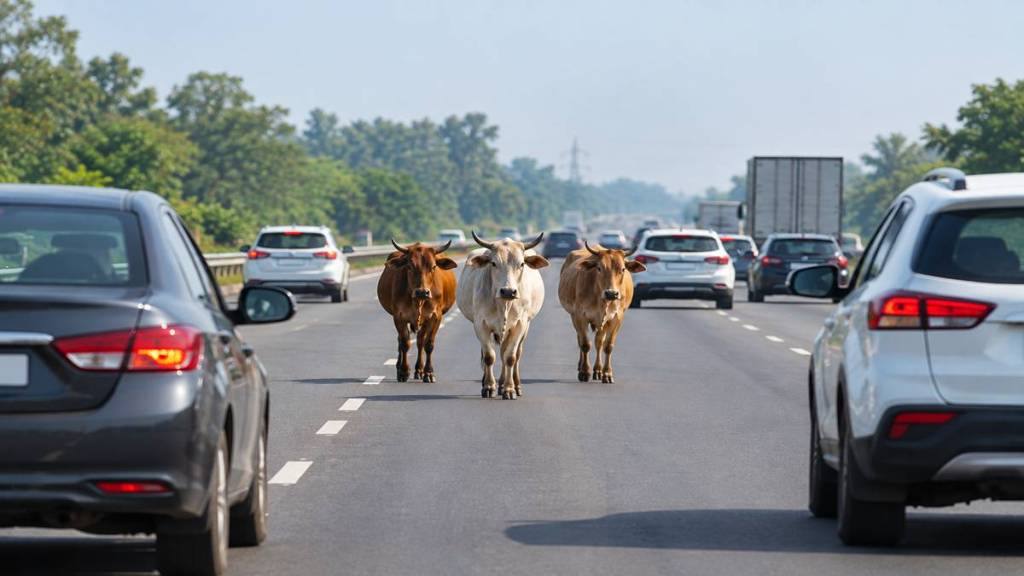

The Centre has introduced a new standard operating procedure (SOP) to handle stray cattle and other animals entering National Highways and expressways. The framework comprises of animal removal, identification of vulnerable stretches and action against owners in applicable cases.
As per a report by PTI, the Ministry of Road Transport and Highways (MoRTH) has issued the SOP to highway agencies and state governments amid concerns over accidents involving stray animals. The ministry’s circular stated the recurring presence of stray cattle and other animals on National Highway carriageways as a “serious and continuing threat to road safety”.
The SOP follows directions from the Supreme Court, which has asked NHAI to form a structured mechanism for the safe removal of stray animals and coordination on National Highways and expressways, as reported by PTI.
How will stray cattle hotspots be monitored?
Under the new SOP, field offices have been asked to maintain stretch-wise records of stray-animal incidents. The records will include details like the location and time of an incident and the type of animal involved.
Stretches that are witnessing incidents will be marked as hotspots, preferably through a GIS-based system. As per the SOP cited by the PTI, these stretches should be “reviewed at least once every six months” and updated on the basis of the data.
Targeted safety measures, including CCTV cameras, lighting, signage and barriers, will be planned for identified hotspots.
Will cattle owners face fines?
The framework also provides for tracing the owners of cattle found on highways and shifted to designated shelters or cattle pounds.
The SOP also asks authorities to “maintain cattle-pound records” and initiate owner-tracing and action for recovery of applicable fees, fines and penalties under relevant cattle-trespass legislation.
The highway agency concerned will manage the cost of removing and transporting stray cattle or other animals from highways to shelter or pounds. The payment arrangements may be structured on a per-animal basis and linked to the number of animals safely removed and handed over.
States asked to deploy nodal officers
The SOP also calls for cooperation between highway authorities and state administrations. States have been ordered to designate a state-level nodal officer and district-level nodal officers and share their contact details with National Highway agencies.
NHAI had earlier stepped up monitoring
The latest SOP comes after NHAI had already undertaken measures to address stray animals on certain National Highway stretches.
As per a PIB release of July 28, 2026, NHAI’s Amaravati Project Implementation Unit was continuously monitoring four vulnerable locations. Three accident black spots on the Chilakaluripet-Vijayawada section of NH-16 were also observed. Regular stray-animal removal drives were also being undertaken on identified stretches of NH-16 and NH-544D.
Incident Management Teams supported by Route Patrol Vehicles were stationed to monitor these stretches and safely remove stray animals. Patrolling was being conducted 24X7 in three shifts. NHAI also conducted awareness activities in nearby villages and was coordinating with police, village panchayats and village panchayats.
What should motorists do?
NHAI has advised motorists to drive cautiously and follow allowed speed limits. Road users who spot stray animals on National Highways can report them through the 1033 National Highway Helpline, which operates round the clock.