


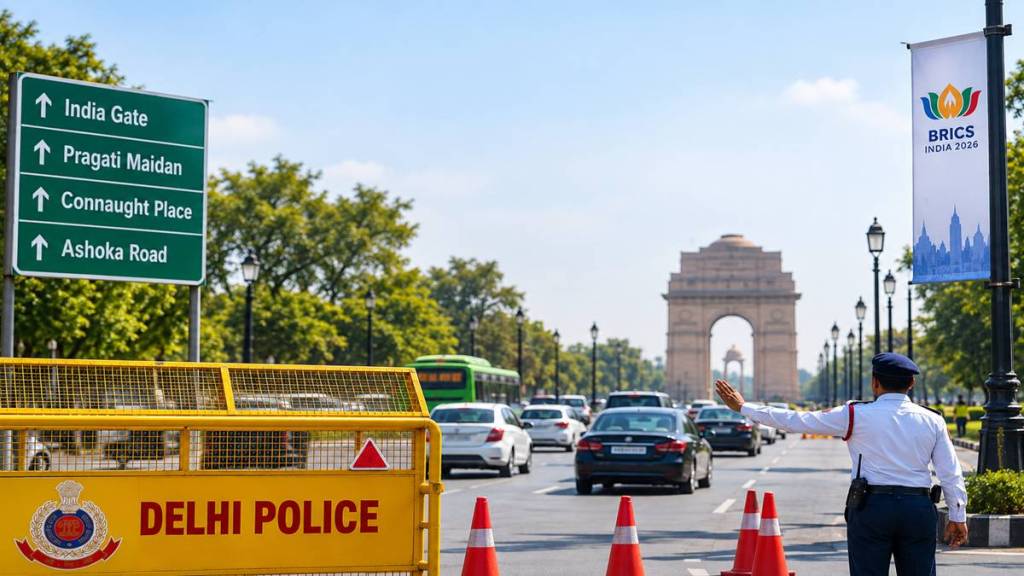

Delhi is set to get a technology-driven traffic management system to improve how vehicles move across some of the city’s busiest roads. The new system will use live traffic data to adjust signals, detect violations and help authorities respond to congestion and road incidents faster.
The project, approved by the Cabinet Committee on Economic Affairs, will cover 42 traffic corridors across Delhi.
An important Cabinet decision that will ensure the usage of technology to boost ‘Ease of Living’ across Delhi! https://t.co/9BPmTQYewE
— Narendra Modi (@narendramodi) September 30, 2026
It is expected to make better use of the existing road network by changing traffic management based on actual road conditions instead of relying mainly on fixed signal timings.
Rs 1,789 cr project to cover 42 Delhi traffic corridors
The Intelligent Traffic Management System (ITMS) has been approved at an estimated cost of Rs 1,789.52 crore. Delhi Police will implement the project in three phases over 24 months, followed by five years of operation and maintenance.
The system will cover 1,092 Adaptive Traffic Control System locations and 1,029 enforcement locations. Work on the next phase will begin after the previous phase meets specified testing, commissioning, and performance requirements.
Delhi Police will select a Master System Integrator through competitive bidding for implementation. C-DAC will provide technical support as the Project Management Consultant.
AI-powered signals to adjust timings based on traffic
One of the key changes for motorists will be the use of adaptive traffic signals. These signals will be able to adjust their timings depending on traffic conditions at different times and locations.
Signals along selected corridors will also be coordinated to reduce unnecessary stops and delays. This is expected to help traffic move more smoothly, particularly on stretches where vehicle volumes change considerably during the day.
Ambulances to get priority at traffic signals
The ITMS will also support priority movement for ambulances and other emergency vehicles.
The system will facilitate green corridors, allowing emergency vehicles to move through congested stretches with fewer interruptions. This could help reduce delays when ambulances or other emergency services need to cross busy intersections.
Real-time alerts for congestion and road incidents
The new system will use real-time information to identify congestion, slow-moving traffic, and incidents on roads.
Delhi Police will be able to use this information to respond more quickly, including by managing diversions when required. Traffic information will also be displayed through Variable Message Signs and digital platforms.
Commuters could receive updates about congestion, diversions, parking availability and prevailing traffic conditions. The information may also be shared with navigation service providers.
Automated enforcement to track traffic violations
The project will introduce wider technology-based enforcement across Delhi. The system will automatically detect violations including red-light jumping, stop-line violations, speeding and wrong-way driving.
It will also cover offences such as riding without helmets, driving without seat belts, illegal parking and using mobile phones while driving.
AI-based analysis will further help authorities identify stolen, hot-listed and blacklisted vehicles, repeat offenders and vehicles linked to hit-and-run cases.
Delhi to get an integrated traffic control platform
The ITMS will bring traffic regulation, enforcement and information services onto a common platform. Traffic Command and Control Centres will form the core of this system, supported by a dedicated Data Centre and Disaster Recovery infrastructure.
The platform will use open standards and APIs, allowing other systems to be integrated into it in the future.
Delhi currently has around 71 lakh active registered vehicles, while the growth in vehicles has been faster than the expansion of road infrastructure. The new system is therefore aimed at managing the existing road network more efficiently by using real-time information and technology.
Once implemented, the ITMS is expected to help Delhi respond more quickly to traffic build-up and road incidents while making everyday travel more predictable for commuters.