


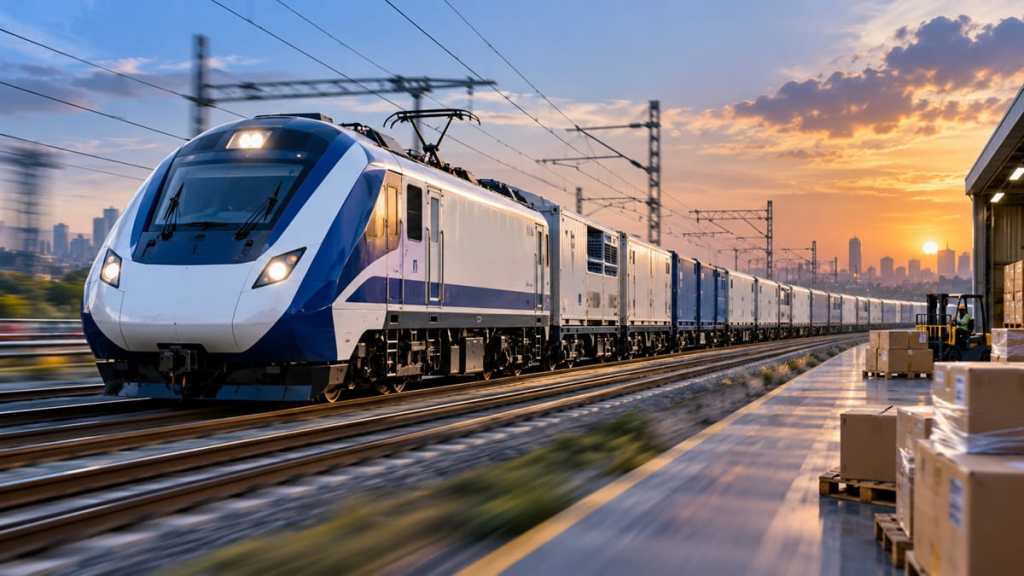

India’s first Vande Bharat Freight EMU has reached a speed of 130 kmph during trials on the Ahmedabad-Mumbai Central route. This has marked another step in the Railways’ effort to develop faster freight services for time-sensitive cargo, The Indian Express reported.
The trial is being conducted by the Research Designs and Standards Organisation (RDSO) on the Ahmedabad-Vadodara-Mumbai Central section of Western Railway.
Developed by the Chennai-based Integral Coach Factory (ICF), the 16-coach train has been designed specifically to transport parcels and other high-value goods at higher speeds.
The rake could be used for transporting e-commerce shipments, courier packages, electronics, pharmaceuticals, cold-chain products and other time-sensitive cargo.
The Railways described the train as a modern alternative to conventional freight services for cargo where speed, reliability and predictable delivery times are important.
130 kmph trial on Ahmedabad-Mumbai route
According to The Indian Express, the Vande Bharat Freight EMU rake was prepared at ICD Sabarmati before leaving Ahmedabad for Mumbai Central at around 9 am on September 12. The return trial from Mumbai Central to Ahmedabad was conducted on September 13.
During the trial, the train was operated with 50% payload and an axle load of 20.32 tonnes.
The daytime trial runs were conducted according to the prescribed testing protocol and while complying with permanent and temporary speed restrictions applicable to the route, The Indian Express reported.
The RDSO team received technical and operational support from the Mechanical, Electrical, and Signal & Telecommunication departments of the Ahmedabad Division, while Western Railway made arrangements covering fitness, crew, safety and operations.
Earlier, the rake had achieved a speed of around 145 kmph in an empty condition during trials on the Kota Division of West Central Railway. Its design speed is around 160 kmph.
What is a Vande Bharat Freight EMU?
Unlike conventional freight trains, the Vande Bharat Freight EMU has been designed around the requirements of fast parcel and cargo movement. The 16-coach configuration includes parcel coaches and refrigerated, or reefer, vans, allowing the train to handle different categories of goods. It also features wide automatic doors to facilitate faster loading and unloading.
For palletised cargo, the coaches are equipped with roller flooring, which can help streamline the movement of goods during loading and unloading operations.
The train also incorporates CCTV surveillance, fire detection systems and automatic door-locking mechanisms, along with safety and stability systems designed for high-speed operation. Modern railway safety technology, including Kavach, is also part of the train’s safety architecture, The Indian Express reported.
What kind of cargo can it carry?
The proposed freight service is aimed primarily at cargo where delivery time is an important consideration.
Potential applications include e-commerce and courier shipments, electronics, pharmaceuticals and temperature-sensitive products requiring cold-chain transportation.
Such cargo is currently moved through a combination of road, air and conventional rail networks, depending on the value, urgency and destination.
A faster rail-based option could provide another mode for moving these shipments between major cities and logistics hubs.
The train’s design is therefore focused less on carrying the maximum possible tonnage and more on combining speed, scheduled operations and specialised cargo handling.
Not a replacement for Dedicated Freight Corridors
The Railways has clarified that the Vande Bharat Freight EMU is not intended to replace heavy freight trains operating on Dedicated Freight Corridors (DFCs).
Instead, it has been developed primarily for smaller, high-value and time-sensitive cargo that can be transported at higher speeds over existing passenger railway routes.
This distinction is important because conventional heavy freight trains and the proposed Vande Bharat freight service serve different requirements.
DFCs are designed to carry large volumes of freight, while the Vande Bharat Freight EMU is aimed at cargo where speed and delivery schedules are key considerations.
What happens after the trials?
These trials are part of the technical evaluation process and do not by themselves represent the launch of a commercial freight service. RDSO will examine the train’s performance during the trial, including its behaviour under payload conditions and its suitability for high-speed operation on the railway network.
The Ahmedabad Division of Western Railway said the successful trial could open up a new option for freight transportation by providing a faster, safer, reliable and time-bound rail service for express logistics.
The Vande Bharat Freight EMU is consequently being positioned as a specialised freight platform rather than a replacement for India’s heavy-haul freight network.