


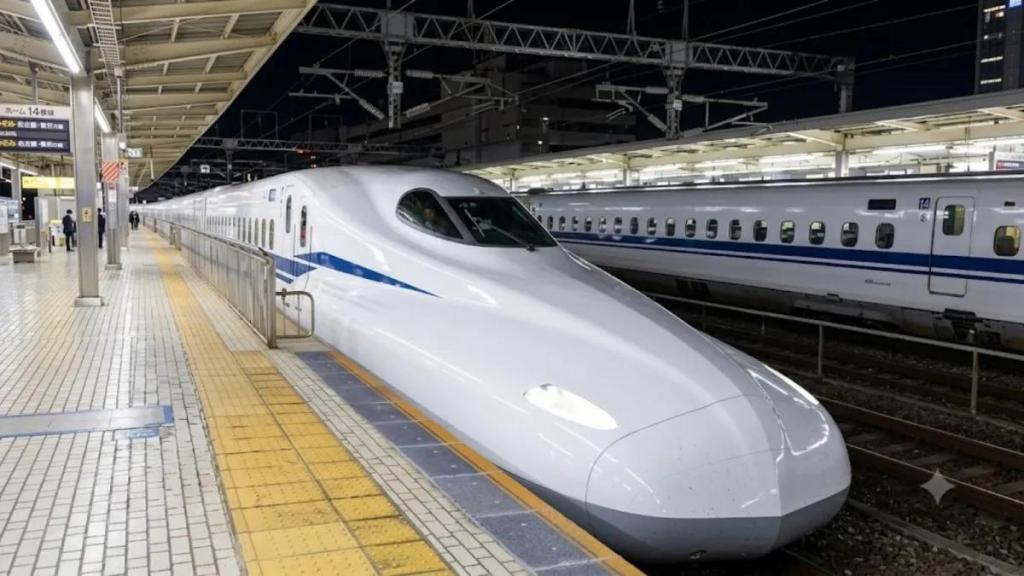

India must demonstrate that two different types of bullet trains, along with their respective signalling systems, can operate safely on the same high-speed rail corridor before deciding which system to adopt, Masafumi Shukuri, chairman of the Japan Transport and Tourism Research Institute (JTTRI) and the International High-Speed Rail Association (IHRA), has said.
In an interview with The Indian Express on the sidelines of the Kautilya Economic Conclave earlier this month, Shukuri said he was not aware of any precedent for operating two different high-speed train systems with separate signalling technologies on the same line. He stressed that the safety of such an arrangement would have to be established before trains carrying passengers at speeds of around 300 kmph could operate.
The issue comes as India prepares to open the first section of the Mumbai-Ahmedabad High Speed Rail (MAHSR) project in 2027 using domestically manufactured rolling stock, while Japanese Shinkansen technology remains part of the broader India-Japan high-speed rail collaboration.
“At the end of the day, how do we know that a system is safe? It has to be proven,” Shukuri said, adding that one of the systems would eventually need to be adopted. He declined to recommend which technology India should choose, saying the decision would depend on discussions between the parties directly involved and the governments of India and Japan.
Why two bullet train systems are a concern
The question centres on whether domestically manufactured trains and Japanese Shinkansen trains, which may use different signalling systems, can operate on the same corridor without compromising safety and reliability.
Signalling systems are integral to high-speed rail operations because they govern train movements and help maintain safe separation between trains. When rolling stock and signalling technologies differ, their compatibility with the wider railway system must be established.
Shukuri said he knew of no previous instance in which two different high-speed train systems and their respective signalling technologies had operated on the same line.
“In my view, if you are looking at this kind of situation where there is any kind of uncertainty and we have two different systems, then to have a rolling stock running at 300 km per hour with people in it, is not possible, in my view,” he said.
He emphasised that the issue was not simply about procuring trains or installing signalling equipment. India would need to demonstrate that the final configuration could operate safely under actual operating conditions.
Shukuri also said he would not comment on whether the Indian or Japanese system should ultimately be selected. That decision, he said, rests with the stakeholders and the two governments.
What is the ‘Total Systems Approach’?
Shukuri argued that high-speed rail must be planned and operated as an integrated system, rather than as a collection of separate infrastructure and technology contracts.
He described this as the “Total Systems Approach”, encompassing civil engineering works, tracks, signalling, rolling stock, maintenance, skilled personnel and management.
Each component must work with the others to ensure that trains can operate at high speeds without compromising passenger safety or reliability.
“Crash avoidance” is particularly important in high-speed rail, Shukuri said, stressing that the system must be designed around preventing collisions.
He added that the training of personnel, availability of technical expertise and completion of adequate trials were as important as the procurement of trains and signalling systems.
For India, this means the readiness of the Mumbai-Ahmedabad corridor will depend not only on the completion of physical infrastructure but also on whether its operating systems, personnel and maintenance arrangements are ready for service.
Mumbai-Ahmedabad bullet train project targets 2027 opening
The Mumbai-Ahmedabad High Speed Rail project was initially scheduled for completion in 2022. The first section is now expected to open in 2027.
Shukuri said the scale of the undertaking needed to be considered when assessing its progress. The corridor spans approximately 500 km and represents India’s first high-speed rail project.
He pointed to land acquisition challenges and disruptions caused by the Covid-19 pandemic as factors that affected the project, while maintaining that construction was progressing.
Japan’s own experience illustrates the scale of the undertaking, he said. The country’s first Shinkansen service began in 1964, giving it more than six decades of experience in high-speed rail construction and operations.
Even in Japan, Shukuri said, constructing a 500-km high-speed railway today would not be a project that could be completed within 10 years.
He said India had always planned to commission the Mumbai-Ahmedabad corridor partially at first, through what is described as a priority section, and that the Japanese side had extended full cooperation.
The initial opening, however, would be only the beginning. The broader task would be to ensure that all elements of the railway system were integrated and ready to support safe and reliable operations.
Why India plans to use domestically manufactured trains
India’s decision to begin operations on the priority section with domestically manufactured rolling stock reflects its plan to start services on part of the corridor while developing local high-speed train manufacturing capabilities.
Shukuri said he understood India’s decision to prioritise the initial section. But he stressed that the timetable for opening the line must not take precedence over the requirements for safe and reliable operations.
That includes ensuring that train crews and other personnel have the necessary skills, technical knowledge and training, as well as conducting sufficient trials before the final commissioned system enters service.
He said Japanese technology and operational experience would remain important to the collaboration.
The central question, therefore, is not just which train is available first, but whether the trains, tracks, signalling and operating procedures can function together as one system.
Which bullet train system will India eventually adopt?
Shukuri did not specify whether India should choose domestically manufactured rolling stock or Japanese trains for the corridor.
Instead, he said the safety of operating two different systems on the same line would have to be demonstrated. In the absence of such proof, he indicated that one system would ultimately need to be adopted.
The decision will depend on discussions between the directly involved parties and the governments of India and Japan.
This leaves an important technical and operational question for the project: how the train and signalling systems planned for the initial section will fit into the longer-term configuration of the entire corridor.
The priority section is expected to begin operations in 2027, but decisions on system compatibility and standardisation will be important to the corridor’s subsequent development.
India’s wider high-speed rail ambitions
Shukuri said India had signalled its interest in developing additional high-speed rail corridors beyond Mumbai-Ahmedabad. He said the first project had been envisaged from the outset as the starting point for a broader programme.
He was also asked about China’s high-speed rail network, which has exceeded 50,000 km, compared with Japan’s network approaching 4,000 km.
Shukuri said the size of a country’s network reflected its government’s policy decisions and assessment of national requirements. He did not offer a judgment on the relative viability of the two countries’ approaches.
For India, the experience of the Mumbai-Ahmedabad project will be relevant to future high-speed rail development, particularly in areas such as technology integration, staff training, maintenance and operational readiness.
Japan’s ethanol blending target and net-zero plans
In the same interview, Shukuri discussed Japan’s target of 20% ethanol blending by 2040. He said he did not have precise information about how the policy had been formulated, but placed it within the country’s broader target of achieving net-zero emissions by 2050.
He said Japan had adopted multiple policy measures across different sectors to work towards that goal, with ethanol blending forming one part of the wider strategy.
Shukuri said he was not aware of significant public concern over ethanol blending or widespread consumer complaints related to vehicles. He also pointed to government subsidies intended to limit the impact of rising crude oil prices on petrol prices.
Japan was also promoting electric and hybrid vehicles as part of its broader transition towards lower emissions, he said.