


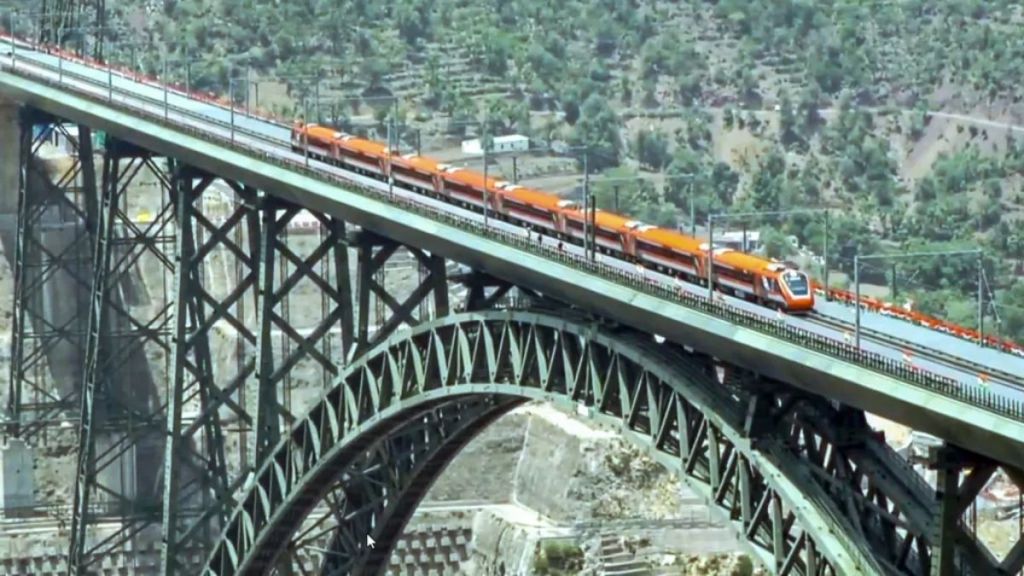

In a historic milestone, a Vande Bharat train crossed the Chenab and Anji railway bridges at 100 km/h for the first time on the Jammu-Srinagar rail route, months after the Railways had approved the higher operating speed on the Katra-Banihal section.
Railways Minister Ashwini Vaishnaw shared a video of the run on Friday, October 2, showing the train travelling at 100 km/h across the two major bridges on the Udhampur-Srinagar-Baramulla Rail Link (USBRL).
“100 km/h over India’s engineering pride!” Vaishnaw said in a post on X on October 2.
The run followed the Railway Ministry’s decision in August to permit trains to operate at a maximum speed of 100 km/h on the 111-km Katra-Banihal section. Before the revision, the permitted speed was up to 85 km/h between Shri Mata Vaishno Devi Katra and Sangaldan and 75 km/h between Sangaldan and Banihal.
The higher speed was cleared after the safety checks were cleared by the Railways.
100 km/h approval came in August, first bridge run in October
The latest run is significant because the approval of a higher speed and its actual implementation on the bridges did not happen at the same time.
After reports in August suggested that a Vande Bharat had already crossed the Chenab Bridge at around 100 km/h, Northern Railway clarified that the revised speed had been approved but no train had yet operated at that speed over either the Chenab or Anji bridges.
“Approval has been given to increase the speed of trains to 100 kmph on the Banihal to Shri Mata Vaishno Devi Katra rail section. No train has been operated at a speed of 100 kmph as of now,” Northern Railway said in its August 20 clarification.
Vaishnaw’s October 2 video shows the subsequent operation at the revised maximum speed.
Northern Railway had said the higher permissible speed would help reduce journey time on the Katra-Banihal section and improve connectivity, although it did not specify how much time could be saved.
The change also comes as the Railways continues to work on increasing sectional speeds across its network. In August, the ministry said around 81% of its track network had been upgraded to support sectional speeds of 110 km/h or above, compared with about 40% in 2014.
Why the Katra-Banihal route is important
The 111-km Katra-Banihal section is part of the 272-km USBRL, which provides an all-weather rail connection between the Kashmir Valley and the rest of the Indian railway network.
The complete rail link became operational in June 2025, when the remaining Katra-Sangaldan section was inaugurated and Vande Bharat services between Katra and Srinagar were flagged off.
The project includes 36 tunnels spanning around 119 km and more than 900 bridges, according to the Railways. Two of its most prominent structures are located on the Katra-Banihal stretch.
The Chenab Rail Bridge stands 359 metres above the riverbed and spans 1,315 metres. The government describes it as the world’s highest railway arch bridge.
The Anji Khad Bridge is India’s first cable-stayed railway bridge. Built across the Anji river valley, it forms another key part of the mountainous rail alignment between Katra and Banihal.
The route also includes Tunnel T-50, a 12.77-km tunnel that the Railways describes as India’s longest operational transportation tunnel.
The Vande Bharat service on the Kashmir route was initially operated between Katra and Srinagar after the USBRL link was completed. In April 2026, the Railways extended the service to Jammu Tawi and increased the train formation from eight to 20 coaches.
Regular services under the expanded Jammu-Srinagar operation began on May 2. The Railway Ministry said the extension created a direct Vande Bharat connection between Jammu and the Kashmir Valley, with the train travelling through the USBRL corridor and across the Chenab and Anji bridges.
The latest run at 100 km/h therefore marks another step in the operation of trains on the challenging Katra-Banihal section, where the Railways has been progressively raising permissible speeds after completing safety and infrastructure requirements.