


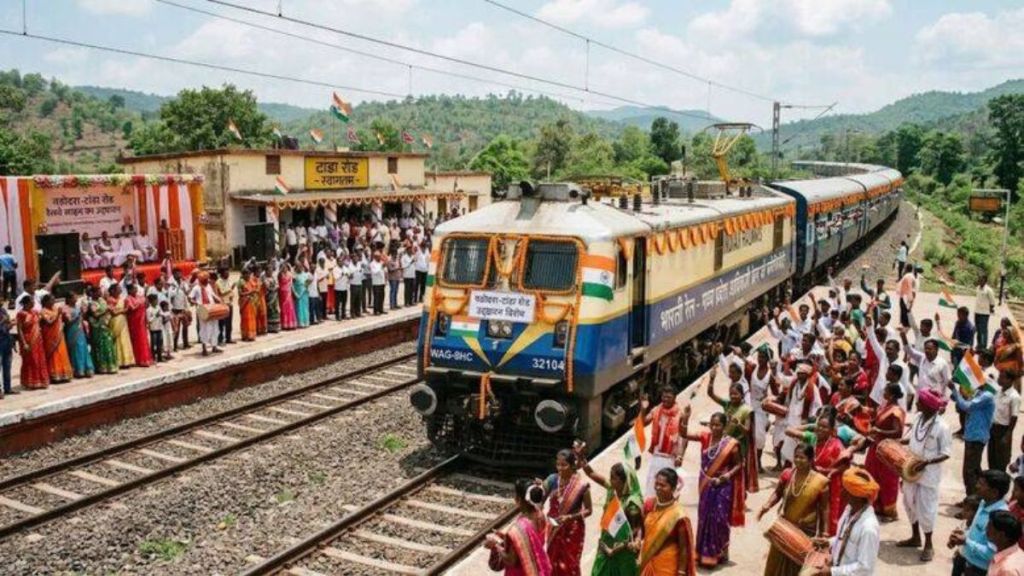

For decades after Independence, Madhya Pradesh’s Dhar district remained outside the country’s railway network, leaving large parts of the predominantly tribal region dependent on road transport for longer-distance travel. That changed on Tuesday when Prime Minister Narendra Modi flagged off a daily MEMU service connecting Tanda Road in Dhar with Pratapnagar in Vadodara.
The 12-coach Mainline Electric Multiple Unit (MEMU) service creates a direct rail connection between parts of western Madhya Pradesh and Gujarat, linking Dhar and Alirajpur in Madhya Pradesh with Vadodara and Chhota Udepur in Gujarat. For residents of Dhar, the significance goes beyond the launch of a new train: it marks the district’s first direct entry into the railway network since Independence.
Modi virtually flagged off the service from Pratapnagar station in Vadodara during his visit to Gujarat. The programme also included the foundation stone for the third and fourth railway lines between Vadodara and Ratlam.
Why Dhar’s first railway connection matters
Dhar’s lack of a railway line has meant that residents in the district have historically had to rely heavily on roads to reach larger urban and commercial centres. The new service provides an alternative rail connection towards Vadodara and neighbouring areas of Gujarat.
The daily MEMU will operate between Pratapnagar and Tanda Road, giving passengers in Dhar access to a regular train service rather than depending entirely on road-based connectivity. Its route also brings Alirajpur, another tribal-dominated district, into a wider rail-connected corridor linking the two states.
The broader significance lies in how the new link could improve access to employment, education, healthcare and markets. Better transport connectivity can make it easier for people in relatively remote areas to travel to larger urban centres while also giving businesses and producers access to wider markets.
The immediate impact, however, will depend on how effectively the new rail connection integrates with existing road transport and other railway services. A train link by itself does not automatically translate into economic transformation; frequency, timings, last-mile connectivity and access to major destinations will determine how extensively residents use it.
From passenger connectivity to a wider Gujarat-MP rail network
The new service is part of a larger expansion of railway infrastructure linking Gujarat and Madhya Pradesh. The foundation stone for the third and fourth railway lines between Vadodara and Ratlam was also laid during the programme.
Additional railway capacity on the corridor is intended to support the movement of both passengers and freight. More tracks can help separate or accommodate different train movements, potentially easing congestion and allowing more services to operate as traffic increases.
For the tribal districts connected by the new Tanda Road service, the larger network could be important because their connectivity is no longer being viewed in isolation. The route links them with Vadodara and Chhota Udepur on one side and the wider railway network in Madhya Pradesh on the other.
Union Minister of State Savitri Thakur said the new railway connection represents a long-awaited development for the tribal region and could create wider economic opportunities.
“This is a major gift for our tribal brothers and sisters, farmers, and the entire region. The dream that the people of our tribal region had years ago has come true today.”
Thakur said the railway connection would make travel easier for farmers, women and young people and contribute to the development of the region.
“New industries will emerge, new jobs will be created, and new opportunities will be available,” Thakur maintained.
The new train service therefore represents more than the addition of a single daily passenger service. For Dhar and Alirajpur, it is the beginning of direct railway access to a wider regional network, while the accompanying expansion of the Vadodara-Ratlam corridor could determine how much further that connectivity translates into passenger and economic benefits.