


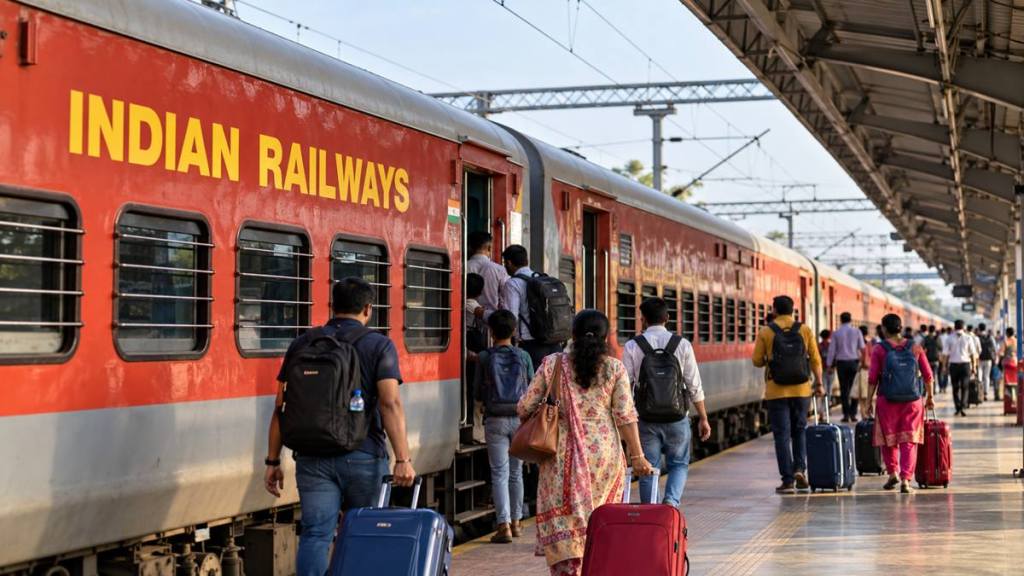

Food safety on trains and at railway stations is set to come under closer scrutiny, with the Indian Railway Catering and Tourism Corporation (IRCTC) partnering with the Quality Council of India (QCI) to introduce independent checks on catering services.
Signed on October 15, 2026, the agreement covers IRCTC-managed food services on trains and at railway stations. The initiative aims to ensure that catering units follow food safety regulations and maintain proper hygiene while preparing and serving meals to passengers.
The new audit system will use technology to assess catering units and check their compliance with food safety standards.
In a major move to transform the on-board dining experience for millions of daily rail passengers, IRCTC has signed a strategic Memorandum of Understanding (MoU) with the Quality Council of India (QCI) on 15.10.2026. The MoU was signed by Sh. Sudhir Warrier, General Manager/Quality & Projects, IRCTC, and Sh. Subroto Ghosh, Principal Advisor/Head-PPID, Quality Council of India, in the presence of Sh. Ramanand Nagendra Shukla, CEO, NABL and Sh. Mohit Padhy, Asst. Secretary General from Quality Council of India and Sh. Rahul Himalian, CMD and Sh. Manoj Kumar Sharma, Director/Catering Services from IRCTC.
This high-stakes partnership establishes a rigorous, technology-driven, independent third-party audit mechanism to ensure the highest standards of food safety and hygiene across all IRCTC-managed mobile (trains) and static (station) catering units, ensuring strict compliance with statutory Food Safety and Standards Authority of India (FSSAI) regulations and international culinary standards.
— IRCTC (@IRCTCofficial) October 15, 2026
What will the new food safety checks cover?
The audits will cover mobile catering units operating on trains and static catering units at railway stations.
The assessments will focus on hygiene practices and compliance with regulations set by the Food Safety and Standards Authority of India (FSSAI), along with recognised international food standards.
What the new audits mean for passengers
For passengers buying meals during train journeys or at railway stations, the initiative aims to improve food safety by bringing catering operations under independent assessment.
The checks could help identify gaps in hygiene practices and highlight areas where catering units need to improve.
However, the agreement does not guarantee changes in food quality or meal prices. Its impact will depend on how the audits are implemented and how any shortcomings are addressed.
Implementation details awaited
The agreement establishes a framework for independent food safety assessments across railway catering services. However, the timeline for implementation, frequency of inspections and action to be taken against units that fail to meet the required standards have not yet been specified.