


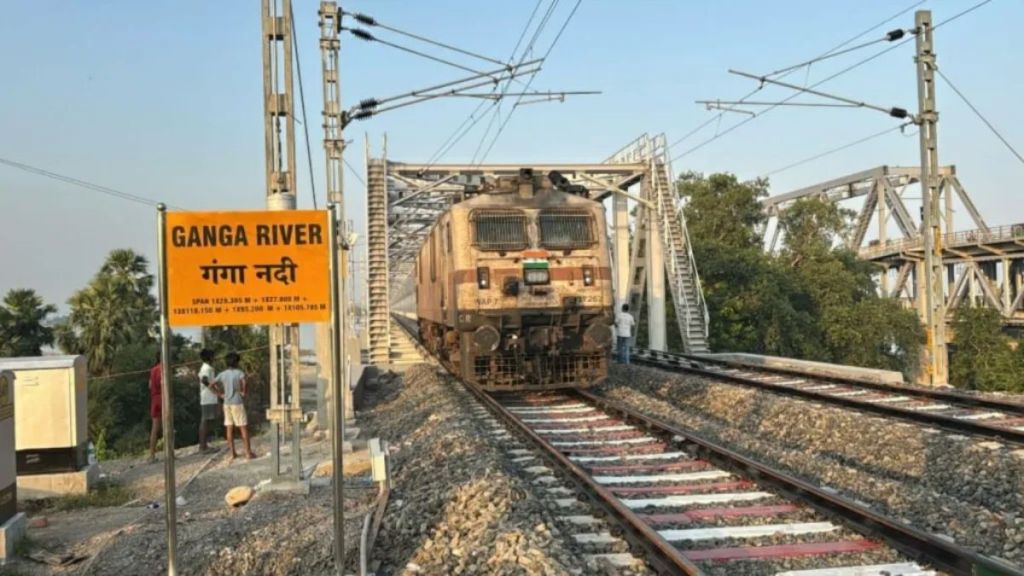

Indian Railways has commissioned a new double-line rail bridge over the Ganga at Mokama in Bihar, strengthening rail connectivity between North and South Bihar and adding capacity for passenger and freight train operations.
Built at a cost of around Rs 2,400 crore, the new bridge has received safety clearance from the Commissioner of Railway Safety (CRS), Eastern Circle. Train operations on the bridge began after the safety inspection conducted on October 3 and 4.
Saraswati Chandra, Chief Public Relations Officer (CPRO), East Central Railway, said the new Mokama rail bridge has been commissioned and train operations began around midnight. He added that train number 15483 Mahananda Express was the first train to cross the newly commissioned bridge, reported The Indian Express.
New Mokama bridge to add two railway lines
The new bridge has been built parallel to the existing Rajendra Pul, which has been operational since 1959. It is located around 50 metres towards the Patna side of the existing bridge.
The project covers around 15.5 km and includes a 1.9-km main bridge over the Ganga connecting Mokama and Barauni. The main structure has 17 steel spans and is supported by around 3.6 km of rail viaducts.
The project also includes eight minor bridges, two road overbridges and three rail-over-rail structures.
According to the CPRO, the new bridge has been designed to minimise changes to the approaches of the existing bridge. It connects with the existing railway stations on both sides of the Ganga.
The new bridge will not replace Rajendra Pul. Train operations will continue on the old bridge, while the new double-line bridge will add two more railway lines to the route.
This will take the total number of railway lines on the corridor to three and increase the capacity of one of the important routes connecting Delhi and Howrah.
Rail traffic capacity expected to rise 2.5 times
The additional infrastructure will provide another rail route between North and South Bihar and improve connectivity towards the northeastern parts of the country.
According to the railway official, traffic capacity on the corridor is expected to increase by around 2.5 times following the commissioning of the new bridge.
“The higher capacity is also expected to make freight movement smoother and reduce transportation time and costs. This could benefit the movement of essential goods as well as trade and commercial activity in the region,” he stated.
For passengers, the two additional railway lines are expected to give Railways greater flexibility in scheduling and managing train operations on the busy corridor.
The increased capacity will also help separate and manage passenger and freight movement more efficiently, while providing an additional route for trains operating between different parts of Bihar and towards eastern and northeastern India.