


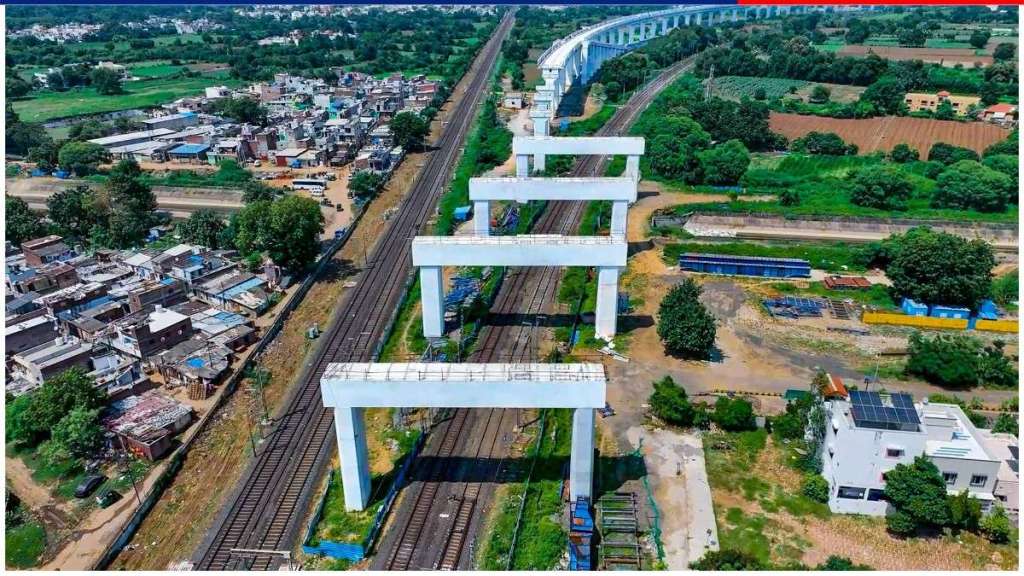

The Mumbai-Ahmedabad Bullet Train corridor has reached an important construction milestone in Vadodara, where 14 massive portal beams have been completed.
Each beam weighs around 1,500 tonnes, and their completion clears the way for the next stage of work on the elevated track.
The stretch presents a major engineering challenge as the new corridor passes through a busy railway area. With the portal beams completed, the focus now shifts to installing girders to complete the viaduct through the city.
Why is the Vadodara stretch challenging?
The Bullet Train station in Vadodara is planned in the heart of the city to provide access to the existing railway station, the city bus station, and other modes of transport.
However, bringing the high-speed rail corridor through this area requires careful planning. The alignment crosses five existing railway lines, including the Mumbai–Delhi main line used by Rajdhani Express trains, as well as several other railway infrastructure facilities.
To address these challenges, engineers constructed massive portal beams over the existing railway lines. Each beam was cast on-site, with careful attention to precision and safety.
With all 14 beams completed, the project can move to the next stage of construction on this section of the corridor.
What happens next in Vadodara?
The next stage involves installing girders to complete the Bullet Train viaduct through Vadodara. These structures will support the elevated tracks as they pass over the existing railway network.
The work must be carried out around railway lines that remain operational. Once the girders are installed and the remaining structural work is completed, the viaduct will take shape through this section of the city.
How the Bullet Train could change travel from Vadodara
Vadodara is one of the 12 planned stations on the Mumbai-Ahmedabad Bullet Train route. Its location in the heart of the city is intended to make it easier for passengers to reach the station and connect with existing train services, buses and other modes of transport.
The high-speed trains are planned to operate at speeds of up to 320 kmph, which is expected to reduce travel time between Mumbai and Ahmedabad. Passengers boarding at Vadodara could also benefit from faster intercity journeys once the service becomes operational.
Sabarmati River bridge completed in Ahmedabad
The Gujarat section of the corridor has also seen progress with the completion of a 480-metre-long bridge over the Sabarmati River in Ahmedabad. With this, 18 of the 21 river bridges planned in Gujarat have been completed, according to the National High Speed Rail Corporation Limited (NHSRCL).
The bridge lies between Sabarmati and Ahmedabad Bullet Train stations, around 1 km from Sabarmati station and 4 km from Ahmedabad station. It stands approximately 36 metres high, comparable to a 12-storey building.
The structure is located next to Western Railway’s Ahmedabad–Delhi main line, which runs around 14.8 metres above ground level.
Mumbai-Ahmedabad Bullet Train: Route, stations and speed
India’s first high-speed rail project will cover 508 km between Mumbai and Ahmedabad, passing through Maharashtra, Gujarat and the Union Territory of Dadra and Nagar Haveli. The project has an estimated cost of around ₹1.08 lakh crore.
The corridor will have 12 stations, including eight in Gujarat and four in Maharashtra. The planned stations are Mumbai, Thane, Virar, Boisar, Vapi, Bilimora, Surat, Bharuch, Vadodara, Anand, Ahmedabad and Sabarmati.