


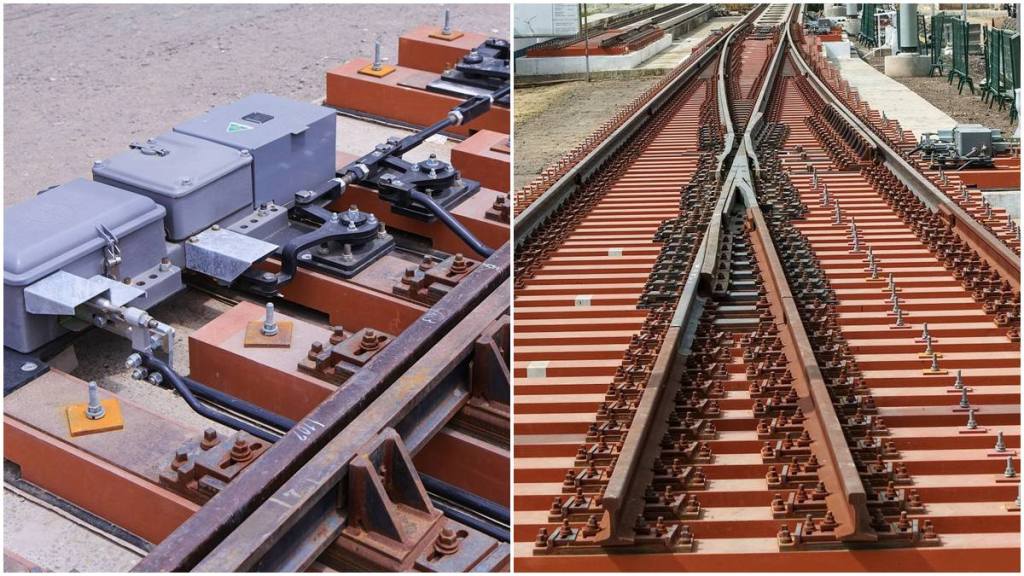

How does a Bullet Train travelling at high speed move from one track to another? On the Mumbai-Ahmedabad Bullet Train corridor, a combination of point machines, specialised turnouts and movable crossings will make such track changes possible.
The National High-Speed Rail Corporation Limited (NHSRCL), in a recent post on X, explained that point machines and movable track components called turnouts work together to assist Bullet Trains change tracks, especially near stations and depots.
“Ever wondered how Bullet Train switch at high speed?” NHSRCL stated in a post. In an official release, NHSRCL mentioned that the Mumbai-Ahmedabad High-Speed Rail project is introducing turnouts equipped with movable crossings, also termed as swing-nose crossings, for the first time on the Indian railway network. This technology is needed for safe and reliable operations on a corridor designed for speeds up to 320 kmph.
What are turnouts and movable crossings?
A turnout is a movable track arrangement that enables a train to shift from one railway track to another.
As per NHSRCL, conventional fixed crossings have a gap at the crossing nose that a train wheel has to bridge. At speeds surpassing 250-300 kmph, this discontinuity can create high dynamic forces and increased vibration. It can also result in wear of wheel flanges and crossing components and increase the risk of irregular wheel behaviour under residual track irregularities.
A movable crossing addresses this issue by physically shifting the crossing nose in coordination with the switch rails. This creates a continuous, gap-free running surface and maintains wheel guidance through the turnout.
NHSRCL stated the system offers “uninterrupted wheel guidance through the entire turnout.” It also said the continuous path lessens dynamic impact, vibration and interior noise, while lowering wear on rails and rolling stock.
Ever wondered how Bullet Train tracks switch at high speed?
Answer lies in a network of switching devices called point machines and movable track components called turnouts. Together they help Bullet Trains in changing tracks especially near depots and stations.#BharatKaGarv pic.twitter.com/urFbFzfZkI— NHSRCL (@nhsrcl) September 22, 2026
Why are two point machines required?
Each high-speed turnout will have two independent point machines, with each doing a separate task. The switch-end point moves and locks the switch rails, whereas the movable crossing point machine moves and locks the crossing nose.
Both machines work under a coordinated control system. When the signalling interlocking generates a route-setting command, movement of the switch rails and movable crossing is implemented in a synchronised manner.
However, train movement is not authorised merely after the track components move into place.
“Position detection and locking confirmation from both machines must be received before the interlocking authorises any train movement over the turnout,” NHSRCL stated.
Multiple checks before a train can pass
The system also has an option of independent detection and verification layers. Separate detection circuits keep a continuous watch on the final position of the switch rails, the final position of the movable crossing and the secure mechanical locking of both components.
Only when all these checks are confirmed that the turnout is correctly positioned and locked does the interlocking system release the route for the train movement.
NHSCRL also mentioned in its official release that high-speed point machines are subject to stern technical requirements than conventional machines. These consist of higher actuation forces, tight positioning tolerances, precise stroke control and robust locking mechanisms. They must also perform under the climatic, vibration and electromagnetic conditions of the Indian operating environment.
What does this mean for passengers?
Passengers are unlikely to notice these mechanisms while travelling, but the system will perform an essential function whenever a Bullet Train has to move between tracks.
According to NHSRCL, movable-crossing turnouts together with dual point machines are among the technical systems enabling the Mumbai-Ahmedabad corridor to meet high-speed railway requirements for safety, asset life, ride quality and operational reliability.