



Indian Railways is looking to ease congestion on its busiest routes by expanding track capacity and developing dedicated freight infrastructure as it seeks to increase its share of the country’s goods transportation market, reported The Indian Express.
Often described as the lifeline of the country, Indian Railways carries more than 20 million passengers every day. It is also one of the world’s largest freight networks, with freight earnings accounting for more than 65% of the Railways’ total revenue and helping subsidise passenger services.
The expansion of India’s National Highways network by more than 60% over the past decade has increased competition for freight movement. While rail transport is generally cheaper and has lower emissions than road transport, congestion on busy railway routes and inadequate last-mile connectivity have limited its ability to attract a larger share of freight.
To address this, the Railways is working on expanding capacity across its seven high-density networks (HDNs), which together carry more than 40% of the system’s traffic. It is also moving ahead with another dedicated freight corridor after the completion of the Western DFC.
High-density routes carry more than 40% of railway traffic
High-density networks are routes where train operations in several sections have reached or exceeded available line capacity. One example is the 28-km Karjat-Lonavala section near Mumbai, where an average of 67 trains operate each way every day against a capacity of 40 trains.
Such overutilisation can result in congestion and delays for both passenger and freight services. It can also affect the overall efficiency of the railway network.
The seven HDNs cover 11,051 km, or nearly 16% of the Railways’ more than 69,000-km network. Despite their relatively limited share of the overall network, they carry more than 40% of total railway traffic, making them critical for both passenger and freight operations, reported The Indian Express.
The seven routes are Howrah-Delhi, Howrah-Mumbai, Mumbai-Delhi, Delhi-Guwahati, Delhi-Chennai, Howrah-Chennai and Mumbai-Chennai.
Railways considers 70-80% of line capacity utilisation to be the preferred range for smooth operations. However, only 4.6% of the HDN network is currently operating below 80% utilisation.
Around 18.89% of the network is operating at 80-100% utilisation, while 32.75% is in the 100-120% range. Another 29.53% is operating at 120-150%, and 14.11% has utilisation above 150%.
The congestion on these routes frequently affects freight services, with the average speed of freight trains remaining around 25 kmph.
Multitracking is key to raising freight capacity
Expanding the number of tracks on high-density routes is seen as important not only for passenger movement but also for increasing freight loading.
Rail’s share in India’s overall freight transportation is around 27%. Indian Railways carried 1,670 million tonnes of freight in 2025-26 and has set a target of raising annual loading to 3,000 million tonnes by 2030.
The National Rail Plan estimates that without multitracking, capacity pressure on HDNs could become significantly worse by 2031. Around half of the network could see utilisation above 150%, while another 39% could operate at 100-150%, The Indian Express report added.
For 2026-27, the Railways has set a target of constructing 500 km of new lines and doubling 2,400 km. In 2025-26, the revised targets were 700 km for new lines and 2,600 km for doubling.
The Union Cabinet has also approved eight multitracking projects covering 1,196 km at a combined cost of Rs 20,804 crore.
“Of the 11,000 km of the high density corridor, about 2,000 km is already four-line. In 5,000 km, the project is sanctioned and work is underway. In 4,000 km, the DPR (Detailed Project Report) is being prepared and work will be approved in future,” said Railway Minister Ashwini Vaishnaw.
The Railways expects greater use of rail for freight to help reduce logistics costs by cutting transit delays, lowering inventory requirements and limiting wastage or deterioration of goods during transportation.
The Ministry of Railways told the Standing Committee on Railways on February 10, 2025: “If we talk about comparison, if we see, approximately Rs 3.60 per tonne per kilometre is the cost on road, and on rail, it is Rs 1.60. In this way, it is cheaper. If we see, we have to reduce the logistics cost, so the more we take onto rail, the cost will come down to 8-9%. Currently, our logistics cost is 12-13%, and it costs a lot.”
Dedicated freight corridors separate goods traffic
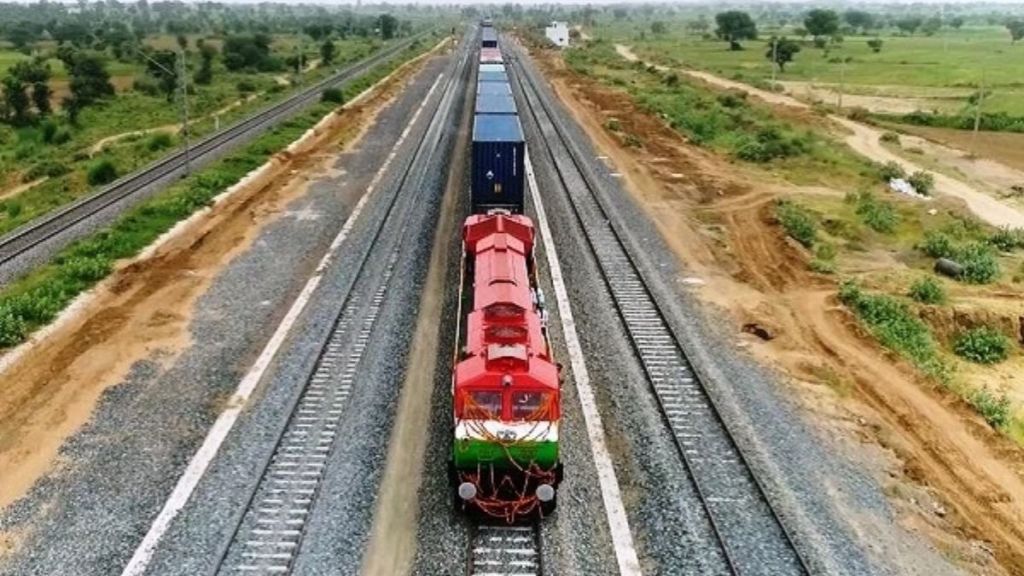
Dedicated Freight Corridors are specialised railway lines designed primarily for freight trains. In some stretches, they run parallel to existing high-density routes, while in others they take alternative alignments to avoid passenger-dominated terminals and congested sections.
The Eastern and Western DFCs were conceived to reduce pressure on the heavily utilised Howrah-Delhi and Mumbai-Delhi routes, where capacity utilisation had reached between 115% and 150% in several sections.
Both corridors are now fully operational and together handle an average of around 420 freight trains a day.
The Eastern DFC runs from Ludhiana in Punjab to Sonnagar in Bihar and is mainly used for coal and mineral traffic moving from eastern India. The Western DFC carries a significant volume of containerised freight from ports including Jawaharlal Nehru Port and Mumbai Port in Maharashtra, and Pipavav, Mundra and Kandla in Gujarat, towards inland container depots in northern India.
Major destinations on the western route include Tughlakabad in Delhi, Dadri in Uttar Pradesh, Dhandari Kalan in Punjab and Khatuwas in Rajasthan.
East-West freight link is next major expansion
With the Eastern and Western DFCs in operation, Indian Railways is now moving ahead with the proposed East-West Dedicated Freight Corridor between Dankuni in West Bengal and Surat in Gujarat.
The proposed 1,738-km line is expected to serve several major freight-generating industries and locations, including coal mines, iron ore and bauxite-producing areas, steel plants, ports, fertiliser facilities and Food Corporation of India godowns.
The expansion of high-density routes and dedicated freight infrastructure is aimed at creating additional capacity for goods trains while reducing pressure on passenger-freight routes. For Indian Railways, improving this capacity will be central to its effort to attract more freight traffic and raise the efficiency of the national logistics network.