


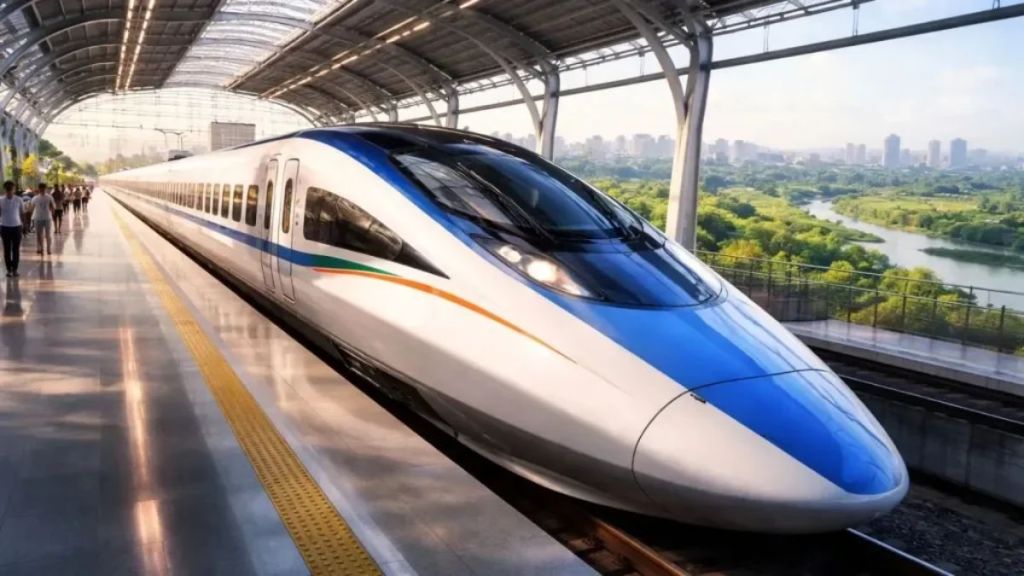

Union Railway Minister Ashwini Vaishnaw on Sunday reviewed the manufacturing progress of India’s indigenous B28 bullet train at BEML’s Aditya manufacturing facility in Bengaluru. The train is being developed for the Mumbai-Ahmedabad High-Speed Rail (MAHSR) corridor.
During the visit, Vaishnaw inspected the specialised infrastructure used to manufacture the train, including precision-engineered jigs and fixtures for carbody fabrication. He also reviewed various stages of production, covering underframe fabrication, sidewall and roof assembly, carbody integration, surface preparation and treatment, according to an official statement.
The minister witnessed a ‘Squeeze Test’ demonstration, a quality assessment procedure in which controlled compressive and tensile forces are applied to the train carbody to evaluate its structural strength, rigidity and dimensional stability.
He also examined passenger seats and onboard equipment, including the heating, ventilation and air-conditioning (HVAC) system, couplers and other train assemblies. The visit included a review of side module and roof module manufacturing, followed by their integration into the train.
The manufacturing processes are aimed at meeting the structural precision, durability and quality requirements of high-speed rail operations.
B28 bullet train speed, capacity and coach configuration
The B28 train is designed for a maximum test speed of 280 kmph and an operational speed of 249 kmph. The eight-coach train will have a passenger capacity of around 557 and a total length of approximately 202 metres.
Its configuration includes seven standard-class coaches with a 3×2 seating arrangement and one executive-class coach with 2×2 seating. The train will have four motor cars and four trailer cars. It will also provide dedicated space for two Divyangjan or Persons with Reduced Mobility (PRM) passengers.
The design allows two eight-coach trainsets to be coupled to create a 16-coach formation, providing scope to increase capacity in line with future requirements.
Both ends of the train will have driving cabs fitted with an Intelligent On-Board Control System. The system is intended to support operational decisions and coordination with the operation control centre.
Passenger amenities, accessibility and onboard systems
The B28 train will feature a passenger information system with LCD screens displaying travel-related information in English, Hindi and regional languages. Audio announcements will also be available through public announcement and automatic announcement systems.
Emergency talk-back units in passenger cabins and vestibules will allow travellers to contact train crew when required. A Wi-Fi-based infotainment system will provide access to preloaded entertainment content during the journey.
Accessibility features include level boarding, with the train floor designed to align with platform height. Retractable footsteps fitted into the doors will help reduce the gap between the train and platform. Dedicated seating and toilet facilities, wheelchair-friendly doors and Braille-enabled information signage are also part of the design.
Each coach will have two HVAC units to regulate temperature and humidity. The train will also incorporate sound insulation in its carbody and floor structure, noise-damping coatings, and specially designed skirts, bogie covers and fairings. These features are intended to limit noise during high-speed operations and improve passenger comfort.
Traction, regenerative braking and aerodynamic design
The B28 train will use a 25 kV, 50 Hz single-phase AC traction system powered through a heavy compound catenary. It will also feature regenerative braking, which recovers energy during deceleration and feeds it back into the system to improve operational efficiency.
Its aerodynamic design has been developed using Computational Fluid Dynamics (CFD) simulations to study airflow around the train. The nose and carbody profile have been shaped to reduce air resistance, limit pressure waves inside tunnels and minimise turbulence at high speeds.
The design also incorporates an integrated rooftop HVAC profile, roof panels and airflow deflectors. Wind-guiding elements on the exterior and a sealed carbody are intended to improve aerodynamic performance and reduce pressure variations inside the coaches.