


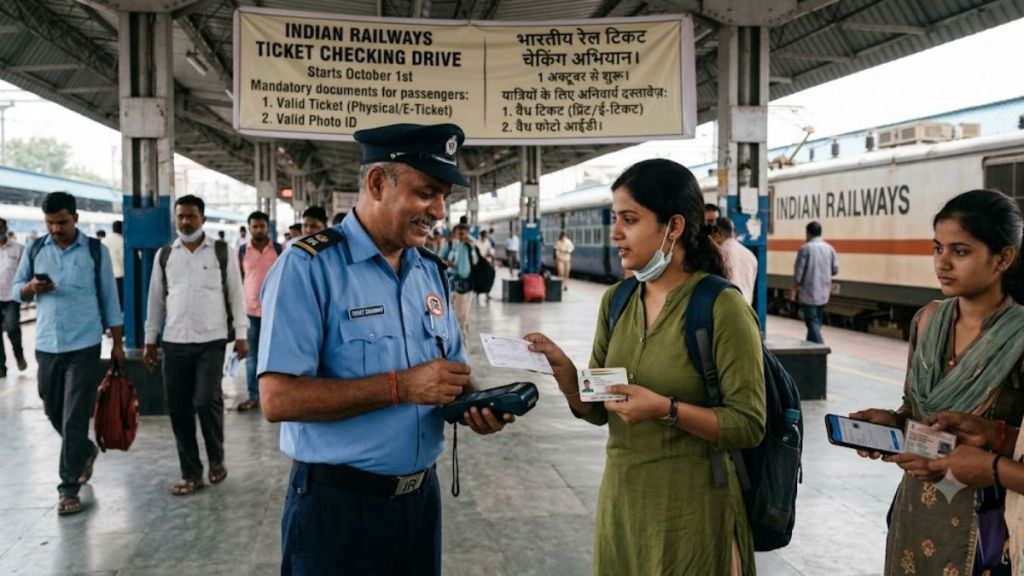

Indian Railways is set to intensify ticket-checking from October 1 to October 31, ahead of the festive season.
The month-long drive by Central Railway will focus on checking the validity and authenticity of passenger tickets, with special attention to concession bookings, specified reservation quotas and railway passes.
Original ID proof required for concession, quota tickets
According to Dr Swapnil Nila, Chief Public Relations Officer (CPRO), Central Railway, passengers travelling on concession tickets or under specified reservation quotas must carry the prescribed original identity proof to establish their eligibility, reported The Indian Express.
For tickets booked for multiple passengers, at least one passenger listed on the ticket must carry the required original identity proof.
“In the absence of the required original proof, all the passengers travelling on the ticket will be treated as travelling without a valid ticket, as per the applicable rules,” he added.
Ticket-checking staff will also verify the original documents required for passengers travelling under specified concessions or reservation quotas.
Passengers travelling with an E-Pass or PTO must carry the prescribed original identity proof and ensure that the E-Pass or PTO has been duly exchanged for the prescribed authority to travel before undertaking the journey.
Unreserved tickets to face additional scrutiny
Central Railway said special attention will also be given to checking the authenticity of unreserved train tickets. Ticket-checking staff may use the TTE App wherever required to authenticate and verify tickets during the special checking drive.
The exercise is aimed at curbing misuse of reservation facilities, preventing fraudulent use of concessions and passes, checking the authenticity of tickets and plugging leakage of railway revenue.
The railway zone has advised passengers travelling under concessions, specified quotas or railway passes to carry the required original documents during the journey.
What documents can passengers carry?
According to Indian Railways, the following documents are valid for train travel:
- Voter Photo identity card issued by Election Commission of India
- Passport
- PAN Card issued by Income Tax Department
- Driving Licence issued by RTO
- Photo identity card having serial number issued by Central/State Government
- Student Identity Card with photograph issued by recognised school or college
- Nationalised Bank Passbook with photograph
- Credit Cards issued by banks with laminated photograph
- Unique Identification Card “Aadhaar”
Ticketless travel penalty raised to Rs 500
The intensified ticket-checking exercise comes after Indian Railways increased the minimum penalty for travelling without a valid ticket.
Under the provisions of the Jan Vishwas Act, 2026, the minimum penalty under Sections 137 and 138 of the Railway Act, 1989, was increased from Rs 250 to Rs 500 with effect from June 20, 2026.
“As per the provisions of the Jan Vishwas Act, 2026, the minimum penalty under Sections 137 & 138 of the Railway Act, 1989 has been increased from Rs 250 to Rs 500 with effect from 20 June 2026. Passengers are requested to travel with a valid ticket and follow railway rules to avoid penalties,” it said.
Under Section 137, travelling in a railway carriage or train without proper authorisation under Section 55, or reusing a ticket or pass already used for a previous journey, can constitute an offence when there is an intent to defraud the railway administration.
Passengers found travelling without proper authorisation can be required to pay the fare for the distance travelled along with an excess charge equal to the fare due, subject to a minimum excess charge of Rs 500.
If the amount is not paid, railway authorities can approach the competent court for recovery. Default in payment may attract imprisonment of up to six months, a fine of up to Rs 500, or both.
With the special checking drive set to continue through October, passengers should ensure that they carry a valid ticket and the original identity or eligibility documents required for their category of travel.