


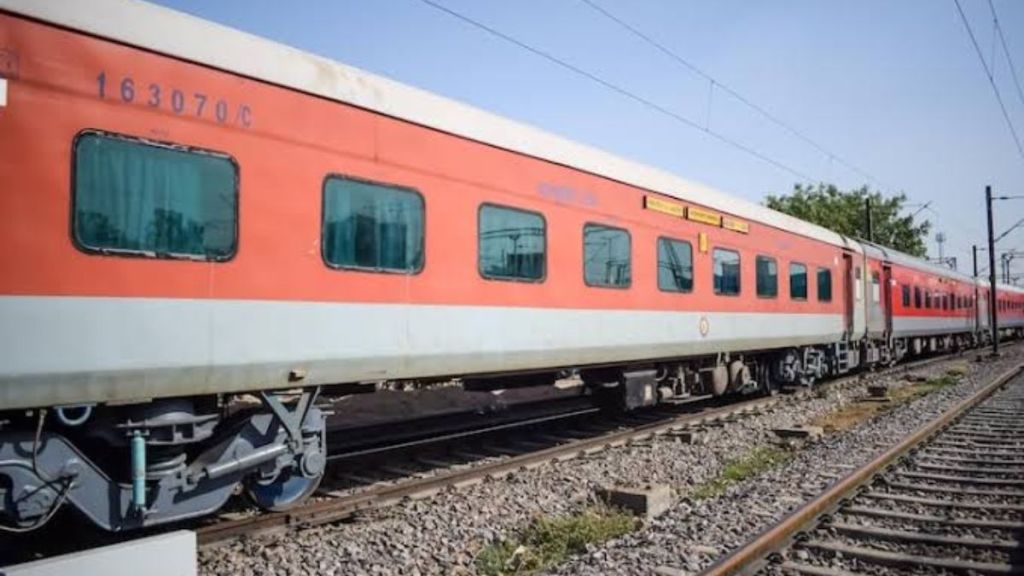

Indian Railways is facing a shortage of passenger locomotives, with freight engines being deployed on passenger trains in several cases, resulting in lower operating speeds and delays of several hours, according to railway records, PTI reported.
Officials said around 80 to 100 such instances are being reported every month across different railway zones. The freight locomotives used in these cases generally have lower permissible running speeds than passenger locomotives, leading to a loss of running time on sections where passenger trains are authorised to operate at higher speeds.
Railway locomotive shortage: 679 passenger locos approved in two years
The Railway Ministry has said it is increasing locomotive production to address the shortage. It has approved the production of 492 passenger locomotives in 2026-27 and another 187 in 2027-28, taking the total planned production to 679 locomotives over the two years.
“The 2026-27 programme includes 326 WAP-7 locomotives and 166 WAP-7 locos. Besides these productions in the pipeline, there is a rapid adoption of modern trainsets and improvement in utilisation of existing assets,” a senior official from the Ministry said, reported PTI.
The official said train operations have expanded significantly over the past 12 years and the national transporter is working to improve passenger safety and comfort.
However, railway records show that the shortage of coaching locomotives has already affected the punctuality of several passenger services. In such cases, freight locomotives are used as substitutes, particularly when passenger locomotives with higher permissible speeds are not available.
Ballia-Dadar Express delayed by over 5 hours
One such case involved Train No. 11044, the Ballia-Dadar Central Express, on September 3, 2026. The train was delayed by 5 hours and 28 minutes because the required passenger locomotive was unavailable.
The service was scheduled to operate with a WAP-4 passenger locomotive, which has a running capability of more than 130 kmph. Instead, North Eastern Railway arranged a goods locomotive with a permissible running capacity of 100 kmph.
The substitution affected the train’s running time on the Bina-Khandwa section. Railway records show that the train suffered a detention of 328 minutes, or 5 hours and 28 minutes.
“The train subsequently suffered loss on run in the Bina-Khandwa section between 13:26 hrs and 00:59 hrs. The incident resulted in a recorded detention of 328 minutes (5 hours 28 minutes),” sources said.
The incident is among several cases recorded by the Railways in which freight locomotives have been pressed into passenger service because of a shortage of coaching engines.
As of September 2026, Indian Railways had around 17,900 locomotives. Of these, approximately 13,700 were electric and around 4,200 were diesel locomotives.
Of the electric fleet, about 3,400 are passenger locomotives of different WAP variants, while the remaining engines are primarily WAG locomotives used for freight and other operational requirements. Of the approximately 4,200 diesel locomotives, only 284 are deployed for passenger links, with most being used for freight, shunting, departmental and other duties.
Freight locomotives used on multiple passenger routes
Railway data shows that the composition of the locomotive fleet has changed substantially over the past decade. In 2013-14, Indian Railways had 10,456 locomotives, comprising 5,633 diesel and 4,823 electric locomotives. Of the electric fleet at the time, 1,371 were passenger locomotives.
The 2013-14 data does not separately specify the number of diesel locomotives deployed for passenger services.
Officials attributed the shift towards electric locomotives to the rapid expansion of railway electrification after 2014. As electrification gathered pace, production of diesel locomotives was progressively reduced while electric locomotive production increased.
Despite the expansion of the electric fleet, railway records show that freight locomotives are still being used on passenger services when suitable coaching locomotives are unavailable.
On September 21, 2026, at least two passenger trains were recorded as operating with WAG-9 freight locomotives capable of running at 100 kmph because passenger locomotives with higher speed capabilities were not available.
One of these was Train No. 14102, the Kanpur Central-Prayagraj Sangam InterCity Express. The train was scheduled to run with a WAP-1 passenger locomotive, which has a maximum running capability of 130 kmph. It was instead provided with a WAG-9 freight locomotive.
“Due to shortage of passenger locomotives, the rail administration has to substitute it with freight engines. This led to a delay of at least 30 minutes as the train operated at 100 kmph in sections where the speed permission was 130,” a railway source said, reported PTI.
Another case recorded on the same day involved Train No. 17601, which operates between Kacheguda in Telangana and Shri Ganganagar in Rajasthan. The train was given a WAG-9 freight locomotive instead of the scheduled WAP-7 passenger engine because of a shortage.
The substitution resulted in detention and affected the overall punctuality of the service.
Railways says production has increased
The Railways has maintained that locomotive production has increased significantly over the past 12 years and that additional capacity is being created to meet operational requirements.
A senior zonal railway official also said the present fleet constraints were linked partly to shortages that had accumulated over an earlier period.
“The production of locomotives has increased manifold in the last 12 years. However, years of neglect of several crucial manufacturing activities before 2014, which caused a severe shortage of locomotives, wagons and coaches, will be compensated in due course of time,” a senior zonal railway official said.
The Ministry is now relying on additional passenger locomotive production, modern trainsets and better utilisation of the existing fleet to address the gap. The effectiveness of these measures will be reflected in how frequently passenger trains continue to require lower-speed freight locomotives as substitutes.