


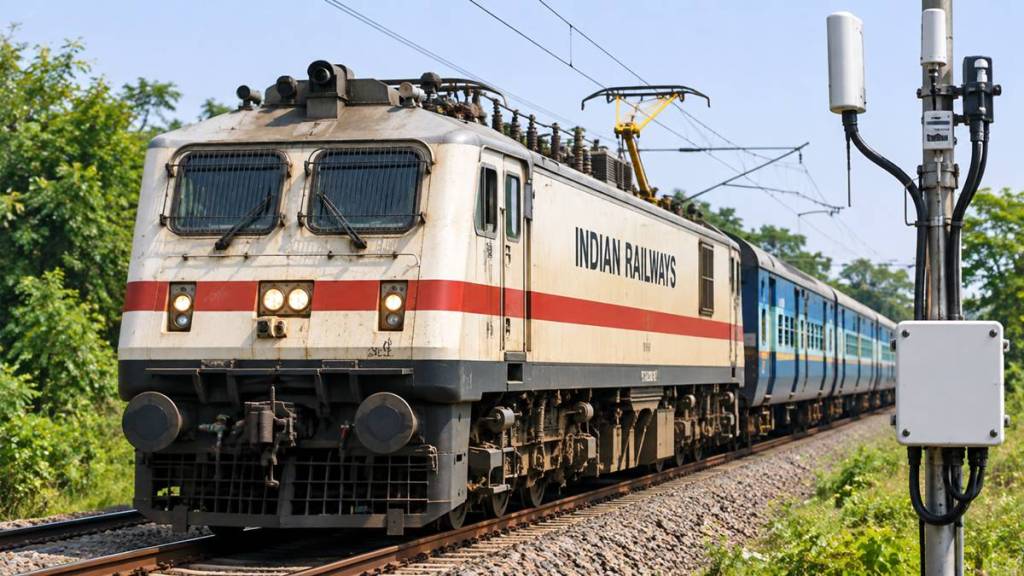

Indian Railways has commissioned Kavach 4.0, its indigenously developed Automatic Train Protection (ATP) system, on the 69.5 km Karchna-Mirzapur railway section in Uttar Pradesh. The latest development on the Delhi-Howrah corridor is intended to enhance passenger safety by reducing the risk of accidents caused by overspeeding, signal violations and certain types of collisions.
While announcing the development on its official X account, the Ministry of Railways stated, “Indian Railways commissioned Kavach 4.0 on the 69.5 route kilometres between Karchna-Mirzapur section, strengthening rail safety.”
With this latest addition, the Kavach shield under the North Central Railway (NCR) has achieved 785 route kilometres, as per The Indian Express. The commissioning marks another step in expanding automatic train protection along one of India’s major railway corridors.
How does Kavach 4.0 enhance train safety?
Kavach is designed to support locomotive pilots by monitoring train speeds and offering protection against potentially dangerous situations.
If a locomotive pilot fails to take appropriate action in response to a signal or speed reduction, the system can automatically apply the brakes. It is designed to stop Signal Passing at Danger (SPAD), where a train crosses a stop signal without authorisation. It also minimises the risk of head-on and rear-end collisions.
For passengers, the deployment means an additional railway section has been equipped with a system that is aimed at reducing the risk of certain accidents. However, Kavach protection needs compatible equipment on locomotives as well as the essential trackside infrastructure.
What makes Kavach 4.0 different?
The upgraded version comprises several technical improvements to boost train monitoring and communication. As per the Ministry of Railways, Kavach 4.0 provides enhanced local accuracy and better details about signals in large railway yards. It also offers station-to-station communication with the help of optical fibres.
It also blends directly with existing electronic interlocking systems, which handle signals and train movements. The system is designed to comply with Safety Integrity Level 4 (SIL-4), a strict safety standard for railway applications.
Kavach was adopted as India’s national Automatic Train Protection system in July 2020, and the Research Designs and Standards Organisation (RDSO) sanctioned Kavach 4.0 on July 16, 2024.
How far has Kavach 4.0 expanded across Indian Railways?
As per details shared by the PIB in August 2026, Kavach 4.0 had been commissioned on 2,633 route kilometres as of July 31, 2026. This comprises 1,423 route kilometres on the Delhi-Mumbai corridor and 1,210 route kilometres on the Delhi-Howrah corridor.
The Ministry also stated that trackside Kavach implementation had been taken up across 21,794 route kilometres. While equipment installation had been completed over 7,726 route kilometres, Kavach has been fitted in 6,290 locomotives.
Installation work had also been commenced for another 7,190 locomotives and 1,200 ENU/MEMU units.
Kavach tested at 160 kmph on Vande Bharat
The Ministry of Railways has also informed Parliament that Kavach trials at 16 kmph had been successfully held using a Vande Bharat trainset on the Chipyana Buzurg-Tundla section of the Delhi-Howrah corridor.
As per the official release in August by the PIB, Rs 3,875 crore had been spent on Kavach-related works up to June 2026, and Rs 2,066 crore was assigned for the 2026-27 financial year.
The commissioning of the Karchna-Mirzapur section adds to the railway network equipped with automatic train protection technology as Indian Railways continues its phased safety upgrades.