


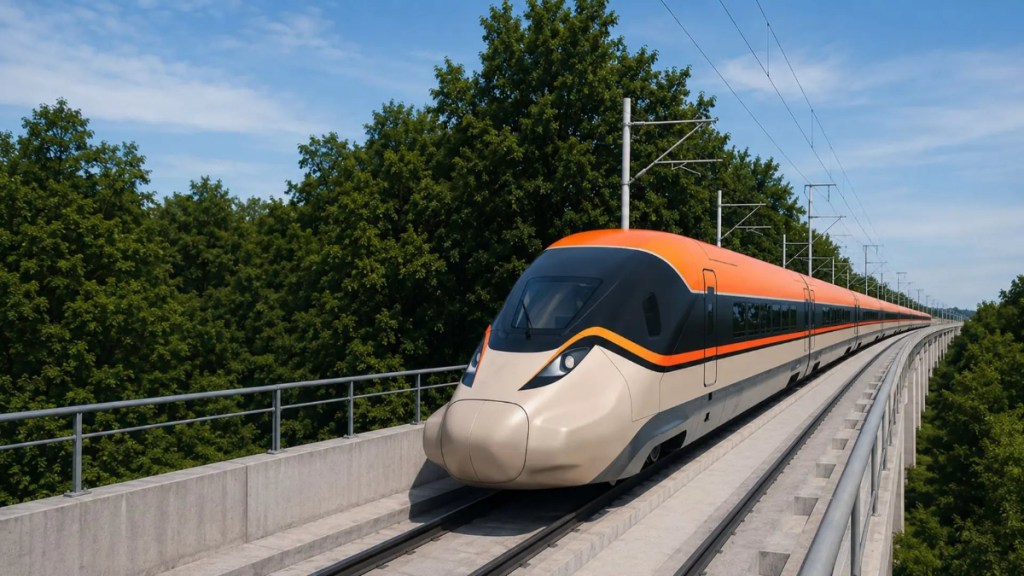

Southern India is set to get faster rail connectivity, with two high-speed rail corridors connecting Bengaluru with Chennai and Hyderabad receiving approval from Prime Minister Narendra Modi.
Union Railway Minister Ashwini Vaishnaw highlighted the new corridors during the flag-off ceremony of the Mumbai-Bengaluru Vande Bharat Sleeper Express on Sunday, November 1.
He also outlined the expected travel time on the two routes and the role of high-speed rail in improving connectivity across southern India.
Bengaluru to Chennai in 73 mins, Hyderabad in 2 hours
The Bengaluru-Chennai high-speed corridor is expected to cut travel time to just 73 minutes, while the Bengaluru-Hyderabad journey could take around 2 hours and 10 minutes.
These faster connections are expected to make inter-city travel easier and improve links between major cities in southern India.
Chennai-Bengaluru corridor to link industrial and IT hubs
The Chennai-Bengaluru high-speed rail corridor will connect two of southern India’s major industrial and technology centres.
The route is expected to improve access between Chennai’s manufacturing and automobile industries and Bengaluru’s technology and business sectors. Faster rail travel could also make it easier for professionals and business travellers to move between the two cities.
Bengaluru-Hyderabad route to link key business hubs
The Bengaluru-Hyderabad high-speed rail corridor will provide a faster connection between two major commercial centres in southern India. Both cities have a strong presence in the IT sector, along with growing business and startup ecosystems.
The new link is expected to make inter-city travel more convenient and support closer business interactions between Karnataka and Telangana.
Seven high-speed rail corridors announced in Budget 2026-27
The Chennai-Bengaluru and Bengaluru-Hyderabad routes are among the seven high-speed rail corridors announced in the Union Budget 2026-27. The remaining five corridors will connect major cities across southern, western and northern India. These include:
–Chennai-Hyderabad: The journey is expected to take around 2 hours and 55 minutes, improving connectivity across southern India.
–Mumbai-Pune: The corridor is expected to reduce travel time to approximately 48 minutes and support frequent inter-city travel in western India.
–Pune-Hyderabad: The journey is projected to take around 1 hour and 55 minutes, creating a faster link between western and southern India.
–Delhi-Varanasi: The high-speed corridor is expected to bring down travel time to approximately 3 hours and 50 minutes, connecting the national capital with an important cultural and economic centre.
–Varanasi-Patna-Siliguri: This extended corridor is expected to cover the journey in around 2 hours and 55 minutes, improving rail connectivity across several states.
Together, the seven corridors are expected to reduce travel time between major cities and improve access to important industrial, business and technology centres.
Mumbai-Ahmedabad: India’s first bullet train corridor
While the seven new corridors will expand India’s planned high-speed rail network, the Mumbai-Ahmedabad High-Speed Rail project is already under construction as the country’s first bullet train corridor.
Spanning 508 km, the corridor will connect Mumbai in Maharashtra with Ahmedabad in Gujarat, passing through the Union Territory of Dadra and Nagar Haveli.
The project has an estimated cost of around Rs 1.08 lakh crore and will have 12 stations. Of these, four stations are planned in Maharashtra and eight in Gujarat.
The planned stations are Mumbai, Thane, Virar, Boisar, Vapi, Bilimora, Surat, Bharuch, Vadodara, Anand, Ahmedabad and Sabarmati.