


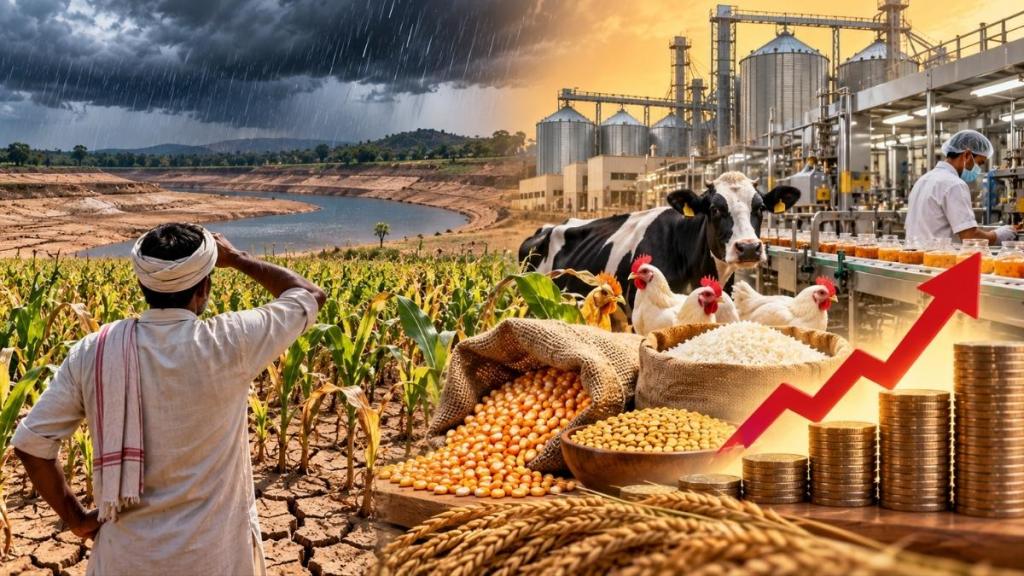

India’s monsoon deficit could push up costs for food businesses before consumers see the full impact on retail prices. Lower crop yields can tighten supplies and make raw materials more expensive, affecting food processors, poultry producers, livestock businesses and other industries that depend on agricultural inputs.
A report by Dun & Bradstreet, titled ‘Economic Impact of Monsoon Deficit in India: Production, Supply Chain and Price Risks’, warns that the impact will depend on the crops and regions affected. It identifies drought conditions in parts of Karnataka, Maharashtra and Andhra Pradesh, while assessments in Telangana and Rajasthan were still under way.
The report does not predict an immediate nationwide food shortage. Instead, it warns that businesses could face higher procurement costs, supply disruptions and greater working-capital requirements if crop losses reduce the availability of key inputs.
Agriculture accounts for nearly 17% of India’s gross value added (GVA), according to the report. The southwest monsoon supplies close to three-fourths of the country’s annual precipitation, making rainfall an important factor in crop production and the cost of agricultural raw materials.
Why could food businesses face higher costs first?
The impact of weak rainfall can reach businesses before it shows up in retail inflation. If crop yields fall and market supplies tighten, food companies may have to pay more for the same quantity of raw materials or find alternative suppliers.
Dun & Bradstreet’s report identifies higher procurement costs, larger inventory requirements, more complex logistics and increased working-capital needs as early signs of pressure.
Food processors are particularly exposed because agricultural products account for 57% of intermediate consumption in the manufacturing of food products, beverages and tobacco, according to the report. A rise in the cost of farm produce can therefore increase expenses for companies making packaged and processed foods.
Businesses may also need to hold additional stocks to guard against supply disruptions. This ties up money that would otherwise be available for wages, transport and other operating expenses.
The risk is greater for companies that depend on a small number of suppliers or sourcing regions. Rajasthan and Maharashtra account for significant shares of cereal-related businesses, while Maharashtra alone represents 21% of businesses engaged in cereal-, grain- and seed-based feed manufacturing.
A crop shortfall in these regions could affect mills, feed manufacturers and companies that buy their products. Businesses with limited cash reserves or little room to raise selling prices could face pressure on their margins before consumers see higher prices in shops.
Which crops and businesses face the greatest risk?
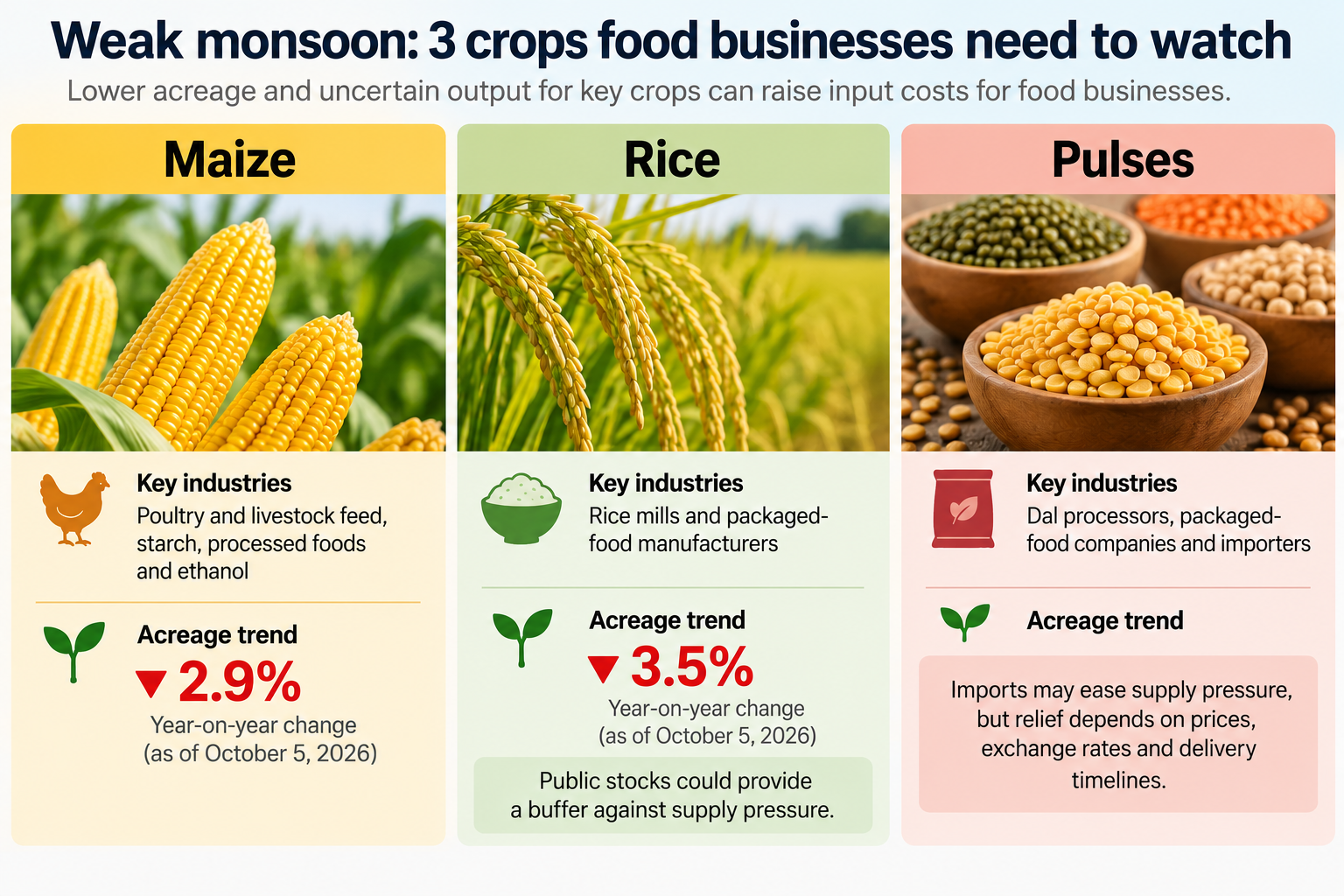
Maize is a key concern because it serves several industries. It is used in poultry, livestock and aquaculture feed, as well as in starch, processed foods, alcohol and ethanol production.
Maize acreage was 2.9% lower year on year as of October 5, 2026, according to Dun & Bradstreet. The report warns that yields remain vulnerable during flowering and grain filling, when moisture stress can reduce production even after sowing is complete.
Lower maize supplies could raise feed costs for poultry and livestock producers and increase input expenses for starch manufacturers, food processors and ethanol producers. The actual impact will depend on the scale of production losses and whether businesses can find alternative suppliers or inputs.
Rice faces a different set of risks. Acreage was 3.5% lower year on year as of October 5, according to the report. Rice requires sustained moisture during much of its growth cycle and is an important input for milling and packaged-food businesses.
However, substantial public rice stocks and favourable crop conditions in other regions could help absorb moderate production losses. A larger or prolonged shortfall could reduce this cushion and increase procurement uncertainty.
Pulses could face supply pressure if domestic production falls. Imports can help fill the gap, but their effectiveness depends on international prices, exchange rates, trade policy and delivery timelines. The report says imports may soften moderate shortages but may not fully offset a broad production shock.
The report also puts cereal acreage 2.3% lower year on year as of October 5. Madhya Pradesh, Rajasthan, Telangana, Maharashtra and Andhra Pradesh together accounted for 1,400.3 lakh tonnes, or 37.7% of foodgrain output across the 20 states analysed for 2025–26.
This concentration makes regional crop losses important for businesses that depend on supplies from these states. The effects would vary by commodity, with maize shortages potentially affecting feed and industrial users, while rice losses could put pressure on milling and packaged-food businesses.
Why could food inflation rise later?
A fall in crop production does not automatically lead to higher retail prices. The impact depends on the size of the shortfall, available stocks, imports and the ability of businesses to substitute other inputs.
Public rice and wheat stocks give the government some room to manage temporary supply disruptions. However, this protection is more limited for commodities such as maize and pulses, where businesses may have fewer alternatives to meet their requirements.
Companies can initially absorb higher raw-material costs to avoid increasing prices for customers. If those costs persist, they may have to accept lower margins, change suppliers or raise selling prices. The timing will vary across businesses and products.
Dun & Bradstreet’s report distinguishes between production risk and inflation risk. Production risk begins with weak rainfall, moisture stress and lower yields. Inflationary pressure can emerge later if lower output leads to sustained supply shortages, declining inventories and rising market prices.
Water availability is another concern. Reservoir storage in 2026 was below both the previous year’s level and the 10-year seasonal average as of October 1, according to the report. Lower storage could limit irrigation support in areas that depend on reservoirs and canals.
However, low reservoir levels alone do not establish that crop losses will occur. The impact will also depend on groundwater access, canal releases and water availability during critical stages of crop growth. Final crop estimates will offer a clearer picture of the production impact.
Imports can provide relief for commodities with established overseas supply channels, including lentils. But they cannot replace domestic production equally across all crops. Dun & Bradstreet says imports offer more limited protection for rice, wheat and particularly maize, where domestic production and available stocks remain important buffers.
What should food businesses watch?
Dun & Bradstreet recommends that businesses assess their exposure by crop, region and supplier rather than relying only on national rainfall figures.
Companies that depend on a small number of suppliers or have limited inventory and working capital could face pressure first. Diversifying suppliers, building stocks of vulnerable inputs, securing suitable contract terms and arranging backup logistics can help them manage supply disruptions.
Businesses and policymakers will also need to track final kharif crop estimates, rabi sowing, reservoir levels and prices of vulnerable commodities. These indicators can help establish whether the rainfall deficit has translated into lasting production losses and tighter supplies.