


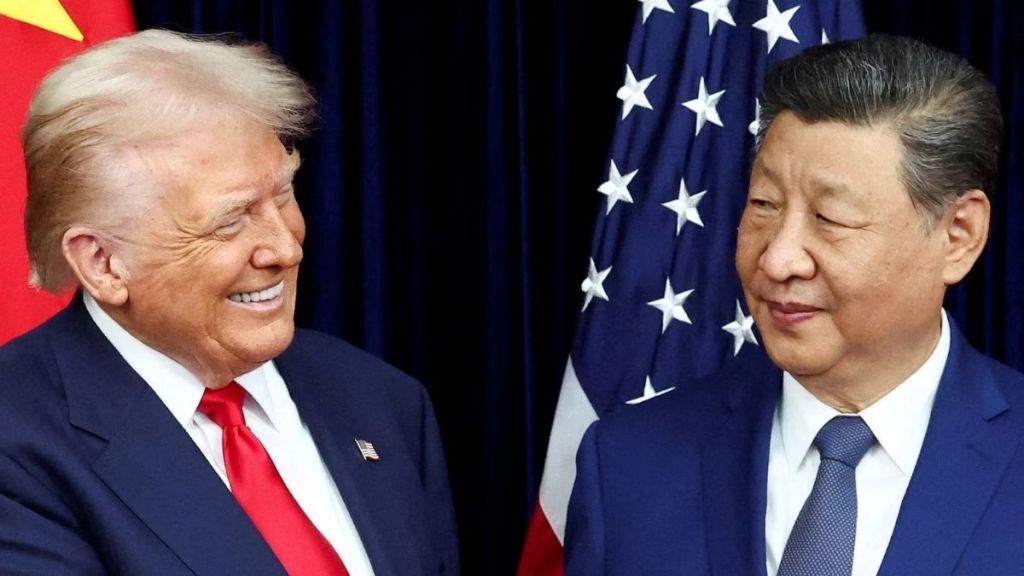

The US and China have agreed to cut tariffs on selected products worth about $30 billion from each side, giving bilateral trade another boost as Washington and Beijing try to ease tensions after years of tariff disputes.
The two countries released their respective product lists on Monday, covering goods ranging from agricultural products and personal-care items to timber, medical equipment, household products and toys, AP reported.
The agreement comes days after Chinese President Xi Jinping met US President Donald Trump in Washington. It is another step towards reducing some of the trade barriers imposed during the broader US-China trade dispute.
US tariffs on Chinese goods had reached as high as 145% last year before Washington reduced them as tensions eased.
Which products will get lower tariffs?
China’s list covers 1,619 categories of US goods, including agricultural commodities, personal-care products, timber, medical equipment and US coal.
The US list covers 77 categories of Chinese products, including tableware, glass products, wooden Christmas ornaments, fireworks and soccer balls.
The US Trade Representative said the lists focus on “non-sensitive goods” that could benefit from lower tariffs, reported AP.
China’s Commerce Ministry said tariff rates on more than 90% of the products on its list would move to most-favoured-nation levels, reported AP. That means the additional tariffs imposed on those products during the trade dispute would largely be removed.
The agreement could therefore benefit US farmers and manufacturers selling in China, while US importers could see lower costs on some Chinese consumer products.
But the size of the lists needs to be viewed in the context of overall trade. US exports to China were worth about $68 billion in the first seven months of this year, while Chinese exports to the US reached about $270 billion in the first eight months, according to figures cited by AP from BNP Paribas Wealth Management.
Prashant Bhayani, chief investment officer for Asia at BNP Paribas Wealth Management, told AP that the $30 billion figure was therefore more significant relative to US exports to China.
Economists also said lower tariffs could support trade in the affected categories. Lynn Song, chief economist for Greater China at ING Bank, said the agreement could lead to a more significant increase in bilateral trade.
However, the deal does not cover several products at the centre of the wider US-China economic rivalry.
What does the deal leave unresolved?
Semiconductors, electric vehicles and batteries are among the strategic products not covered by the new tariff lists.
That means the agreement does not remove the broader trade barriers or resolve the main economic disputes between Washington and Beijing. Instead, it provides lower tariffs for a selected group of products considered less sensitive by both sides.
The two countries have also extended their broader trade truce until January 2027, reported AP. The latest product agreement could provide additional support to trade during that period.
The US is investigating China and 15 other trading partners under a Section 301 investigation into excess industrial capacity, which could potentially lead to additional tariffs.
China’s large trade surplus also remains a point of concern. The country recorded a record surplus of about $1.2 trillion last year, while its surplus had reached around $800 billion by August this year, reported AP.