


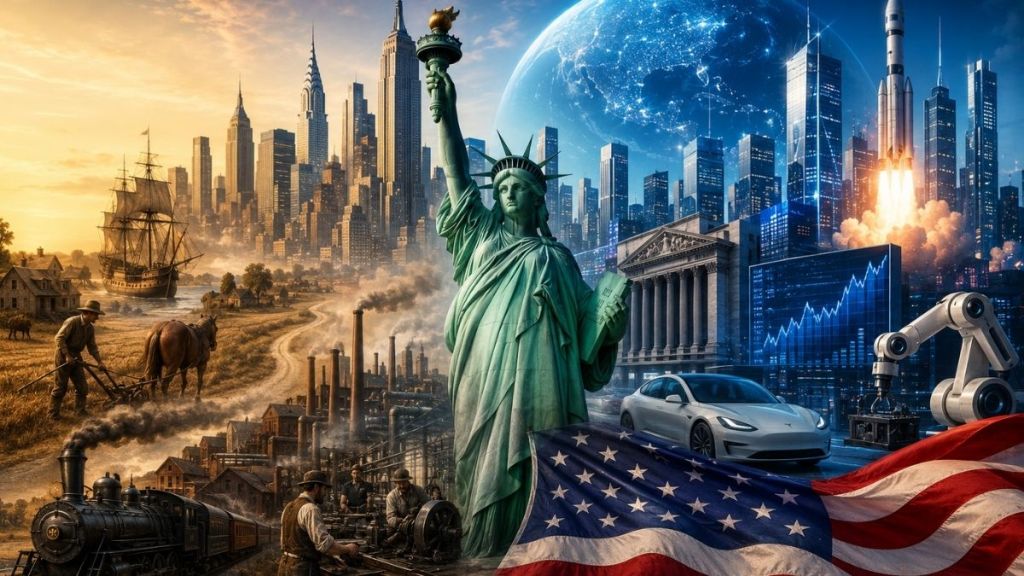

Few could have imagined that when representatives of 13 British colonies adopted the Declaration of Independence on July 4, 1776, the new nation would one day be the world’s largest economy. Most American families relied on farming. Britain was very important for trade and there was little manufacturing and it was underdeveloped.
Two and a half centuries later, the story is completely different. The US economy is now worth more than $30 trillion, according to the latest estimate by the International Monetary Fund (IMF). It represents roughly one quarter of the total economic output of the world. It hosts some of the largest companies in the world, deepest financial markets and most powerful technology companies.
It took centuries of growth, industrial development, scientific innovation, immigration and private enterprise for the United States of America to lead as the strongest economy of the world post World War II. The nation survived civil war, economic collapse, financial crises and two world wars to become the world’s leading economic and financial power.
The United States celebrates its 250th Independence Day today. Economists say the nation’s journey is one of the greatest economic transformations in modern history. The country now confronts new challenges, including rising public debt, slower population growth and stronger competition from China. Yet it is central to global trade, finance, investment and technology.
The White House has planned year-long celebrations for America’s 250th birthday. The administration says the celebrations will celebrate the country’s history, accomplishments and its influence around the world.
How did 13 colonies become world’s largest economy?
America’s economic story starts long before independence. Farming was the backbone of the economy during the colonial period. Virginia exported tobacco, the Carolinas rice and New England timber, fish and other goods to Britain and Europe. Ports like Boston, New York and Philadelphia became busy centres of trade which provided a base for future growth.
The new government after independence was concerned with establishing stability. The Constitution created a legal system to protect property and encourage business. The federal government put in place a national currency, improved the public finances and stimulated private investment. These measures helped restore confidence among businesses and investors.
A big turning point happened in 1803 when President Thomas Jefferson finalised the Louisiana purchase from France. The treaty nearly doubled the size of the country. It opened up large areas of fertile farmland for settlement, agriculture and commerce. Historians and economists regard it as one of the most valuable land deals in history, as it gave the young nation enormous room to expand.
As settlers pushed westward the country made a massive investment in roads, canals and later railways. These transport networks connected the farms with the growing towns and cities. Farmers had bigger markets and manufacturers had new customers all over the country. Better transportation lowered costs and helped create one of the world’s largest domestic markets.
During the 19th century, the American economy was altered by the Industrial Revolution. Many local companies were displaced by steel mills, machine workshops, and textile factories. Millions of workers relocated to growing industrial hubs from rural areas. The East Coast and the interior were connected by railroads, which made it possible for factories to swiftly move goods over great distances.
Another significant driver of economic expansion was immigration. In the late 19th and early 20th centuries, millions of immigrants came from Germany, Italy, Ireland, and other regions of Europe. They created enterprises, constructed railroads, provided labor for factories, and raised demand for housing, products, and services. Their efforts boosted the nation’s economy and sped up industrial growth.
The United States had surpassed Britain as the world’s largest industrial economy by the early 20th century. Mass production was one of the main causes. Henry Ford developed the moving assembly line for the production of automobiles in 1913. The approach made cars more affordable for regular families by lowering production costs. The similar strategy was later used by several sectors, boosting economic productivity.
Natural resources were plentiful in America as well. Industries received vital raw materials from vast quantities of coal, iron ore, oil, natural gas, and lush agriculture. The United States was less dependent on imported resources than many other nations. This encouraged long-term industrial growth and provided manufacturers with a significant advantage.
Following the 1929 stock market crash, the nation had its biggest economic setback during the Great Depression. Thousands of banks failed. Unemployment hit all-time highs as businesses shut down. In response, President Franklin D. Roosevelt implemented the New Deal, which included job initiatives, banking reforms, and public investment programs. These actions promoted economic recovery and contributed to the restoration of confidence.
Another significant turning point was the Second World War. Huge amounts of military vehicles, equipment, and supplies were manufactured in American factories. Millions of employment were produced during the war, and economic activity was revived. America’s factories were mostly unharmed at the conclusion of the war in 1945, while most of Europe’s industrial base had been severely damaged. The United States benefited greatly from this in the post-war international economy.
The Bretton Woods Agreement of 1944 substantially enhanced America’s standing. The World Bank and the International Monetary Fund were established by the agreement. Additionally, it made the US dollar the focal point of the global monetary system. The dollar quickly rose to prominence as the world’s primary reserve currency, providing the US unparalleled control over international trade and finance.
What keeps America ahead after 250 years?
Another wave of economic growth occurred in the decades following World War II. American businesses rose to prominence in manufacturing, consumer goods, banking, aircraft, and medicines. The nation made significant investments in infrastructure, scientific research, and higher education. While government assistance aided in the development of innovative technologies that eventually found commercial customers, universities generated highly qualified laborers and researchers.
In the latter half of the 20th century, the digital revolution changed the economy once more. Silicon Valley emerged as the global hub for technological innovation. Some of the most valuable companies in the world are Apple, Microsoft, Alphabet, Amazon, Nvidia, and Meta. Their goods and services transformed artificial intelligence, communication, business, and entertainment while bolstering American dominance in the world of technology.
Another important factor was the robustness of the US banking system. Wall Street grew to be the biggest financial marketplace in the world, drawing capital from all over the world. Nasdaq and the New York Stock Exchange assisted businesses in raising money for growth and innovation. The US dollar continued to be the favored currency for worldwide investment, central bank reserves, and international trade.
Long-term expansion was also aided by the American consumer market. With a population of over 340 million, the nation grew to become one of the biggest markets for goods and services worldwide. Businesses were encouraged to invest, increase production, and create jobs by high household spending. For many years, this cycle fueled economic expansion.
Innovation was still a significant benefit. Significant advances in computing, biotechnology, aircraft, healthcare, and clean energy were made by American businesses and academic institutions. Every year, thousands of new companies are born thanks to a culture that rewards entrepreneurship. Numerous startups eventually developed into multinational firms.
However, economists claim that there are threats to the nation’s future. The amount of public debt is at an all-time high. The rate of labor force expansion has decreased due to a slowdown in population growth. While supply chain disruptions and inflation have created new challenges in recent years, political divides have hindered policymaking.
The American economy is also facing a stiff competition from China, the second largest in the world. China’s economy has grown quickly in the areas of manufacturing, infrastructure, electric vehicles, renewable energy, and cutting-edge technology. Global trade, investment, and industrial policy are currently shaped by the rivalry between Beijing and Washington.
Due to its diverse industries, robust institutions, innovation environment, and worldwide financial influence, the US economy continues to be the largest in the world despite these obstacles. According to economists, these advantages continue to draw talent, capital, and companies from all over the world.