



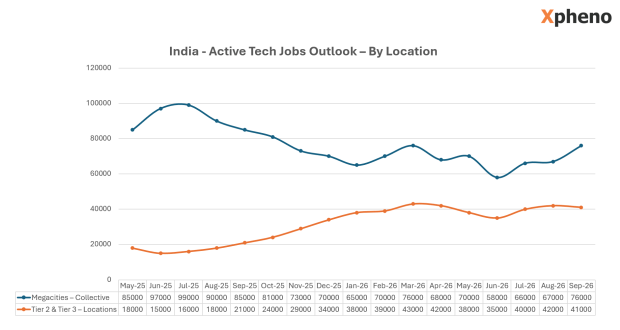
India’s tech hiring map is changing. Active tech job openings in Tier 2 and Tier 3 cities have jumped 95% year-on-year, even as demand in the country’s megacities has cooled.
The latest Active Tech Jobs Outlook – India, September 2026 report by specialist staffing firm Xpheno points to a major change in where companies are hiring tech talent. Smaller cities are gaining a bigger share of India’s tech jobs.
The change is real, even if the sharp percentage growth needs to be seen in context, according to Xpheno co-founder Kamal Karanth.
A sharp rise, but the trend is real
The 95% year-on-year increase is partly due to the low base last year. “The 95% YoY movement is a statistical surge due to the low base value of 21,000 jobs in the same period last year,” Karanth told exclusively to Financial Express (Digital).
Active tech demand in Tier 2 and Tier 3 cities stood at 21,000 openings in September 2025. A year later, the number climbed to 41,000. The low base, however, does not take away from the growth trend.
“Irrespective of the low base value, the overall trajectory of active demand from Tier-2 & Tier-3 has registered a visible and consistent upward trend over the year,” Karanth told Financial Express (Digital).
Xpheno’s data shows that demand in Tier 2 and Tier 3 cities has risen almost every month since May 2025, increasing from 18,000 openings to 41,000 in September 2026. At the same time, demand in megacities has fallen from a high of 99,000 openings in July 2025 to a low of 58,000 in June 2026. It recovered to 76,000 openings in September.
Smaller cities emerge as new tech hubs
The big change is being driven mainly by the IT Services and BPM cohort, followed by software products and e-commerce companies, according to Karanth.
Ahmedabad, Coimbatore, Kochi, Indore, Nagpur, Guwahati, Jaipur, Lucknow, Trivandrum and Chandigarh are leading the growth in tech hiring. Surat, Bhubaneswar, Faridabad, Madurai and Bhopal are also emerging as newer tech hiring destinations. Several of these cities are now developing their own talent specialisations.
“Coimbatore for engineering skills, Chandigarh for R&D & IT, Jaipur for BPM and process back-offices are almost becoming brands in the talent market,” Karanth told Financial Express (Digital).
Megacities continue to hold on to specialised and high-value roles such as product engineering, specialist leadership and client-facing commercial positions. Smaller cities, meanwhile, are attracting more volume-driven operations such as shared services and transaction processing, where companies can improve operating efficiency.

Why companies are looking beyond metros
Lower salaries are no longer the biggest reason companies are moving operations to smaller cities. “Talent cost arbitrages have significantly shrunk with the delta narrowing between megacities and tier-1/2 salary expectations,” added Karanth.
Talent retention has become a more important factor. Companies are finding it easier to build long-term teams in cities with lower employee attrition. Real estate and operating costs are also making Tier 2 and Tier 3 cities more attractive.
Cities such as Coimbatore, Indore, Ahmedabad and Kochi offer rental and operating costs that are around 30-40% lower. At the same time, commercial rents in Bengaluru and other megacities have risen by 15-20%.
State governments are adding to the appeal by offering incentives such as compensation paybacks, capital subsidies, duty waivers and power-tariff rebates. These benefits are helping smaller cities attract mid-sized Global Capability Centres, or GCCs.
“A sub-200 seater can significantly benefit through lower friction for talent clubbed with a potential 25-30% lower overall costs with the perks and incentives,” Karanth explained. Fresher hiring and training can also be cheaper and easier to manage from smaller cities as companies face increasing pressure on margins.
IT services hiring hits an 18-month high
The report also shows a strong recovery in India’s IT Services sector, historically the biggest employer in the country’s tech industry. Active demand in the IT Services cohort reached 57,000 openings in September 2026, the highest level in 18 months. Hiring was up 30% month-on-month and 33% year-on-year.
The cohort had last seen a much higher level of demand in February 2025, when active openings stood at 80,000. The recovery in IT Services has pushed the overall IT sector’s active demand to 117,000 openings, close to the 119,000 high recorded in March 2026.
“As the largest employer in the Indian IT Sector, the current recovery in the IT Services Cohort is definitely the sleeping giant waking up,” Karanth said. “A sustained momentum in the months ahead will be a welcome shift.”
Will the shift away from metros last?
The bigger question is whether companies will continue to expand tech hiring in smaller cities or eventually shift their focus back to the metros. Karanth believes the current trend may be temporary.
“The Tech sector’s talent demand patterns are among the most elastic and prone to swinging in short durations and high frequency,” he told Financial Express (Digital).
India’s tech hiring patterns have shifted several times since the pandemic, moving between megacities and Tier 2 and Tier 3 centres depending on business conditions and revenue pressures.
“We do believe the current surge is one such cyclical movement, and under current conditions, we expect the pattern to swing back towards the metros and megacities in a quarter or two,” Karanth told exclusively to Financial Express (Digital).
India’s tech job market shows signs of recovery
The September 2026 data also points to a recovery in India’s tech job market. Total active tech openings stood at 117,000, up 7% month-on-month and 15% year-on-year. The tech sector’s share of India’s total active job openings has crossed 50% for the first time this financial year.
Full-time roles account for 90,000 of the total openings, while mid-senior positions continue to dominate hiring with 64,000 active jobs. The strong growth in smaller cities and the recovery in IT Services suggest that India’s tech hiring market is gaining momentum again. The key question now is whether the rise of Tier 2 and Tier 3 cities will become a long-term shift or remain another cycle in India’s rapidly changing tech talent market.