



Long before it became synonymous with India’s corporate success, one of the nation’s largest corporate houses dabbled in mundane businesses like steel trading and betting on rejected military vehicles.
The 18 months surrounding India’s eventual independence in 1947 redefined everything. Its founding members were separated by political boundaries, and its business model pivoted from trading metal to assembling vehicles.
This is the story of how three founders built an industrial titan through 75 Jeep kits, complementary skills, and a refusal to waste a single sheet of stationery. Eventually one of the founders became Pakistan’s first Finance Minister, but the other two kept the dream alive right here in India.
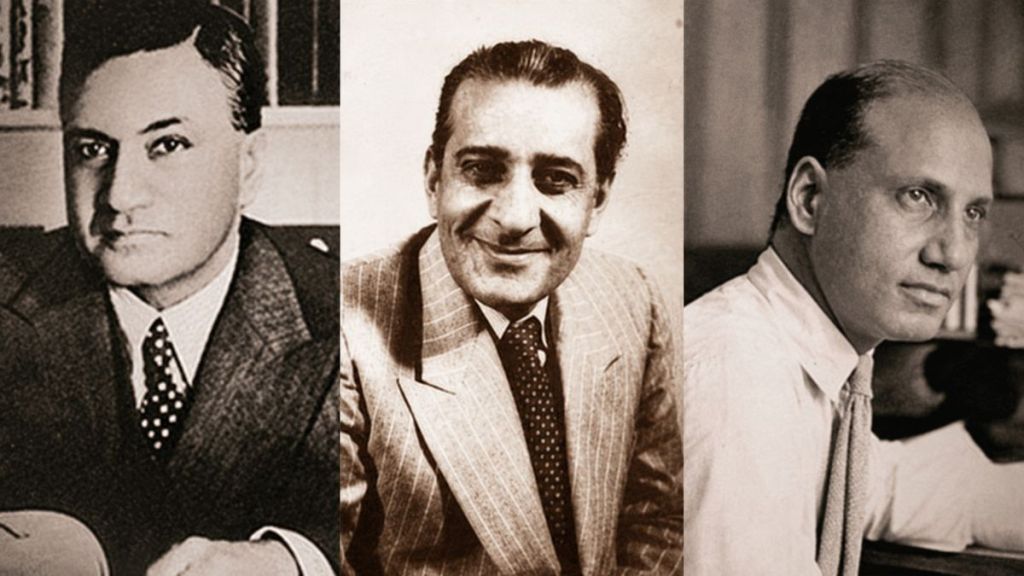
Three men who weren’t meant to be founders
Jagdish Chandra Mahindra was born in Ludhiana in 1892, the eldest of nine children. His father died young, and the responsibility of the family fell on him early. He studied at Bombay’s Victoria Jubilee Technological Institute, then joined Tata Iron and Steel, where he rose to the rank of a senior sales manager by 1929.
When the Second World War made steel a matter of national strategy, the British Indian government made J.C. Mahindra the country’s first steel controller. He was, in effect, put in charge of who got steel and who didn’t.
His younger brother Kailash Chandra Mahindra’s life journey took a different route. J.C. sent him to Cambridge for higher studies. He came home with not just degrees but international contacts that scripted his onward journey. He went on to chair the Indian Coal Fields Committee and the government’s Automobile and Tractor panel. His wartime supply work would matter more than anyone realised at the time.
The third person in consideration was Malik Ghulam Muhammad, born in Lahore in 1895 to a wealthy Pashtun family. He trained as a chartered accountant, worked at Tata Steel alongside J.C and went on to fix the finances of Hyderabad, India’s richest princely state of that time.
By the time these three decided on setting up an enterprise, none of them were either young or chasing a first idea. They were seasoned professionals in their prime. J.C. brought steel. K.C. brought contacts. Muhammad brought numbers. It was a partnership built on skills complementing each other, and one shared ambition.
Mahindra & Mohammed – A steel-trading firm with bigger plans
On October 2 1945, the three founded Mahindra & Mohammed in Ludhiana. On paper, it was a steel-trading business, importing metal from England and the United States.
Eleven days later, the company put out a full-page announcement in Commerce, a Bombay financial weekly. It called itself a cooperative effort to secure India’s industrial development. It took a swipe at the times, complaining that India was full of “plans, many plans,” and promised something more concrete.
This was the era of the Bombay Plan, the industrial blueprint pushed by J.R.D. Tata, G.D. Birla and Purshotamdas Thakurdas. Mahindra & Mohammed positioned itself as the practical, ground-level version of that vision.
There was a second message buried in the announcement, and it wasn’t subtle. The company called itself a “joint venture of Hindus and Muslims.” It promised that merit alone, not colour, creed or caste, would decide who rose within it.
Muhammad actually held only a small stake in the business. The Mahindra brothers still put his name next to theirs, so he would never feel like the junior partner.
Why a steel trader bet on Jeeps
Steel trading was never going to be enough. All three founders wanted an industrial business of real scale, and the war had just left one lying around.
Battlefields across the world were littered with military Jeeps. The founders looked at buying up the surplus vehicles and reselling them. When they inspected the stock, the vehicles simply weren’t good enough. So they changed the plan: instead of buying used Jeeps, they would assemble new ones in India.
K.C. Mahindra’s wartime supply contacts turned out to be exactly what the plan needed. The Jeep idea was already in motion well before anyone in Bombay believed Partition was truly coming.
Nobody expected a clean break
Through 1946, communal violence kept rising. Even so, much of Bombay’s business class assumed that whatever came next, India and a possible Pakistan would stay economically tied together. Shared markets. Shared institutions. Maybe even a shared currency.
Commerce magazine dismissed the idea that Pakistan could function as a separate economy, calling the question “highly academic.” Big industrial houses hedged anyway, quietly preparing for disruption even while publicly assuming continuity.
Then, on 3 June 1947, Lord Mountbatten announced that British India would be split into two Dominions. Commerce called it India’s “D-Day,” and asked whether it would bring deliverance or disaster.
In the middle of that uncertainty, Mahindra & Mohammed placed its first big order: 75 complete knock-down Jeep units from the Willys-Overland Export Corporation in the United States. Knock-down meant the vehicles would arrive in parts and be assembled in India. The order was signed almost at the exact moment the map was being redrawn.
Partition split the founders
Independence arrived on 14 and 15 August 1947 for the two newly separated countries.
Malik Ghulam Muhammad chose Pakistan. The very next day, he was named the country’s first Finance Minister. The three-man partnership that had built Mahindra & Mohammed was suddenly down to two.
The company, though, stayed exactly where it was: in India. And curiously, it didn’t rush to change its name. For more than five months after independence, it kept operating as Mahindra & Mohammed, as if working through what Partition actually meant for the business before deciding what to call itself.
How a printing bill saved M&M’s identity
The rename finally happened in January 1948. On 14 January, the company was legally registered as Mahindra & Mahindra under the Indian Companies Act of 1913.
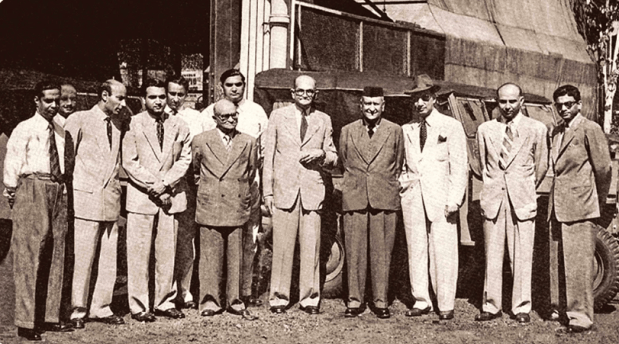
The reason had nothing to do with sentiment and everything to do with a printing bill. The company already had stacks of letterheads, invoices and stamps carrying the initials ‘M&M.’ Reprinting all of it would have cost money, a young company didn’t want to spend.
As it happened, there were still two Mahindra brothers running the show. Swapping “Mohammed” for “Mahindra” kept the initials identical. Every existing seal, stamp and sheet of stationery could carry on being used without a rupee wasted.
A name that had once symbolised a Hindu-Muslim partnership became, through a small act of frugality, the name of a company now run entirely by one family.
What happened to the founder who left
Muhammad’s departure went on to become another journey altogether. He had already joined Pakistan’s Ministry of Finance as Cabinet Secretary in 1946, before independence was even formal. As Finance Minister, he drafted the country’s first budget and, in 1948, its first Five-Year Plan, though the plan later collapsed for lack of institutional capacity.
Strangely, the political rupture didn’t erase the personal relationship. When Muhammad visited India for Republic Day in 1955, the first call he reportedly made was to Keshub Mahindra’s grandmother.
From dockside assembly to top-20 managing agency
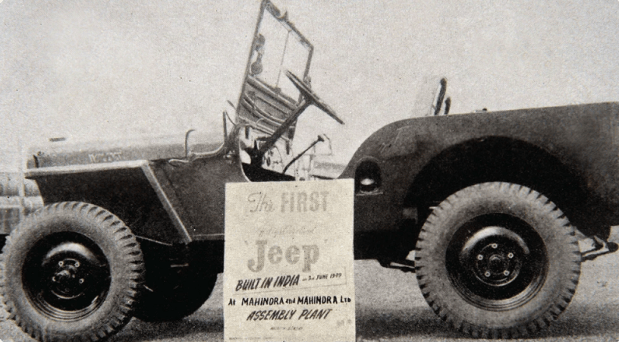
The 75 Jeep kits ordered back in October 1947 finally arrived in 1949. The first Willys Jeep, a CJ-2A, came off an assembly line the company had set up at Mazagaon, near the Bombay docks, on 3 June 1949.
A steel trader had just become a vehicle “manufacturer”. The CJ-3A and CJ-3B models followed, and the boxy, no-frills Jeep silhouette became the foundation of Mahindra’s identity as an automaker. Manufacturing spread across Worli, Ghatkopar and Kandivali as the company grew inside an economy that was tightening around it: import curbs, manufacturing licences, price controls.
J.C. Mahindra died in 1951, having lived just long enough to see the steel and industrial base he’d built take hold. He had personally sold family property to help fund the venture in the first place.
K.C. Mahindra builds an industrial company
After J.C.’s death, K.C. Mahindra carried the business through the 1950s and kept pushing it beyond Jeeps. He struck a joint venture with the French company Ugine Kuhlmann to form Mahindra Ugine Steel Company, and he began steering the group toward tractors, a bet that would pay off for decades.
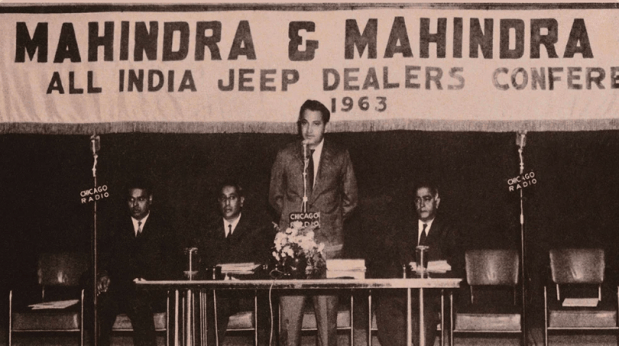
In 1955, M&M announced plans to list publicly, and the company debuted on the Bombay Stock Exchange in 1956. By 1958, barely thirteen years after it started as a small steel-trading outfit, M&M had climbed into the top 20 managing agencies in independent India.
Keshub Mahindra inherits the business
K.C. Mahindra died in 1963. His son, Keshub, took over as Chairman the same year, and stayed there for close to five decades.
Keshub hadn’t planned on a career at M&M at all. He joined in 1947 after graduating from Wharton, then took a job offer from a company in Brazil and fully intended to build his life abroad. His father asked him to come home first.
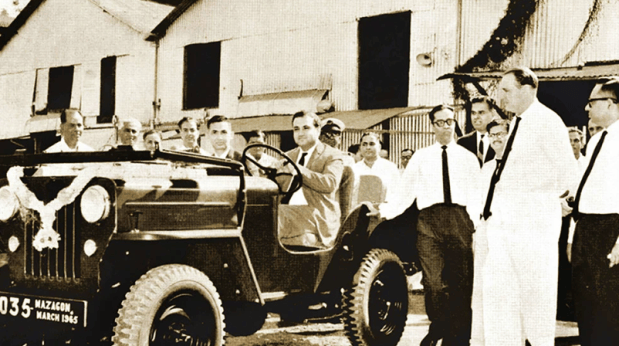
Keshub returned, meaning to leave again, but he never did. Seeing conditions on the ground in India changed something in him, and he became deeply committed to institution-building and philanthropy. His own phrase for it was simple: “Dream the impossible.”
Navigating the License Raj and expanding beyond Jeeps
His tenure ran straight through the Licence Raj, an era when the government could cap how many vehicles or tractors a company was allowed to make, regardless of demand, and layoffs were nearly impossible under existing labour law. Under those constraints, Keshub pushed M&M into IT, real estate, financial services and hospitality, and built partnerships with International Harvester, British Telecom, Ford and Mitsubishi.
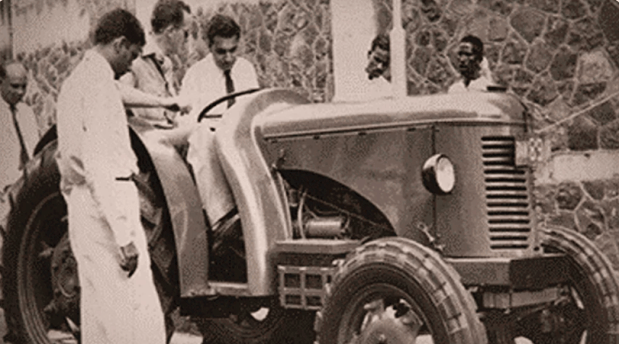
In 1961, M&M partnered with International Harvester to enter tractor manufacturing, and launched its first tractor, the Mahindra B-275, in 1963. It would go on to become one of the group’s most important businesses.
Anand Mahindra joins the family business
In 1981, J.C. Mahindra’s grandson, Anand Mahindra, joined the group as an Executive Assistant to the Finance Director at Mahindra Ugine Steel Company. A Harvard graduate and by some accounts a classmate of Bill Gates, Anand began pushing the group into real estate and hospitality even at that early stage.
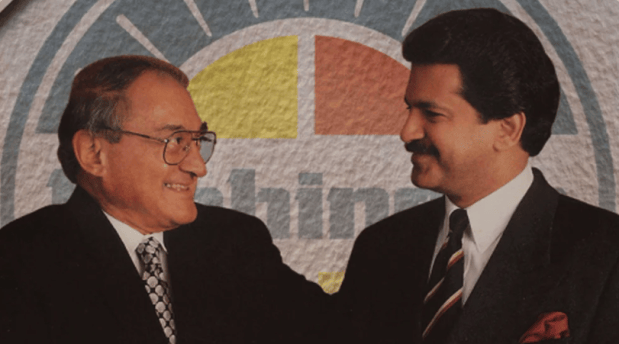
He rose to President, then Vice Chairman, continuing a leadership line that ran from J.C. to K.C. to Keshub to him.
From a Jeep assembly line to a global conglomerate
What began with 75 Jeep kits has since spread into automobiles, tractors, farm equipment, auto components, aerospace, defence, energy, construction and industrial equipment, logistics, IT, financial services, insurance, real estate, retail, hospitality, leisure and agribusiness.
Tech Mahindra grew into the group’s flagship IT arm, and Mahindra businesses now operate well beyond India’s borders. In 2020, Anand Mahindra received the Padma Bhushan, India’s third-highest civilian honour.
As of FY26, the consolidated revenue of the Mahindra Group was Rs 1.98 lakh crore. The profit after tax came out to be Rs 17,099 crore.
Among the listed entities of the group, the prominent players include marquee names like M&M, Tech Mahindra. The group currently has a presence across a host of industries including farm equipment, financial services, hospitality, logistics, real estate, renewable energy, among others. As of September 11, 2026, M&M has a market cap of Rs 3.86 lakh crore. Tech Mahindra commands a market cap of Rs 1.51 lakh crore.
None of it was inevitable. A steel trader could easily have stayed a steel trader. A partnership split by Partition could easily have collapsed with it. Instead, three men and their skills that complemented each other, a rejected pile of surplus war Jeeps and a company too frugal to reprint its own stationery combined to build one of India’s largest industrial groups, eight decades and four generations later.
Editorial Note: This profile is based on original reporting, including direct communication with Mahindra Group. To ensure a comprehensive perspective, FinancialExpress.com corroborated this information with public records and third-party sources. FinancialExpress.com retains full editorial independence and final authority over all editorial decisions.