


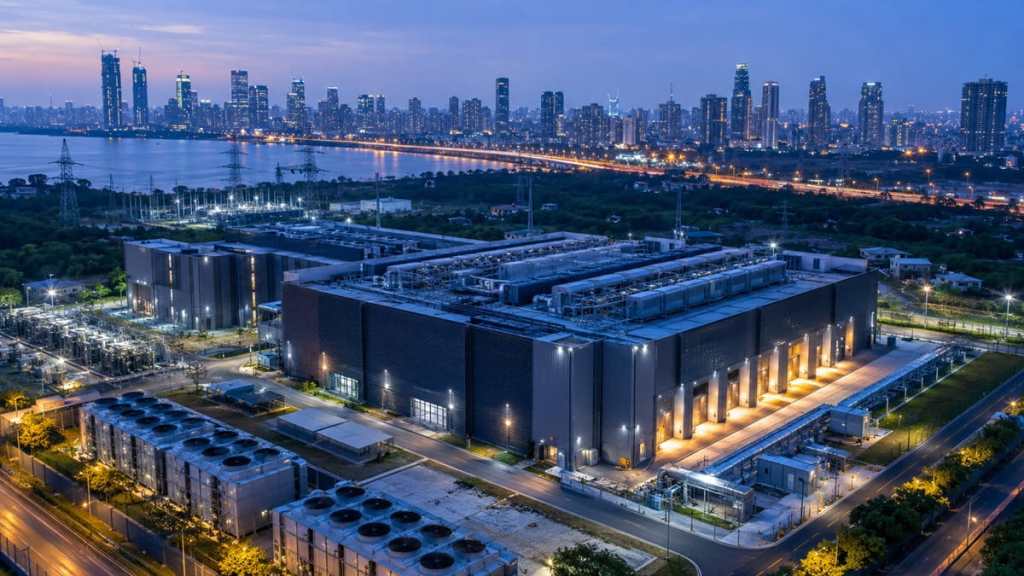

For Darshan Hiranandani, running the family’s sprawling real estate empire would have been the easy way out. But the chairman and co-founder of Yotta has an appetite for bigger things. Hiranandani is investing billions — $2-2.5 billion in the next few months alone — in physical data centres, cashing in on India’s talent, cost efficiencies and affordable blended power. His firm, he says, has adequate capacity in good locations that can scale up to 2 GW. And he is convinced the data centre play will soon dwarf the group’s other businesses.
Going by the crowd in India’s data centre space, it seems a sound bet. Demand from hyperscalers is surging, and the global tech giants are all here — Google, Amazon, Microsoft and Meta. The big foreign storage players, NTT Global Data Centers and STT GDC, have set up shop. The local conglomerates are in the game too: the Tata Group, the Adani Group, Bharti Airtel, Reliance Industries and Larsen & Toubro. India has an estimated 2 GW of operational capacity, projected to double to 4 GW by 2028, with investments tipped to top $250 billion over five years. Google has talked of $15 billion, Microsoft $50 billion, Reliance $10 billion and the Adani Group $100 billion.
The giants will dominate the landscape, no doubt. But several smaller companies are giving it a shot — and they believe they have an edge. As Sharad Agarwal, CEO of Sify Infinit Spaces, points out, local players know how to negotiate India’s infrastructure challenges. Even with hyperscalers committing their own capital, he argues, AI- and cloud-led growth will demand far more capacity than is being built. Sify, among the early movers, operates 14 data centres across six major cities with a built IT power capacity of 188 MW, and its revenues are running at an annualised Rs 5,000 crore. Armed with $371 million of debt financing from the International Finance Corporation, it plans to invest about $5 billion in the years ahead.
Investors, clearly, are keen to back the story. CtrlS Datacenters recently announced a $740-million investment partnership with CPP Investments, and counts local backers like Zerodha founder Nikhil Kamath. The company has commissioned capacity fairly fast — more than 370 MW is live, with much more at various stages of development. Founder and CEO Sridhar Pinnapureddy says large-scale projects depend on several critical enablers moving together, and that grid and timely power availability have become the defining constraints as AI deployments demand ever-higher power capacities. His firm, nevertheless, is sticking to its schedules.
Bharti Airtel’s Nxtra Data, which recently closed a $1-billion investment from a clutch of investors, is ramping up to serve enterprises, hyperscalers and the government. With close to 300 MW today, the aim is to scale to 1 GW in the next few years and target a market share of about 25%, says Gopal Vittal, executive vice-chairman, Airtel. Nxtra has also partnered Google to build a gigawatt-scale AI data centre campus, backed by a $15-billion investment.
The conglomerates are moving in force. Reliance is partnering Meta Platforms on a data centre in Gujarat — 168 MW to be delivered within two years, with an option to scale — and is a partner in Digital Connexion, a joint venture with Brookfield Asset Management and Digital Realty that is building over 140 MW of AI-ready capacity across Chennai and Mumbai in its initial phase.
The Tata Group proposes to partner OpenAI and AMD with scalable capacity of 100 MW to 1 GW, while TCS is putting up an AI data centre campus of up to 1 GW in Hyderabad to serve frontier AI companies and hyperscalers with high-density GPU deployments; HyperVault and its partners are expected to invest up to Rs 70,000 crore to build and manage the infrastructure. The Adani Group, for its part, plans to invest $100 billion in AI data centres by 2035.
With AI data centres guzzling power, some firms are turning green. Iron Mountain Data Centers is accessing 32 million kWh of clean power, supplying solar and wind energy to the grid for its Mumbai, Pune and Bengaluru facilities. By focusing on hybrid renewable sources across Maharashtra and Karnataka, says CEO Rajesh Tapadia, the company is securing stable, sustainable clean power.
Tomorrow: Electronics