


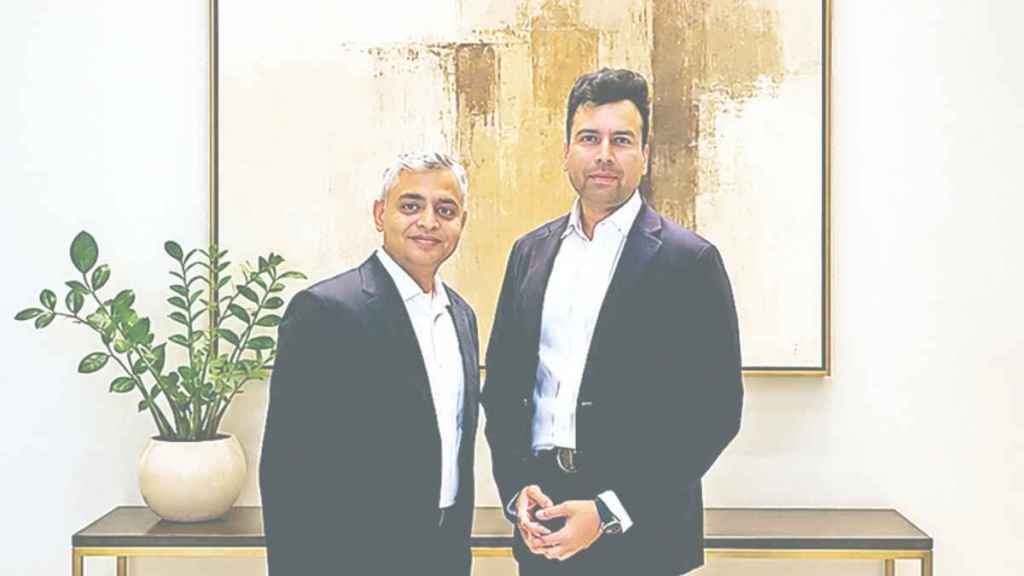

For Redcliffe Labs founders Aditya Kandoi and Dheeraj Jain, the idea began with experiences within their own families. Jain had lost his sister-in-law at a young age, while Kandoi lost his closest aunt to cancer as a child. Years later, when Jain asked Kandoi, “Why isn’t anyone doing anything about it?”, the question brought together experiences that both had carried for years.
Looking more closely at healthcare, they found a larger problem. Diagnostics accounted for only 3-5% of healthcare spending, but influenced nearly 70-80% of medical decisions. Preventive care was an even smaller part of the equation, accounting for less than 0.3% of healthcare spending.
That became the starting point for Redcliffe Labs in 2021. The question was straightforward: if diagnostics influence so many healthcare decisions, why should access to quality testing remain difficult, expensive and largely reactive? The answer they pursued was to build a diagnostics platform that could take testing beyond the metros and make it more accessible.
The company today operates more than 80 laboratories, has over 1,000 home collection experts and 2,000 collection centres, and covers more than 4,000 pin codes. It processes over 100,000 tests a day. But the business was built on experience that Kandoi had accumulated well before Redcliffe.
Kandoi grew up in a Marwari family where entrepreneurship was part of the culture. His father had built a successful CA practice, but around 1998, when Kandoi was 10, the business went through a series of setbacks. As a child, he helped with documents and balance sheets and accompanied his father to tax hearings. “I saw early on that behind every balance sheet were real people, real risks, and real consequences,” he recalls.
He initially planned to become a CA but eventually studied engineering at IIT (BHU), Varanasi, followed by an MBA in finance and strategy from MDI Gurgaon. He then worked with Deloitte, JP Morgan, American Express and Barclays, experiences that gave him exposure to finance, strategy and technology.
In 2015, he left the corporate world for healthcare entrepreneurship. His first two ventures failed. One was an online medicine-delivery business, while the other connected patients with hospitals for fertility, cancer and transplant care. The failures shaped his approach to the next venture. “If the unit economics don’t work, scaling only makes the bleeding worse,” he says. The second venture taught him that healthcare businesses also depend heavily on trust and the patient experience.
Jain brought a different but complementary experience. He had started Redcliffe Lifesciences in 2018 as a specialised diagnostics business focused on genomics, oncology, reproductive health and rare diseases. By 2020, Kandoi, his wife Preeti and Jain had begun shaping what would become Redcliffe Labs. “Redcliffe Labs’ journey actually started with Dheeraj,” Kandoi says.
The timing also mattered. Redcliffe was being built as the country was emerging from Covid, when consumer behaviour around diagnostics had changed sharply, particularly around home collection. The founders had already invested in building that capability. They started in Noida with one laboratory and a team of around 20 people. By June 2021, the team had grown to around 100.
The first institutional funding came in March 2021, with about $2 million from Alkemi Venture Partners, Y Combinator and LetsVenture, followed by a $10 million Series A. The company has since raised $110 million. In FY26, it reported revenue of Rs 500 crore, having grown at more than 40% CAGR over three years. It says it has served more than 10 million consumers in five years.
For Kandoi, the funding and growth were less about building a chain of laboratories and more about creating a system that could scale access. “The ambition was always much larger: to build a national diagnostics platform that could take quality testing beyond the metros,” he says.
That meant building the infrastructure around the laboratory rather than treating the laboratory as the business itself. Home collection, a wider collection-centre network, technology and geographic expansion became part of the model.
Five years on, the original question has translated into a substantially larger operation. Redcliffe’s bet was that diagnostics could move from being a largely reactive part of healthcare to a more accessible and scalable service. The test for the company now is whether that model can continue to expand while maintaining the quality, economics and trust on which the idea was built.