


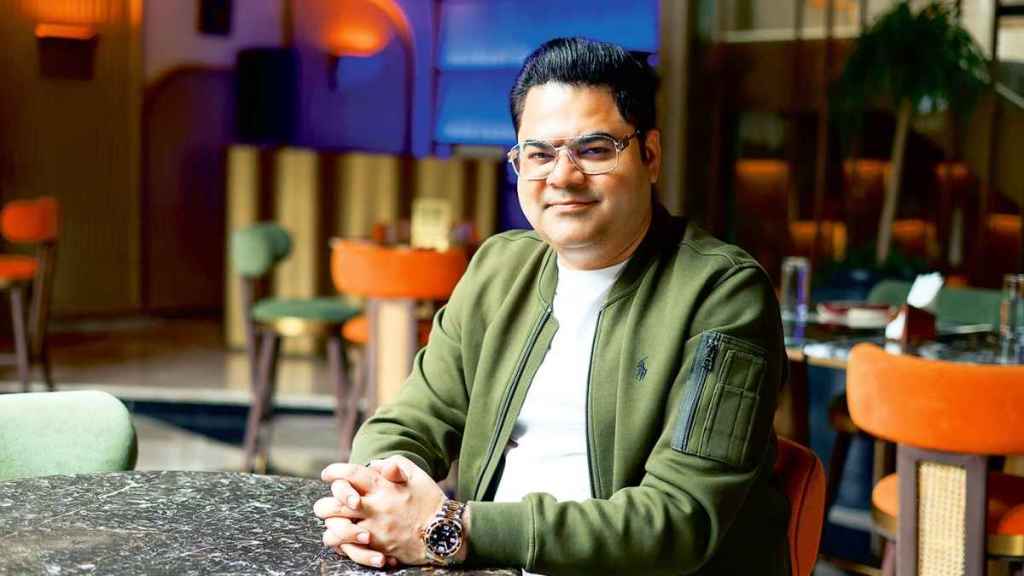

For nearly a decade, Deepak Sahni spent much of his time inside hospitals, running healthcare technology and medical travel businesses. As he watched thousands of patients pass through, one sentiment kept recurring. “I hope I never see this place again,” was how people seemed to feel, regardless of how good the care was. Around 2012-13, Sahni began looking at the problem differently. If people did not want to end up in hospitals, he wondered, what were they doing to avoid getting there?
The answer, he found, was not much. India had one of the youngest populations in the world, yet a large part of healthcare spending was going towards lifestyle-driven chronic diseases, many of which were preventable. The gap between what could be prevented and what people actually did to prevent it became the starting point for Healthians, founded in 2015.
Sahni, who grew up in Delhi, had already learnt the harder side of entrepreneurship. His family was in textile exports and hospitality, but a setback around 1999-2000 meant he had to start earning early. At 19, he began a business assembling and repairing computers. “For me it was never one winning idea; it was a habit of solving the problem in front of me,” he said.
Healthians initially operated largely as an aggregator, helping consumers detect health problems early. But Sahni soon realised that a diagnostic report by itself was unlikely to change behaviour. The company introduced a health-risk questionnaire and a health score to make the findings more personal and actionable. It then moved towards a full-stack model, combining home sample collection, accredited laboratories and doctor consultations.
The proposition was tested in corporate health camps. Screening a few hundred employees repeatedly threw up cases of dangerously high, undiagnosed diabetes among people who had no idea they were at risk. That established the need. The bigger problem, however, was getting people to test themselves in the first place.
Healthians found that consumers were wary not only of what a test might reveal but also of the motives of healthcare providers. The company therefore tried to position itself as a neutral diagnostic service rather than a hospital or clinic. “We found that if we positioned ourselves as neutral, not a hospital, not a clinic, with nothing to gain from your diagnosis, resistance dropped sharply,” Sahni said.
Trust also had to be built operationally. A customer could not independently verify whether a diagnostic result was accurate. Accreditation, laboratory standards and consistency therefore became central to the model. In effect, Healthians was trying to solve two problems at once: make testing convenient enough to happen at home and credible enough for consumers to act on the result.
The funding journey was less straightforward. Sahni says he was turned down 12 times before finding investors willing to back the direct-to-consumer model. In June 2015, Yuvraj Singh’s YouWeCan Ventures invested `1.10 crore along with other angel investors. “Yuvraj had personally faced a serious health battle, so when I explained why catching things early mattered, he didn’t need convincing,” Sahni said.
Healthians has since raised `940 crore and attracted investors including WestBridge Capital, BEENEXT, DG Daiwa Ventures, Tokio Marine, Trifecta Capital, Kotak Private Equity and Evolvence. The Gurugram-based company is now valued at more than `3,000 crore and operates across 250-plus cities with more than 22 laboratories. It has conducted over 100 million tests.
The business has also begun to demonstrate financial traction. Healthians reported revenue of `357 crore in FY26, up 35.7% from `263 crore in FY25. More significantly, FY26 was its
first profitable year, with a net profit of `5.4 crore compared with a net loss of `4.77 crore in FY25.
For Sahni, however, the early breakthrough came much before the scale or financials. It was when an ordinary family agreed to let Healthians into its home, hand over a sample and trust the report that came back. “Once that worked even a handful of times, we knew there was a company here,” he said. The hardest part, he believes, was never building laboratories or logistics. Those could be solved with capital and execution. The harder task was changing the way people viewed preventive testing. “The operational side was hard but solvable. Changing how people felt about testing was the real challenge.”
Sahni resigned from his executive positions at Healthians in January 2026 and continues to hold a minority stake. He is now the founder of UN:BLOC, while Nishant Singhal, who had earlier served as COO, is the company’s CEO.