


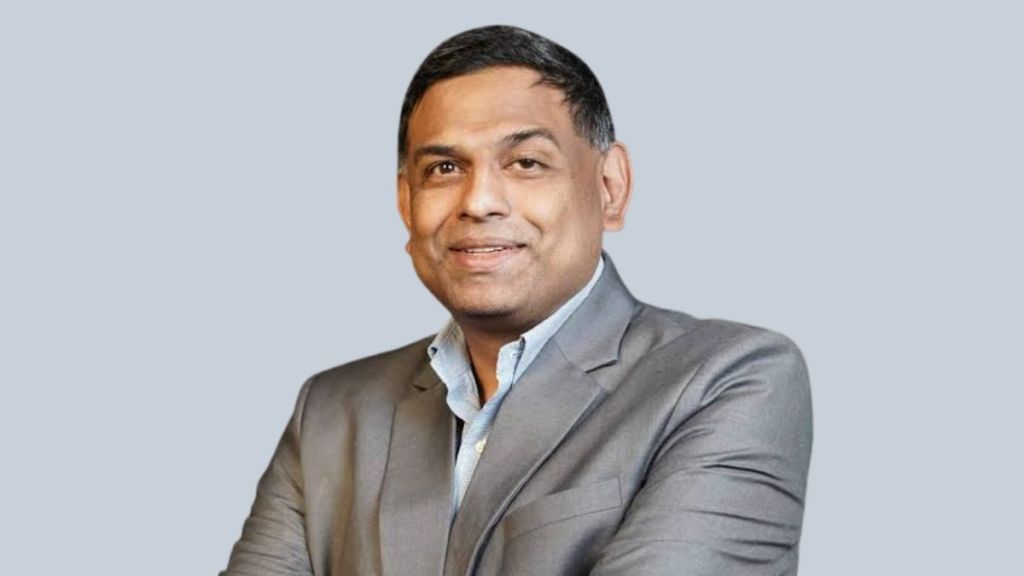

Sovereign AI in India has so far been argued as a question for the nation. Ganesh Gopalan, co-founder and CEO of Gnani AI, says it has moved to enterprises, who he says are wary that foreign frontier AI companies will train on their data and hand their “secret sauce” to competitors. In a conversation with Anees Hussain on the sidelines of the Global Fintech Fest in Mumbai on Friday, Gopalan talks about why enterprise AI’s shift from testing to returns makes cost matter more than model size, the 14-billion-parameter speech-to-speech model Gnani is building under the IndiaAI Mission, and plans for another external funding round. Excerpts:
Is the backlash against frontier AI growing among enterprises?
In B2B, there’s already so much backlash. Look at what Palantir’s Alex Karp or Palo Alto Networks’ Nikesh Arora are saying: the future is companies building their own models. That’s India’s biggest opportunity. We are model builders, and we’ll be model builders for every enterprise in the world.
But frontier AI models are moving towards data residency in India. Is there still a risk?
There’s always a risk. Data residency only decides where your data sits. The model is still theirs, and they can switch it off, as we saw with Anthropic’s Fable 5. The critical sectors are aware that their secret sauce is at risk. We have talked about sovereign AI for nations. Today, it’s about sovereign for enterprises.
Are you looking at raising more funding?
We just raised a Series B of $14.19 million, and we’ll be doing another large external round. We will use this for go-to-market globally. The IndiaAI Mission has helped us with compute, which is scarce as global AI companies chasing AGI are grabbing whatever they can find. It was a godsend. We wouldn’t have been able to build these models without it.
When will the 14-bn-parameter speech-to-speech model you committed to under the IndiaAI Mission launch?
A few months away. I won’t give an exact date, as I want to keep pressure on my product teams. Voice was always our focus, but speech-to-speech first needed a low-latency, low-cost LLM strong in Indic languages. That became Evon, our 30-billion-parameter text model. Now we are finding there is a huge market for it on its own.
Why make Evon open-weight?
With an open-weight model, companies can download it, run it on their own servers and fine-tune it on their own data, without even contacting us. Others are already building on it: someone has released a quantised version, and I met someone building a BFSI version. We will build our own verticalised versions too.
Will there be premium, closed versions?
Yes, alongside the open-source versions. We’ll also offer managed services for companies that need help with fine-tuning.
Competitors like Sarvam have built larger models. Why build a smaller one?
Indian players are our partners, not competitors. The fight is with foreign frontier models, and there, outcome matters more than size. On MILU, an Indic language benchmark, our 30-billion-parameter model beats Sarvam’s 105-billion-parameter model and many older global models. On accuracy relative to compute cost, we beat DeepSeek by 2.5x and some very large models by 40x to 50x.
Tasks such as coding aren’t our focus yet. We built Evon for what enterprises need: Indic language understanding, translation, safety, low latency, and reasoning on underwriting, payment reconciliation and claims. A smaller model retrained on a company’s own data will very often beat frontier. AI was once a shiny new object. Now enterprises want ROI.
Which markets outside India are you going after?
We are acquiring new customers in West Asia, Japan and the Philippines, where frontier models don’t have an entrenched position and are weak by a huge margin. We are also in the US, the largest market in the world, where we have some large installations. We won’t always be the cheapest in these markets. What will matter is accuracy relative to cost, and that’s where we win.