


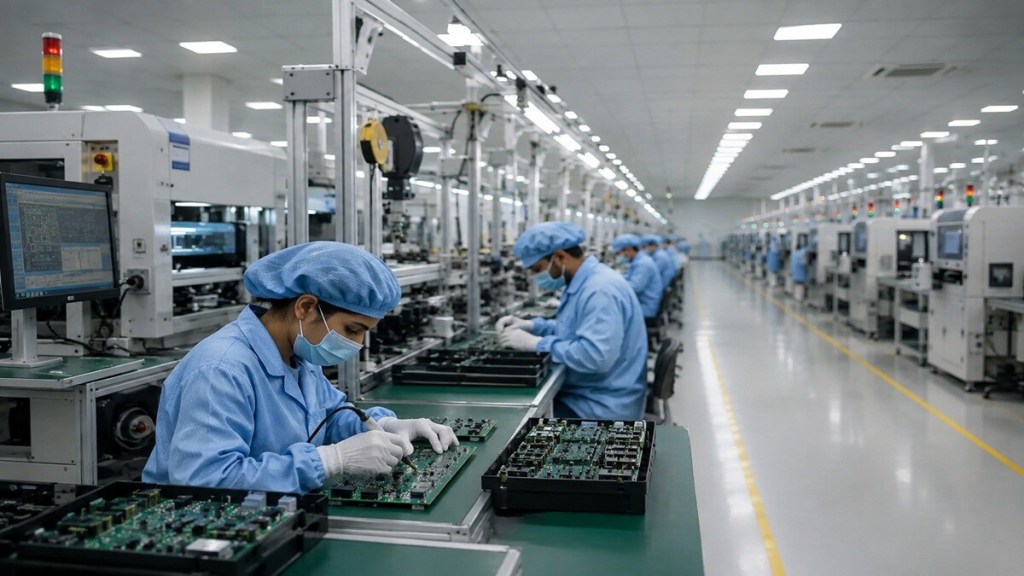

Companies participating in the government’s Production Linked Incentive (PLI) scheme for Large Scale Electronics Manufacturing (LSEM), which largely covered smartphone manufacturing, have received incentives worth nearly as much as their investments, highlighting the scale of the programme’s impact on India’s electronics industry.
Against cumulative investments of Rs 20,580 crore, companies under the scheme have received Rs 19,090 crore in incentives up to the end of June. The scheme, among the first PLI programmes notified on April 1, 2020, completed its tenure in March 2026 after a one-year extension granted to offset disruptions caused by the Covid-19 pandemic.
During the scheme’s tenure, participating companies recorded Rs 11.62 lakh crore in production and sales and generated 1.67 lakh direct and indirect jobs.
Electronics Sector Outpaces
The electronics sector has emerged as the largest contributor to output among the 14 PLI schemes. Companies selected under LSEM accounted for 48% of the combined Rs 23.79 lakh crore output generated by beneficiaries across the 14 sectors, despite accounting for only 7.9% of their total investment of Rs 2.58 lakh crore.
The sector also accounted for 51% of the total Rs 36,754 crore PLI incentives disbursed so far.
The programme has coincided with a sharp expansion in India’s smartphone exports. Shipments of smartphones from India rose to $29.36 billion in 2025-26, from $5.5 billion in 2021-22, when the scheme was beginning to gain traction.
The LSEM scheme covered mobile phones across categories, including high-value devices with an invoice value of ₹15,000 and above. It also provided support for electronic components, sub-assemblies and Assembly, Testing, Marking and Packaging (ATMP) units.
Government Shifts Strategy
With LSEM now completed, the government has shifted its focus from creating manufacturing scale to deepening domestic value addition and building a wider electronics supply chain through two new initiatives—the Mobile Phone Manufacturing Scheme (MPMS) and the expanded Electronics Component Manufacturing Scheme (ECMS).
The Rs 62,500-crore MPMS, announced in July 2026 for FY2026-27 to FY2030-31, seeks to move the mobile-phone industry beyond large-scale assembly towards greater value capture within India. It provides an additional 1.5% incentive for domestic sourcing of key components and sub-assemblies.
The scheme also specifically targets Indian mobile-phone brands. Eligible Indian brands can receive a 5% incentive, with an additional 3% incentive linked to product design and research and development.
The ECMS, with an outlay of Rs 40,000 crore, takes the policy further down the electronics value chain. Instead of primarily incentivising the assembly of finished products, it seeks to establish a domestic ecosystem for critical components and manufacturing inputs.
The scheme covers sub-assemblies, printed circuit boards and related materials, camera modules and capital equipment, among other components.
The policy transition marks a shift from building manufacturing capacity and export scale to increasing domestic value addition, developing component capabilities and retaining a larger share of the value generated by electronics manufacturing in India.