




The educational path behind some of the world’s billion-dollar companies has a distinctly Indian flavour.
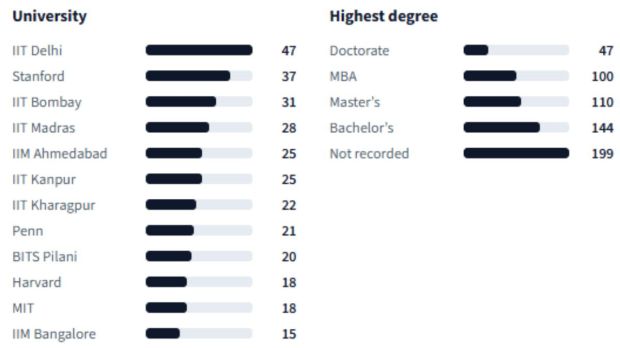
IIT Delhi has the highest representation in the education data from the Indian Diaspora Index, followed by Stanford University, IIT Bombay and IIT Madras.
The data, compiled by Prosus and Dealroom, covers the educational backgrounds of founders linked to the wider Indian diaspora startup ecosystem. It shows that India’s top engineering colleges continue to appear frequently in the stories of founders behind some of the world’s biggest startups.
The numbers also show that the typical founder in this group did not necessarily start a company straight out of college. Many had years of education and work experience before launching their businesses.
IIT Delhi is at the top
IIT Delhi has 47 founder records in the education data, the highest among the universities listed. Stanford University follows with 37, while IIT Bombay has 31 and IIT Madras has 28.
IIM Ahmedabad and IIT Kanpur each have 25 records. IIT Kharagpur follows with 22, while the University of Pennsylvania has 21.
BITS Pilani has 20 records. Harvard University and MIT have 18 each, while IIM Bangalore has 15.
Together, these 12 institutions account for 307 of the 600 founder education records, or just over half of the total.
The five IITs in this group, IIT Delhi, IIT Bombay, IIT Madras, IIT Kanpur and IIT Kharagpur, account for 153 records, or about one-fourth of all 600 records.
The data, however, should not be read as saying that every founder studied at an IIT. It is a record of universities represented among the founders, and some founders have studied at more than one institution.
The IIT connection goes beyond India
The IIT numbers become more interesting when looked at alongside the overseas companies in the index. The founders behind several of the biggest companies have IIT degrees before going on to study or work in the US.
Palo Alto Networks co-founder Rajiv Batra studied electrical engineering at IIT Kanpur before completing a master’s degree in computer science at the University of Wisconsin-Madison.
Zscaler founder Jay Chaudhry studied electronics engineering at IIT-BHU Varanasi before going to the University of Cincinnati for further education.
Rubrik offers perhaps the clearest example of how strong the IIT network is among Indian-origin founders. Its four co-founders came from four different IIT campuses.
Bipul Sinha studied at IIT Kharagpur. Arvind Jain went to IIT Delhi and later the University of Washington. Arvind Nithrakashyap studied at IIT Madras, while Soham Mazumdar attended IIT Kanpur.
The same IIT network can also be seen in the story of Nutanix.
Dheeraj Pandey and Ajeet Singh studied at IIT Kanpur, while their co-founder Mohit Aron went to IIT Delhi. The network did not end with Nutanix. Pandey later co-founded DevRev, while Aron went on to co-found Cohesity.
IIT Madras has also produced founders who went on to build major technology companies. Aravind Srinivas, co-founder and CEO of Perplexity, followed the B.Tech and M.Tech route in electrical engineering at IIT Madras.
He later completed a PhD in computer science at the University of California, Berkeley.
The data also has plenty of examples of founders who did not attend an IIT. The list includes founders who studied at BITS Pilani, NITs, IIMs and universities in India and abroad.
India’s home-grown unicorns show a similar pattern
The 101 India-based unicorns in the dataset include companies such as Flipkart, Zomato, Groww, Lenskart, Policybazaar, Swiggy and Razorpay. Their founders also show a strong presence of IIT and IIM graduates.
The difference is where these founders chose to build their companies. Many stayed in cities such as Bengaluru, Gurugram and Mumbai, instead of moving abroad.
Stanford stands out among US universities
The list also shows how closely the Indian and US education systems are connected in the backgrounds of these founders.
Stanford is second overall with 37 records. The University of Pennsylvania has 21, while Harvard and MIT have 18 each. Together, these four US universities account for 94 records among the top 12 institutions.
This aligns with a bigger picture from the Indian Diaspora Index.
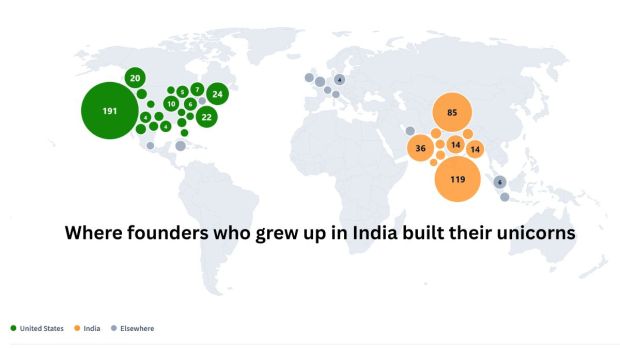
Prosus and Dealroom found 205 current and former unicorns outside India with at least one founder who grew up in India. Of these, 187 are based in the US.
Indian founders account for $560 billion in value abroad
The 205 overseas unicorns have a combined $560 billion in founder-share-attributed value, according to the index.
Of these companies, 70 were built entirely by founders who grew up in India. They account for around $243 billion in founder-share-attributed company value.
Another 135 companies have mixed founding teams, with at least one founder who grew up in India. This group includes companies such as Palo Alto Networks, Bloom Energy, Astera Labs and Perplexity.
Together, these companies account for another $317 billion, taking the total to around $560 billion.
Note: The figure mentioned is not the personal wealth of the founders. It is a calculation based on the value of the companies and the portion attributed to their founders under the methodology used by Prosus and Dealroom.
Technical education dominates
The education data also shows that most founders in the dataset came from technical or technology-related academic backgrounds.
There are 405 records for which information about the field of study was available. Of these, 238 were classified as technical.
Another 86 had both technology and business backgrounds. Business-only backgrounds accounted for 76 records, while five were listed under other fields.
That means technical education, either on its own or combined with business, makes up the clear majority of the records where a field of study is known.
The overseas companies linked to these founders include technology businesses such as Zscaler, Rubrik, Nutanix, Palo Alto Networks, Bloom Energy, Astera Labs and Perplexity.
A bachelor’s degree is the most common qualification
The data does not show that founders necessarily need multiple advanced degrees to build a billion-dollar company. Among the 401 records where the highest degree was available, 144 were bachelor’s degrees.
Master’s degrees accounted for 110 records, while 100 founders had an MBA as their highest recorded degree. Doctorates accounted for 47 records.
So bachelor’s degrees form the largest single category, accounting for about 36% of the records where degree information was available. Master’s degrees made up around 27%, MBAs about 25% and doctorates roughly 12%.
Many founders built their companies after 30
The age data offers another interesting detail. The index has estimated age-at-founding information for 383 records.
Only nine founders were estimated to have started their companies before the age of 22. Another 38 were between 22 and 24, while 68 were between 25 and 29.
The 30–34 age group had 65 records, while the 35–39 group had 68. But the biggest group was founders aged 40 and above, with 135 records.
In total, 268 of the 383 records were for founders aged 30 or above, which is about 70%.