


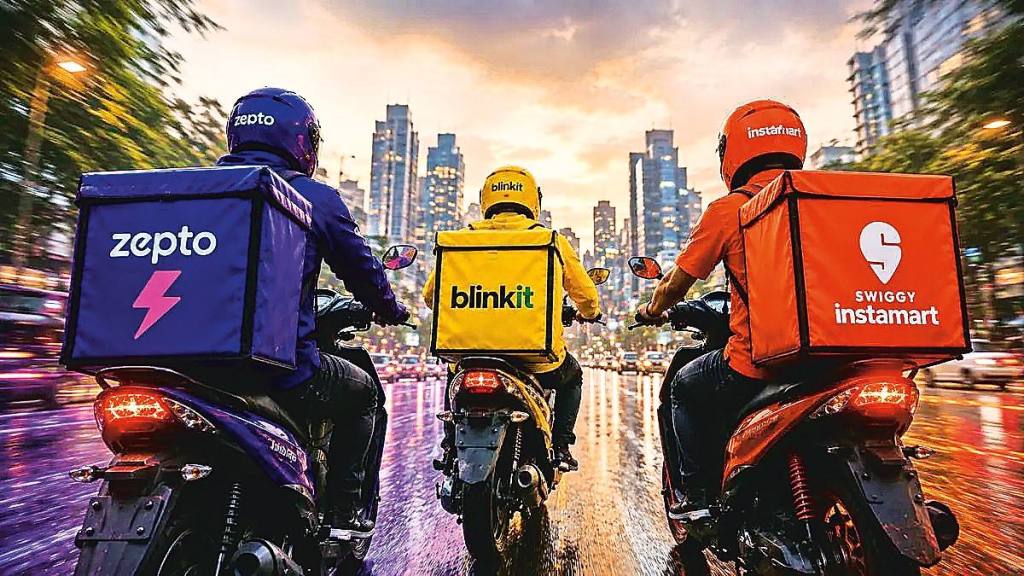

Quick commerce is shedding its middleman skin. Swiggy’s decision to move Instamart to an inventory-led model will change not just how the business reports revenue but how investors read its economics — bringing it a big step closer to a conventional retailer. For FMCG companies, this confirms what their sales data has been whispering for months: the 10-minute channel is now a mainstream, profitable route to the consumer.
The path cleared on August 18, when Swiggy shareholders approved a 49.5% cap on aggregate foreign ownership, the main hurdle to qualifying as an Indian-owned and controlled company. Swiggy says the transition to owning inventory could take two to four quarters; analysts expect it to begin in the third quarter, with margin gains visible over the following two. Rival Blinkit made the same move in September last year.
The accounting change alone is dramatic. A marketplace books only its commission — typically 20-35% — while an inventory-led business books the full value of goods sold. Analysts estimate Instamart’s reported revenue could rise four to five times without a single extra order. Instamart posted quick-commerce revenue of ₹1,232 crore in the June quarter of FY27 on a net order value of ₹5,817 crore. At Blinkit, the same transition helped drive parent Eternal’s consolidated FY26 revenue up 168.5% to ₹54,364 crore.
FMCG Sector Impact
For consumer goods makers, however, the shift is less about accounting and more about leverage. “Delivery and servicing costs tend to be higher with e-commerce marketplaces versus quick commerce. The move towards owning inventory will make q-commerce even more cost-efficient, prompting a bigger shift from e-commerce to quick commerce as dark store networks expand and assortments grow,” said Mohit Malhotra, global CEO, Dabur.
The numbers back him up. Dabur gets 10% of overall sales from online channels — with quick commerce, at 5-7%, already ahead of e-commerce’s 3-5% — and the q-comm business is growing 50% year-on-year against 20-30% for e-commerce. The CEO of a top FMCG company, who declined to be named, said quick-commerce margins run 200-300 basis points higher than on conventional e-commerce marketplaces, with historically lower servicing costs.
“Convenience is driving shopping choices, especially in the top 8-10 metro cities. Wider and relevant assortment along with convenience are the key priorities for consumers today. Quick commerce taps into this felt need,” said Tarun Arora, CEO, Zydus Wellness.
Inventory ownership sharpens that proposition further. Platforms gain direct control over assortment, pricing and availability, and capture sourcing and supply-chain efficiencies — control they can use to push premium, higher-margin products. Swiggy has said inventory ownership could add about 80 basis points to Instamart’s contribution margin, currently pegged by brokerages at ₹4-5 per order against the roughly ₹30 needed to break even.
Blinkit’s playbook shows the benefits compound. Its adjusted Ebitda loss narrowed through FY26 before turning positive, and gross margin improved 320 basis points in the September 2025 quarter as about 80% of order value moved to owned inventory — rising to 90% by December. Analysts now estimate Blinkit’s gross margin at 25-26%, versus 14-15% at Avenue Supermarts, with advertising income explaining part of the gap.
The relationship with brands is changing in the process. Quick-commerce platforms will increasingly resemble organised retail partners rather than digital marketplaces, with greater say over what is stocked, promoted and surfaced. The channel has also become a launchpad: Malhotra calls quick commerce a “cradle” for innovation at Dabur, which tests new concepts there before widening distribution. New products make up 3-4% of Dabur’s overall business but 10-12% on quick commerce, helped by targeted performance and social-media marketing instead of the heavier promotional spend that modern and general trade demand.
Retail Trade-Off
The retail model, however, imports retail risks. Eternal reported inventory losses in quick commerce for the first time in July, at 1.8% of net order value — covering expiry, shrinkage, damage, transit losses and pilferage, with perishables the biggest culprit. Instamart doesn’t disclose an equivalent figure. Capital intensity is rising too: Eternal has raised steady-state capex per dark store, including warehousing, to ₹2.5 crore from ₹1 crore, though higher order density and lower working capital have improved the economics.
For investors, that means a new dashboard. Return on capital, inventory turns and stock losses could matter as much as contribution margin and order growth, and expectations will build for retail-style disclosures — same-store sales for mature dark stores, private-label sales — as inventory risk rises.
For consumer companies, the verdict is already in. It shows in where they launch products, how they market them and where sales are growing fastest. Quick commerce, once dismissed as a convenience channel, is fast becoming a load-bearing wall of India’s retail architecture.