


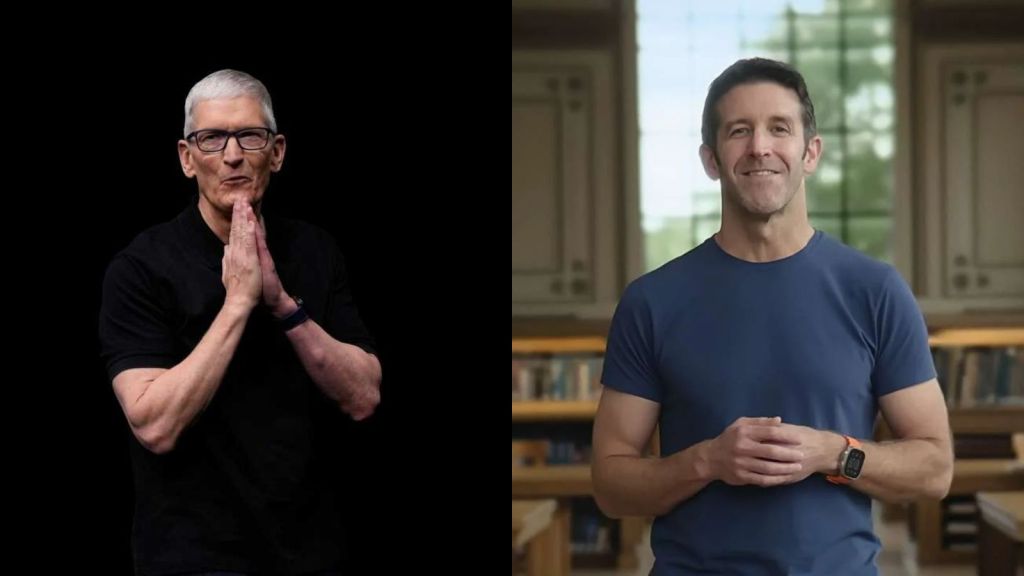

John Ternus is now the chief executive officer of Apple, taking charge of one of the world’s most powerful and closely tracked companies after spending almost his entire professional life helping build its products.
For 25 years, Ternus worked his way through Apple’s hardware organisation, rising from an engineer to the company’s senior vice president of Hardware Engineering. Along the way, he helped shape generations of the Mac, iPhone, iPad and Apple Watch and played an important role in introducing products including AirPods.
His appointment as CEO marks the beginning of a new chapter for Apple. Ternus succeeds Tim Cook, who led the company for 15 years and oversaw a period of extraordinary growth. Cook is now Apple’s executive chairman, remaining closely associated with the company as Ternus takes charge of its day-to-day future.
Ternus represents both continuity and change. He is a longtime Apple insider who worked under Steve Jobs and was mentored by Cook. His career has been shaped by the company’s culture of integrating hardware, software and design. At the same time, he has taken charge at a time when Apple faces challenges very different from those that defined much of Cook’s tenure.
Artificial intelligence is reshaping the technology industry. Competitors are racing to build new devices for the AI era. Apple is facing questions about the future of Siri, the pace of its AI strategy, and whether it can once again produce the kind of breakthrough products that changed the way people use technology.
An engineer who grew with Apple
Born on May 19, 1975, Ternus studied mechanical engineering at the University of Pennsylvania and graduated in 1997. He was also part of the university’s varsity swim team. After college, he worked briefly as a mechanical engineer at Virtual Research Systems, a virtual reality startup. His second job after graduation shaped the rest of his career.
Ternus joined Apple in 2001, when he was 26 years old. Apple was a very different company at the time. Steve Jobs was leading the business, the iPod was about to become a global phenomenon and the company was beginning the transformation that would eventually make it one of the most influential businesses in the world.
For Ternus, joining Apple was both exciting and intimidating. Years later, speaking to engineering graduates at the University of Pennsylvania, he recalled the uncertainty he felt when he first entered a workplace filled with highly accomplished engineers.
“I wasn’t sure I belonged there,” Ternus said during a 2024 commencement speech to engineering graduates at the University of Pennsylvania. “The people I met were so smart and so confident, and they knew so much more than me.”
The lesson he drew from that experience would become central to his approach to work and leadership. “Always assume you’re as smart as anyone else in the room, but never assume that you know as much as they do,” he said. “With this mindset, you’ll find the confidence you need to push forward, but more importantly, the humility to ask questions and learn.”
The combination of confidence and humility appears to have shaped Ternus’s rise at Apple. He did not become one of the company’s most senior executives by presenting himself as someone who had all the answers. Instead, he has spoken about learning from the people around him and being willing to ask for help.
“I’ll always be grateful that I wasn’t afraid to ask for help when I needed it,” Ternus said. “Because being around people that care that deeply, it won’t just make you want to stretch your limits and see how far you can go, but they’re also the best people to help you understand how to get there.”
Rising through Apple’s hardware ranks
Ternus began his Apple career on the company’s product design team and gradually took on larger responsibilities within its hardware organisation.
During his early years, he worked on products including the Cinema Display and G5-era iMacs. Over time, he moved into management and became increasingly involved in the engineering decisions behind Apple’s expanding product portfolio.
In 2013, he became vice president of Hardware Engineering. His responsibilities included work involving the iPad and Mac, and his influence continued to grow as Apple introduced new products and expanded existing categories.
Hardware engineering sits at the heart of Apple’s identity. While software has become increasingly important to the company, Apple’s business has long been built around controlling the experience of using its devices. Hardware, software, chips, materials and industrial design have to work together. Ternus’s role was to help make that happen.
Throughout his tenure, Apple says, Ternus oversaw hardware engineering work across a variety of groundbreaking products and was instrumental in introducing multiple new product lines, including iPad and AirPods. He also worked across many generations of the iPhone, Mac and Apple Watch.
In 2021, after two decades at Apple, Ternus joined the company’s executive team as senior vice president of Hardware Engineering, reporting directly to Cook.
From that point, his role became even more central to Apple’s product strategy. As the company’s top hardware executive, Ternus was responsible for an organisation whose work touched nearly every major Apple device.
The hardware leader behind Apple’s biggest products
Ternus’s work has covered the products that generate much of Apple’s revenue and define its relationship with consumers, the iPhone, Mac, iPad, Apple Watch and AirPods.
One of the biggest achievements associated with his leadership was Apple’s historic transition of the Mac from Intel processors to Apple-designed silicon.
The shift was one of the most important technical decisions in Apple’s recent history. For years, Macs relied on Intel chips. Apple’s decision to design its own processors gave it greater control over the performance, efficiency and integration of its computers.
The transition helped usher in a new generation of Macs that combined high performance with long battery life and quieter designs. It also demonstrated the advantages of Apple controlling more of its own core technology.
Ternus’s engineering teams played a major role in making that transition possible. This required Apple to rethink how hardware and silicon worked together and execute a complex shift across its entire Mac lineup.
The result helped make the Mac category more powerful and popular globally than at any point in its 40-year history, according to Apple.
More recently, Ternus unveiled the MacBook Neo, Apple’s most affordable MacBook. The device showed many of the themes that have defined his hardware approach that is integrating powerful custom silicon with carefully engineered materials and design.
The Mac’s transformation is particularly important to understanding Ternus’s career. It demonstrated Apple’s ability to make a fundamental change to one of its oldest product lines while maintaining the company’s focus on performance, design and the overall user experience.
From the iPhone to AirPods
Ternus’s influence has also been visible in Apple’s biggest product that is the iPhone. Under his leadership, Apple’s hardware division oversaw major developments across the iPhone lineup, including the redesigned iPhone 17 Pro and Pro Max and the radically thin iPhone Air.
The iPhone 17 Pro represented a major redesign after several years of relatively incremental changes. It was defined by a shift towards an engineered aluminium alloy with significantly improved thermal conductivity, alongside changes to its camera design.
The iPhone Air, meanwhile, demonstrated another important part of Apple’s engineering philosophy: achieving thinner designs without sacrificing durability and performance.
The challenge of building increasingly powerful devices while managing heat, battery life and durability has become more important as smartphones pack more processing power into smaller spaces. Ternus’s background as a mechanical engineer has made such problems central to his work.
His philosophy was clear when he spoke to CNBC in late 2023. “If we build the right products with the right components within them, right silicon and other technologies, people love them,” Ternus told CNBC.
AirPods have been another major success story during Ternus’s time at Apple. Something that began as a new category of wireless headphones has grown into one of the company’s biggest wearable businesses.
Under his leadership, Apple continued to develop AirPods with increasingly advanced active noise cancellation and new health-related features. The products have evolved beyond simple headphones and, in some models, can serve as part of a hearing health system, including over-the-counter hearing aid capabilities.
Apple has also credited Ternus with helping introduce new product categories that include the iPad and AirPods. The breadth of his experience is striking. His work has extended from computers and smartphones to watches, headphones and immersive headsets. Few Apple executives have spent as much time working across such a wide range of the company’s hardware.
Engineering for durability and sustainability
Ternus’s work has not been limited to making Apple products faster or thinner. He has also led much of the company’s focus on reliability and durability. Apple says he introduced new techniques that made its products more resilient and helped extend their lifespans.
This focus is important for a company whose products are used by hundreds of millions of people around the world. Durability is not just a design consideration. It affects how long a product lasts, how easily it can be repaired and its broader environmental impact.
Ternus has also driven innovation in materials and hardware design aimed at reducing Apple’s carbon footprint.
Over his career, he has seen Apple move through major changes in design, including the shift from products featuring clear plastic components to the aluminium designs that became a defining part of the company’s visual identity. Those changes helped him understand how engineering and design could evolve together.
Vision Pro and the challenge of finding the next big product
Not every product associated with Ternus’s rise has been a commercial success. The Apple Vision Pro demonstrated the enormous technical ambition of the company’s hardware teams. Ternus’s organisation was responsible for helping execute the complex integration of dual micro-OLED 4K displays, custom chips and spatial audio technology into a single wearable headset. The product showed what Apple’s engineers could build.
It also indicated one of the biggest challenges Ternus now faces as CEO that is technical excellence does not always guarantee commercial success. The Vision Pro has not become the major business Apple hoped it could be. At the same time, the technology industry is increasingly looking towards new devices designed for the AI era.
Competitors are pushing ahead in areas such as AI-enabled glasses and other new computing devices. Apple, despite its enormous strength in consumer hardware, is under pressure to show that it can once again define the future of personal technology rather than simply improve the devices it already dominates. This is perhaps the biggest difference between Ternus’s old role and his current one.
As head of Hardware Engineering, his responsibility was to help make great products. As CEO, he must also decide where Apple should place its biggest bets and what the company’s next major product opportunity could be.
The confidence of Tim Cook
Ternus’s appointment came after what Apple described as a thoughtful, long-term succession planning process. Cook, who joined Apple in 1998 and became CEO in 2011, stepped down after overseeing one of the most remarkable periods of growth in corporate history. Under his leadership, Apple expanded dramatically, growing its revenue, market value, services business and global footprint.
Cook’s confidence in his successor has been unmistakable. When announcing Ternus as Apple’s next CEO, Cook described him as someone with the technical knowledge, creativity and character needed to lead the company.
“John Ternus has the mind of an engineer, the soul of an innovator, and the heart to lead with integrity and with honor. He is a visionary whose contributions to Apple over 25 years are already too numerous to count, and he is without question the right person to lead Apple into the future. I could not be more confident in his abilities and his character, and I look forward to working closely with him on this transition and in my new role as executive chairman.”
Cook gave similar praise in his final message to Apple employees. “I take enormous comfort in handing the helm to someone as brilliant and wonderful and capable as John,” Cook said in an email. “Few people understand what it takes to build products that change the world the way John does and I could not be more excited for his leadership.”
For Ternus, Cook was more than just a predecessor. He was also a mentor. “I am profoundly grateful for this opportunity to carry Apple’s mission forward,” Ternus said. “Having spent almost my entire career at Apple, I have been lucky to have worked under Steve Jobs and to have had Tim Cook as my mentor. It has been a privilege to help shape the products and experiences that have changed so much of how we interact with the world and with one another.” His challenge now is to build his own leadership identity.
The engineer faces his biggest test
Ternus takes charge of Apple at a moment when the company remains extraordinarily strong while also facing some of its biggest questions.
Apple is one of the world’s most valuable companies. The iPhone remains a global success. Its services business has grown into a massive operation and its ecosystem reaches billions of active devices. The technology landscape, however, is changing rapidly.
Apple is under pressure to catch up in artificial intelligence and articulate a clearer strategy for a future increasingly shaped by generative AI. Its Siri assistant has faced criticism, while competitors including OpenAI, Google and Meta are pushing aggressively into new AI products and devices.
Ternus also faces immediate business challenges, including slowing growth, pressure on margins and concerns over rising component costs.
Perhaps most importantly, he must convince investors, employees and customers that Apple can continue to evolve under new leadership.
“What worked for Tim Cook is not going to be the same that works for John Ternus,” Kathy Gersch, CEO of Kotter, a consulting firm focused on leadership changes and transitions, told CNBC. “The company is in a new environment. It’s going to have to keep evolving and competing.” The observation captures the challenge facing Apple’s new CEO.
Cook’s greatest strength was turning Apple into an extraordinarily efficient and financially powerful global company. Ternus inherits that success, but he is taking charge in a period when Apple is being asked to demonstrate something different.
The company needs to show that it can compete in artificial intelligence. It needs to respond to the possibility that AI could change the devices people use every day. It also needs to answer questions about whether the company can still create products that surprise consumers in the way the iPhone, iPad and Apple Watch once did.
Ternus has spent his career solving engineering problems. His new role requires him to solve something much bigger: how Apple should navigate the next era of technology. “The care that you put into your work, it really matters,” he told CNBC. He has also spoken about the importance of accepting change rather than fearing it.
“Ongoing change is one of the great gifts of life, and learning how to learn and keep learning is one of the great gifts of your college education,” Ternus said.For the man who joined Apple as a 26-year-old engineer unsure whether he belonged among some of the smartest people in the room, becoming CEO represents the culmination of a remarkable 25-year journey.
His rise, however, is about more than technical expertise. Over a quarter of a century, Ternus learned how to work across teams, manage increasingly complex products and help turn ambitious engineering ideas into devices used by millions of people. Now, the engineer who helped build Apple’s products is responsible for leading the company itself. His next task may be the hardest one that is to help Apple build the future.