


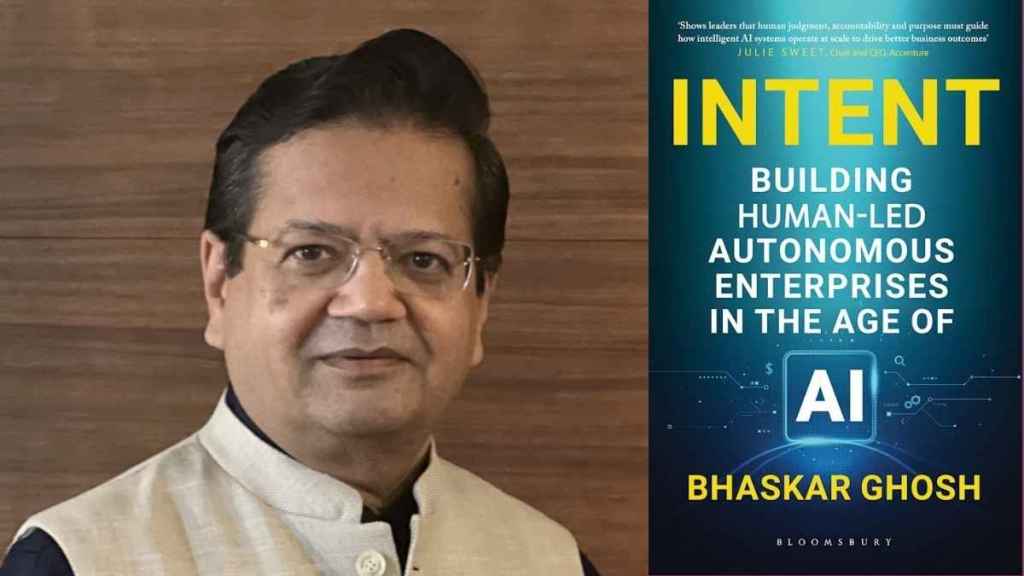

Artificial intelligence is forcing companies to rethink not just how work gets done, but also how businesses are structured, decisions are made and value is created. At a time of such rapid change, Bhaskar Ghosh, former chief strategy and innovation officer at Accenture, explores in his latest book, Intent, the transition from digital enterprises to human-led autonomous organisations. He tells Joydeep Ghosh that the economics of India’s IT industry will change fundamentally as it begins to shift from labour arbitrage towards the economics of intelligence including tokens, compute, proprietary knowledge and the ability to orchestrate AI systems. Excerpts:
You have argued in Intent that enterprises should be human-led and AI-executed. How will this change the role of the CEO?
The CEO’s role will increasingly shift from managing execution to setting intent being clear about the outcomes the organisation wants to achieve, the boundaries within which AI can operate, and who remains accountable. AI may increasingly figure out the how, but the CEO and leadership must continue to own the why, the what and, ultimately, the consequences. That is why I see the CEO increasingly becoming the chief architect of intent.
Agentic AI is moving from answering questions to taking action. This could put a fintech organisation in a difficult situation if AI makes a lending or investment decision. What guardrails can be put in place to avoid this?
As AI moves from recommending decisions to actually making and executing them, governance has to change too. I believe in risk-based autonomy: give AI the freedom to act, but within clearly defined boundaries. Low-risk decisions may be handled autonomously by AI. But as the financial, regulatory or human consequences increase, human oversight should increase too. Risk limits, explainability, bias checks, continuous monitoring and escalation mechanisms need to be built into the system from the beginning. My principle is simple: the greater the consequence, the greater the human oversight over AI-led decisions. Accountability must remain human.
Many companies have hundreds of AI pilots, but relatively few have produced material returns. Why is enterprise AI proving so difficult to scale, and what separates experimentation from genuine transformation?
The problem is quite simple. Most companies are putting AI into existing processes instead of rethinking the processes themselves. That may improve productivity, but it rarely changes the economics of the business. A pilot proves that AI works. Transformation happens when you redesign how work gets done and translate AI into measurable business outcomes — growth, better customer experience or structurally lower costs. That requires changes not only in technology, but also in processes, operating models, skills and accountability. The real opportunity is not to automate the old, but to reimagine the new.
The first wave of generative AI largely helped employees become more productive. Agentic AI could potentially eliminate entire workflows. Consequently, many organisations may be tempted to automate rather than retrain staff. How do you see the situation panning out?
There will undoubtedly be displacement. AI will eliminate some tasks and, in some cases, entire roles. But the strategic opportunity is larger than headcount reduction. It is to redesign work so that people, augmented by AI, can achieve substantially more.
Companies will need to reskill people to focus more on judgment, creativity, relationships and accountability, while AI takes on more of the execution. For me, the real measure of success is not simply how many people you can remove, but how much more each person can achieve.
What kinds of roles do you see becoming redundant, and which ones will gain relevance?
Roles dominated by repetitive, rules-based work and routine analysis will decline. But there is a more fundamental shift. AI will make generic knowledge increasingly abundant. That will make deep contextual knowledge more valuable, not less — knowledge of an industry, a customer, a regulatory environment or a complex organisation.
Judgment, creativity and accountability will also command a greater premium. Customer-facing and other human-intensive roles will remain important because context, trust, empathy and relationships matter.
And we will see new roles emerge around AI governance and the management of human-AI teams.
India’s IT industry has historically benefited from labour-cost arbitrage. In an agentic AI world, does that advantage diminish? What could replace it as India’s competitive advantage?
The economics of IT services will change fundamentally. For a growing share of the work delivered from India today, including coding and testing, the economics will begin to shift from labour arbitrage towards the economics of intelligence: tokens, compute, proprietary knowledge and the ability to orchestrate AI systems.
But that also creates a major opportunity. The world will need people who can build, engineer, govern and manage AI and agentic systems. If India can develop that talent at scale, its competitive advantage can shift from providing people at scale to providing AI capability at scale.
That, to me, is India’s next big opportunity.
You spent decades advising companies through previous technology transitions. What is genuinely different about AI compared with cloud, digital or earlier waves of automation?
Earlier technology waves — automation, digital and cloud — largely helped us execute instructions faster, cheaper and at greater scale. AI is different because it can reason, create, make decisions and increasingly act. That changes the enterprise from instruction-led to intent-led.
Humans can increasingly define the outcome, boundaries and accountability, while AI determines more of how the work gets done. And that is the bigger opportunity: not simply eliminating repetitive work, but augmenting human intellect and elevating creativity, judgment and decision-making.
Five years from now, what will distinguish a company that has genuinely become an intent-led enterprise from one that has simply bought a lot of AI?
Five years from now, most companies will have access to broadly similar AI technologies. The real difference will be how the enterprise operates. The companies that pull ahead will increasingly operate as human-led autonomous enterprises — continuously sensing, deciding, acting and learning. Humans will set the intent, boundaries and accountability, while AI executes and learns at scale. AI will no longer be just another technology layer. It will become part of the operating system of the enterprise.
The distinction will not be who has bought the most AI, but who has redesigned the enterprise to make human and artificial intelligence work together at scale.