


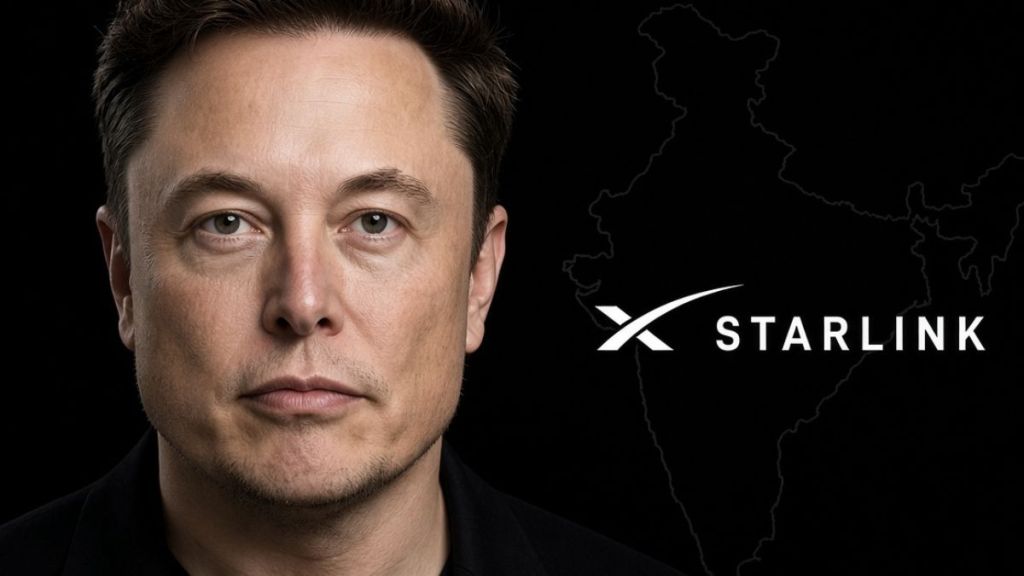

The Ministry of Communications has rejected claims that India is unfairly delaying or blocking Starlink’s plans to launch satellite internet services in the country. The ministry said India’s regulatory framework for satellite communication is fair and applies equally to all companies.
The clarification came after SpaceX CEO Elon Musk alleged that Starlink was being blocked by “certain oligarchs” who wanted to protect their monopoly in India.
Government says rules are same for all
In a statement issued by the Press Information Bureau, the Ministry of Communications said the government has created a “fair and non-discriminatory” system for authorising telecom services, including satellite communication.
The ministry said licences have been given to three Global Mobile Personal Communication by Satellite (GMPCS) service providers using non-geosynchronous satellite orbit-based systems. The government said this is part of its effort to allow satellite communication services in India.
However, getting a licence is not the final step before a company can start commercial services.
The ministry said all three licence holders must first show that they meet the required security conditions. These checks are meant to ensure the safety of users and their data.
“Security assessment as part of this process is currently under way in respect of all the three licensees. As and when this process is completed for a licensed entity, it may proceed to the next step of seeking assignment of spectrum,” the ministry said.
The government also said all three companies are currently at broadly the same stage of the regulatory process.
“At present, all the three entities are at broadly the same regulatory stage. As such, the suggestion that the framework or its application is unfair or discriminatory is baseless and misconceived,” the statement added.
Elon Musk alleges Starlink is being blocked
Musk had made the allegation while replying to a post on X about why India needs Starlink.
“Unfortunately, we (Starlink) are being blocked by certain oligarchs in order to maintain their monopolistic chokehold on the Indian people. You can guess who they are … This is a crime against the people of India,” Musk said.
The post he was replying to, from the X account DogeDesigner, argued that Starlink could provide another option for high-speed internet in underserved parts of India.
The post said 11,256 listed villages in India still did not have 4G coverage as of May 2026. It also said India had 1.093 billion internet subscriptions in March 2026, but only 440.87 million of them were in rural areas.
Rural internet subscription density stood at 48.31 per 100 people, compared with 126.80 in urban India, according to the post. It also pointed out that only 4.26% of India’s internet subscriptions were wired connections in March 2026.
The post said Starlink’s satellite network could help bring high-speed internet to remote villages and give underserved communities another way to access broadband.
Starlink says it has built India infrastructure
The comments from Musk came a day after Starlink’s Vice President of Business Operations Lauren Dreyer spoke at India Mobile Congress 2026.
Dreyer said Starlink had developed security controls specifically for India and had already built 20 gateway sites in the country. She also said the company was keeping Indian users’ data within India.
“We’ve built our Starlink operations specifically for India in recognition of Indian security requirements and other regulations, establishing controls at every layer for India, and keeping Indian user data within India,” Dreyer said.
She said Starlink had already invested in the infrastructure needed to serve the Indian market.
The Indian government has granted licences to three satellite communication companies, including Starlink, to provide services in the country.
Dreyer said Starlink had built ground infrastructure across India, including 20 gateway sites with hundreds of antennas, and had also established operations to prepare for the launch.
“We’ve already made the investment and built the existing ground infrastructure here, 20 gateway sites comprising hundreds of antennas, and we’ve established the operations to be ready to serve India,” she said.
“What India has achieved digitally is extraordinary,” Dreyer added.
KTR asks Musk to name the ‘oligarchs’
The issue also drew a response from Bharat Rashtra Samithi working president KT Rama Rao, popularly known as KTR. On Thursday, KTR asked Musk to reveal the identity of the “oligarchs” he accused of blocking Starlink’s launch in India.
In a post on X, KTR said, “Elon, Name and shame the oligarchs. The nation (India) wants to know who has got this stranglehold on our government.”
Meanwhile, Dreyer had also rejected reports in June that India had frozen Starlink’s approval process because of geopolitical and security concerns.
At the time, she said Starlink remained in active discussions with the Indian government over the launch of its commercial satellite internet services in India.