


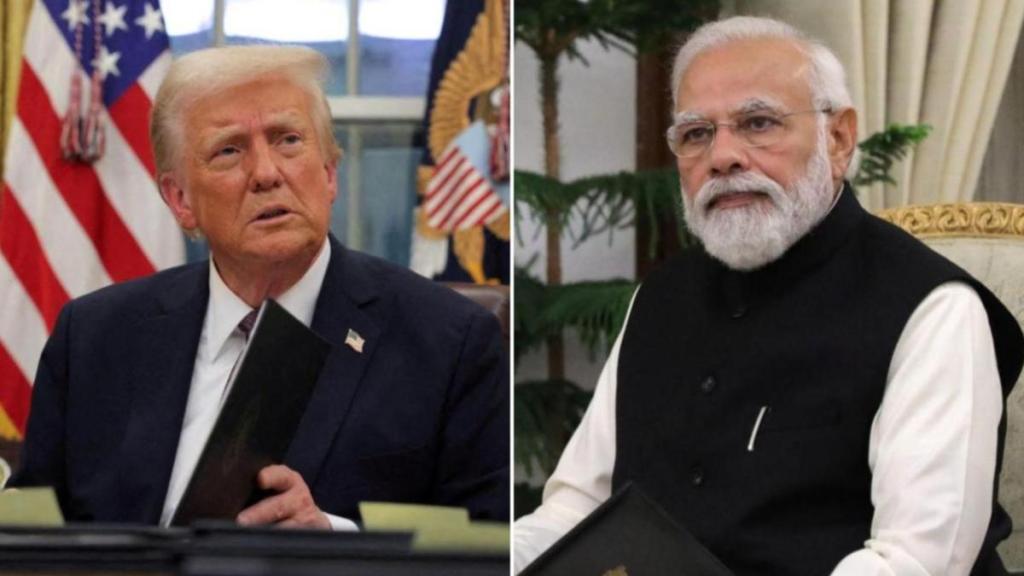

The Indian government has said its energy buying decisions will continue to be guided by market conditions and the need to keep energy affordable for its 1.4 billion people, as a US bill targeting Russia cleared the House of Representatives and gave President Donald Trump the power to impose tariffs of up to 100% on major buyers of Russian oil and gas.
The Ministry of External Affairs (MEA) said India has taken note of the passage of the legislation and is monitoring what happens next.
“The Government of India has noted the passage of the Sanctioning Russia and Iran Act in the US Congress. We are monitoring further developments on this matter,” the MEA said in a statement issued on September 17.
India says energy security remains priority
The government said India remains firmly committed to ensuring energy security for its 1.4 billion people. “As stated on several earlier occasions, India remains firmly committed to ensuring energy security for its 1.4 billion people,” the MEA said.
It added that India will continue to meet this requirement through diversified energy sourcing and by taking into account changing market conditions. “It will continue to do so through diversified sourcing and on the basis of evolving market dynamics,” the statement said.
India flags impact on ties, global energy market
The MEA said the issue has been discussed at senior levels between India and the US in recent months. “This issue has been discussed at high levels in recent months with various US interlocutors,” it said.
India has also clearly explained to its American counterparts the possible impact of the legislation, not just on the relationship between the two countries but also on the wider global energy market.
“Its potential implications for not just the bilateral relationship but also the international energy market have been very clearly articulated by the Indian side,” the MEA said.
India warns it will protect trade interests
The government also said it is prepared to take steps to protect India’s economic and trade interests in response to any impact from the new developments.
“The Indian side has also made clear its determination to take all necessary measures to protect its trade and economic interests,” the MEA said. It added that the government will work closely with Indian trade and industry bodies to deal with the possible impact of the legislation.
“Government will work closely with Indian trade and industry bodies to deal with the implications of these developments,” the statement said.
US House clears Russia sanctions bill
The US House of Representatives on Wednesday passed the Lindsey O. Graham Sanctioning Russia and Iran Act of 2026 by 262 votes to 159. The bill had already cleared the Senate last month by a much wider 86-11 vote. It now goes to Trump for his signature.
In the House, 203 Republicans, 58 Democrats and one Independent voted for the bill. Seven Republicans and 152 Democrats voted against it.
The legislation is named after Republican Senator Lindsey Graham of South Carolina, who died in July after spending more than a year building support for the measure.
The bill targets Russia’s leadership and energy sector and also goes after the network of tankers known as the “shadow fleet”, which Washington says helps Moscow get around existing sanctions.
The legislation also extends US sanctions on Iran by five years, a provision that was important in securing support for the wider package.
India could face tariffs of up to 100%
The biggest concern for India is a provision that gives Trump the power to impose tariffs of up to 100% on countries that continue to buy Russian oil and natural gas.
India and China are among the countries that could face the new tariffs. Other countries that could be affected include Turkiye, Azerbaijan, Hungary, the Slovak Republic, the UAE, Singapore, Kazakhstan and the Kyrgyz Republic.
The bill also allows tariffs of up to 100% on countries that were among the five biggest importers of Russian oil or natural gas during the relevant period. It also covers countries involved in helping Russia avoid oil sanctions.
However, the bill does not mean that India will automatically face a 100% tariff.
It gives the US president the legal authority to impose such tariffs. Trump would decide whether to use that power, when to use it, and what tariff rate to apply.
The legislation also has an exemption for countries that account for less than 15% of Russia’s natural gas exports and have taken “substantial steps” to reduce those purchases.
Why India is in focus
India and China have emerged as major buyers of Russian energy since the start of the Ukraine war. American lawmakers have repeatedly pointed to the two countries while discussing the bill.
After the Senate passed the legislation, Democratic Senator Richard Blumenthal said, “China and India, you better buy your oil and gas somewhere else.”
Senator Jeanne Shaheen also accused Russia of using its “shadow fleet” to sell oil below market prices, mainly to China and India.
“Russia is getting that oil and gas sold by using the shadow fleet, which means that it’s being bought at less than market rates, and it’s going mostly to countries like China and India,” Shaheen said.
She added that the US needed to “send a very strong message” to China and Russia.
The House vote comes just days before Chinese President Xi Jinping’s planned official visit to the US. It also comes at a time when India-US trade relations are already under pressure.
New tariffs would come on top of existing duties
Any tariff imposed under the new law would be separate from duties already imposed by the Trump administration. In August 2025, the US imposed an additional 25% tariff on Indian goods over New Delhi’s continued purchases of Russian crude. This came on top of an existing 25% reciprocal tariff, taking the combined tariff burden to around 50%.
The White House had described India’s Russian oil purchases as contributing to the “national emergency” linked to Russia’s war in Ukraine.
India had rejected the move, with the MEA calling the US tariff “unfair, unjustified and unreasonable” and saying New Delhi would take all necessary steps to protect its national interest.
India has continued to defend its purchase of Russian crude, suggesting the need for affordable and secure energy supplies.
New Delhi has also repeatedly said its energy sourcing decisions are based on global market conditions and the need to secure energy from different sources.