


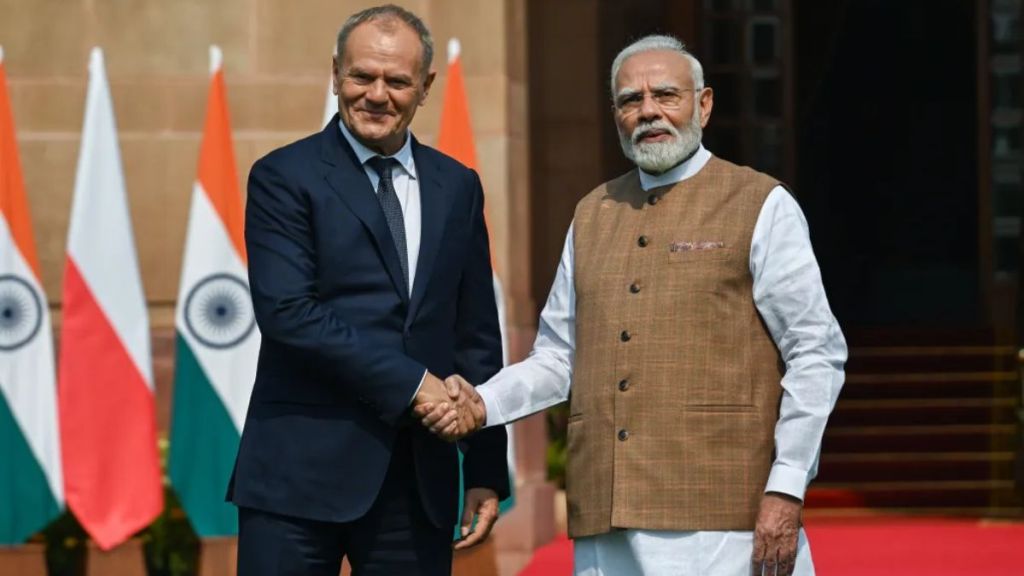

India and Poland have set a target to double bilateral trade by 2030. The two countries have agreed to explore cooperation in defence, artificial intelligence, semiconductors and critical minerals. The decisions were taken during talks between Prime Minister Narendra Modi and his Polish counterpart Donald Tusk on Thursday.
The two sides proposed a Defence Industry Dialogue to help companies work together. They also agreed to hold talks on counter-terrorism and explore more direct flights between the two countries. Tusk is on an official visit to India from October 21 to 23. He is accompanied by around 100 business leaders and industry representatives.
Key outcomes of the visit
Trade: India and Poland aim to double bilateral trade by 2030
Defence: Both countries plan to set up a Defence Industry Dialogue
Technology: They will explore joint research in artificial intelligence, semiconductors and quantum technology
Counter-terrorism: Both sides agreed to hold talks on tackling terrorism
Climate: Poland announced that it would join the Coalition for Disaster Resilient Infrastructure
Connectivity: The countries will explore more direct flights and greater cooperation in shipping and ports.
VIDEO | Delhi: MEA Secretary (West) Sibi George on India-Poland economic ties, says, "You know, we have noted the recent growth in Poland and the economic progress it has made. The Prime Minister of India has congratulated the Prime Minister of Poland for its becoming a $1 trillion economy recently. We appreciate it and it is also of interest to us that you are growing, India is growing. India is growing, the last recorded growth was 7.8% in the quarter, which is a significant growth in these challenging times. So, being two countries which are growing well, whose economy is doing very well, there is huge opportunity for us to work together and that is exactly what we plan to do. The fact that the Prime Minister is accompanied by a large business delegation shows the interest the business community has in building this relationship. And also, as you are aware, we have now finalised our India-EU FTA, which will be implemented very shortly and which would again give a framework for the businesses to come together, engage well and fully utilise this framework which is being put in place." (Full video available on PTI Videos – https://t.co/bIyFWTfmBd)
— Press Trust of India (@PTI_News) October 22, 2026
India, Poland eye stronger economic cooperation
MEA Secretary (West) Sibi George during a media briefing said India and Poland have significant opportunities to strengthen economic cooperation, citing the strong growth recorded by both economies. He noted that Prime Minister Narendra Modi had congratulated his Polish counterpart on Poland recently becoming a $1 trillion economy.
“We appreciate it and it is also of interest to us that you are growing, India is growing,” George said, focusing on India’s recorded growth of 7.8% in the quarter despite challenging global conditions.
Emphasising the potential for deeper engagement, he said, “being two countries which are growing well, whose economy is doing very well, there is huge opportunity for us to work together.”
George also pointed to the presence of a large business delegation accompanying the Indian Prime Minister as a sign of the business community’s interest in strengthening bilateral ties. He added that the finalisation of the India-EU Free Trade Agreement (FTA), expected to be implemented shortly, would provide a framework for businesses from both sides to expand engagement and fully utilise the opportunities it creates.
Trade and investment
India and Poland want to increase trade and investment over the next four years. PM Modi invited Polish companies to invest more in India. He focused on India’s large market, skilled workforce and growing manufacturing sector.
Tusk said Poland could help Indian companies expand into Central and Eastern Europe. He also welcomed investments by Indian businesses in Poland. The leaders encouraged companies to explore partnerships in several sectors. These include industrial machinery, defence, infrastructure, pharmaceuticals, mining, energy and information technology.
They also agreed to restart a joint working group on agriculture. The group will focus on increasing trade and cooperation in the sector. India and Poland called for the early signing and approval of the India-European Union Free Trade Agreement. They said its implementation could create new trade and investment opportunities.
Defence and technology
India and Poland plan to establish a Defence Industry Dialogue. The proposed platform will help companies from both countries identify business opportunities. The two sides will explore joint development and production of defence equipment. They will also look at technology partnerships.
The leaders agreed to maintain regular contact between their defence establishments. They also discussed cooperation in cybersecurity and new defence technologies. Both countries expressed hope that an agreement on the protection and exchange of classified information would be signed soon.
Technology is another area of focus. India and Poland agreed to explore joint research in artificial intelligence, semiconductors and quantum technology. They also want to strengthen ties between startups, companies and research institutions.
Critical minerals and connectivity
The two countries identified opportunities to work together in battery recycling and rare earth mineral refining. They will also explore cooperation in mining and critical minerals. A memorandum of understanding on geology, mining and critical minerals is under discussion.
India and Poland will also explore the possibility of increasing direct flights between the two countries. Their aviation authorities have been encouraged to hold talks on the issue.
Both sides want to strengthen cooperation in shipping, maritime security and ports. They also explained the importance of the India-Middle East-Europe Economic Corridor.
The corridor could improve transport links and help diversify supply chains. The leaders also agreed to develop scientific cooperation in polar affairs.
Poland backs India’s bid for UN reforms
India and Poland called for reforms at the United Nations. They said the UN Security Council should be expanded to include more permanent and non-permanent members.
Poland backed India’s bid for membership of a reformed Security Council. It also supported India’s candidature for a non-permanent seat for 2028-29.
The leaders expressed concern over the war in Ukraine. They called for a lasting peace that respects international law and the sovereignty of countries.
Both sides condemned terrorism, including cross-border terrorism. They also condemned the April 22, 2025, attack in Pahalgam, Jammu and Kashmir.
The leaders called for action against terrorist groups and their funding networks. They also agreed to hold a dialogue on counter-terrorism.
India invited Poland to join the Indo-Pacific Oceans Initiative. Both countries also supported a free and peaceful Indo-Pacific region.
Climate, education and cultural ties
India welcomed Poland’s decision to join the Coalition for Disaster Resilient Infrastructure. The initiative focuses on making infrastructure more resilient to natural disasters. India also invited Poland to join the International Solar Alliance and the Global Biofuels Alliance. Both countries agreed to explore greater cooperation in clean energy and climate-friendly technology.
In education, the leaders called for more partnerships between universities. They also encouraged student exchanges, faculty exchanges and joint research. The two countries discussed their historical ties. During the Second World War, India provided shelter to thousands of Polish women and children.
The leaders welcomed the Jam Saheb Memorial Youth Exchange Programme. They also recalled Poland’s assistance to more than 2,000 Indian students stranded in Ukraine during Operation Ganga. India and Poland further agreed to strengthen cooperation with Hungary, the Czech Republic and the Slovak Republic through the Visegrad Group and India format.