


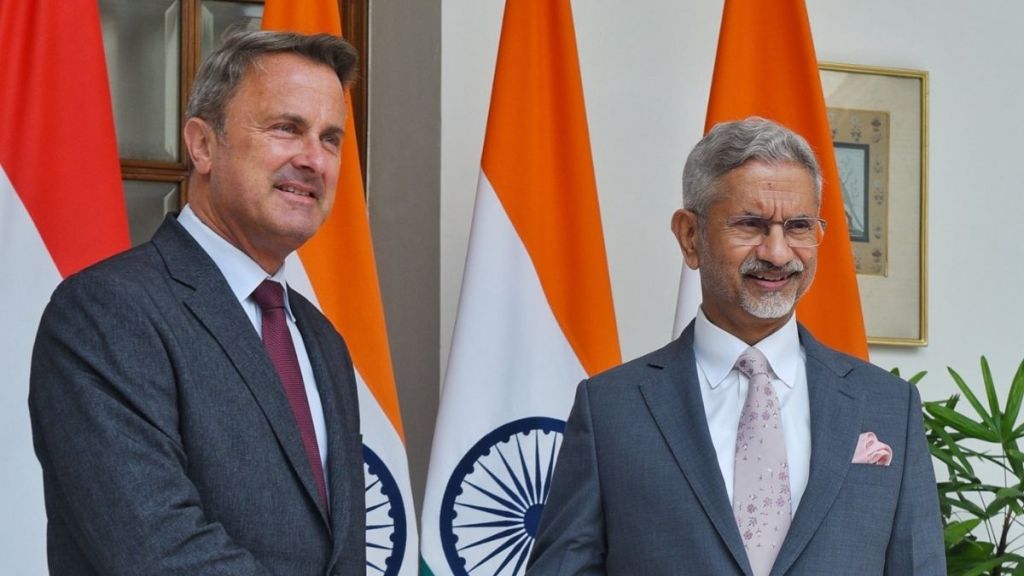

External Affairs Minister S Jaishankar on Monday thanked Luxembourg for its “very strong support” for the India-European Union Free Trade Agreement, saying the deal could open new opportunities for trade, investment and supply chains.
Jaishankar made the remarks during his meeting with Luxembourg’s Deputy Prime Minister and Foreign Minister Xavier Bettel in Delhi.
The India-EU FTA is not yet in force. India and the European Union concluded negotiations on January 27, 2026, but the European Commission says the agreement remains subject to legal revision and will become binding only after both sides complete their internal procedures.
So what will actually change once the deal takes effect? The biggest change will be tariff access.
The European Commission’s 2026 FTA factsheet says India will eliminate or reduce tariffs on 96.6% of EU goods exports, while the deal is expected to save European exporters up to €4 billion a year in duties and could potentially double EU goods exports to India.
Those are projections based on the concluded agreement, not savings or trade gains already recorded in 2026.
Which European products will get easier access to India?
Machinery is one of the major areas affected. EU exports of machinery and electrical equipment to India were worth €16.3 billion in 2024, according to the European Commission. Indian tariffs on some products in this category were as high as 44%.
Under the agreement, tariffs on almost all products in the category will eventually fall to zero, although the reductions will be phased in over periods of up to 10 years, with many taking five to seven years.
Aircraft and spacecraft are another major European export category. EU exports to India were worth €6.4 billion in 2024, while current tariffs can reach 11%. Tariffs will fall to zero for almost all products, with implementation spread over up to 10 years.
Medical and optical equipment will also get greater access. EU exports in the category were worth €3.4 billion in 2024, with tariffs currently reaching 27.5%. Under the agreement, tariffs will fall to zero for 90% of the products, either immediately or over five or seven years.
Chemicals and pharmaceuticals will see similar changes. EU chemical exports to India were worth €3.2 billion in 2024, with some tariffs reaching 22%. Pharmaceutical exports were worth €1.1 billion, with tariffs currently at 11%. Most tariffs in both categories will eventually fall to zero, with many reductions taking effect when the agreement enters into force.
The automobile sector is different. India currently imposes tariffs of up to 110% on motor vehicles. Under the FTA, the tariff will fall to 10%, but within a quota of 250,000 vehicles.
What happens to European food and drink?
Agriculture remains one of the more sensitive parts of the agreement. Average Indian tariffs on EU agri-food products exceed 36%, according to the European Commission. The FTA will reduce many of those duties, but India has retained protections for sensitive agricultural products.
Wine tariffs, currently as high as 150%, will fall to between 20% and 30%, depending on the category and price range. Spirits tariffs will fall from up to 150% to 40%, while beer tariffs will decline from as high as 110% to 50%.
Olive oil tariffs, currently up to 45%, will eventually fall to zero. Fruit juices, non-alcoholic beer and several processed food products will also receive tariff reductions over the agreed transition periods.
But India has not opened its entire agricultural market. Sensitive products remain protected, while imported food must continue to meet India’s applicable standards and regulations.
The FTA goes beyond physical goods. EU-India services trade reached €67 billion in 2024, according to the European Commission, with EU services exports worth €29 billion.
The agreement provides preferential access for EU services suppliers in areas including financial services and maritime transport. It also contains commitments covering senior management, boards of directors and local presence.
For European businesses, these provisions are intended to create a clearer framework for operating in India.
The agreement also includes chapters covering digital trade, intellectual property, competition and small and medium-sized enterprises, along with customs measures aimed at making trade more predictable.
What does FTA mean for India?
The benefit for India is the other side of the tariff equation: wider access to the European market.
The European Commission says the agreement covers a combined market of about two billion people and close to a quarter of global GDP.
EU-India goods trade reached €118 billion in 2025, with the EU accounting for 11.1% of India’s total goods trade. The EU also had €132.8 billion of FDI stock in India in 2024, while around 6,000 European companies were present in the Indian market.
That means the FTA is being built on an already substantial trade and investment relationship.
For European companies, the immediate attraction is lower or eliminated Indian tariffs across a wide range of products. For Indian exporters, the opportunity is improved access to European consumers and businesses.
But preferential tariffs will not automatically translate into higher trade. Companies still have to meet regulatory requirements and the agreement’s rules of origin to qualify for the concessions. A bi-lateral safeguard mechanism also allows temporary measures if a significant increase in preferential imports causes, or threatens to cause, serious injury to domestic industries.
Jaishankar said the agreement, along with its future ratification, is opening “new horizons” for trade, investment and financial cooperation. The tariff reductions, therefore, are future changes rather than benefits already available to exporters.
Once the agreement enters into force, the impact will differ by sector. Machinery, chemicals, pharmaceuticals and medical equipment will see substantial tariff reductions, while automobiles, agriculture and other sensitive areas will operate under specific quotas, safeguards or longer transition periods.