



India emerged as a key diesel supplier for Europe in August — accounting for 60% of the fuel transiting the strategic Bab-el-Mandeb route. The country is also a net importer of crude and purchased more than 88% of its oil supply in the past year. The seeming contradiction highlights the crucial role played by Indian refiners as they process massive volumes of imported crude into high-value fuel products for global markets. Data from Vortexa however suggests these industrial plants will soon be forced to slow down.
“The one part of the eastern route still working normally runs through Bab-el-Mandeb, where diesel/gasoil transits bound for Europe reached 200kbd in August. India supplied roughly 60% of that volume, which makes Europe’s eastern cover into September/October a question about Indian refining rather than about the strait itself,” the analytics firm wrote in a recent report.
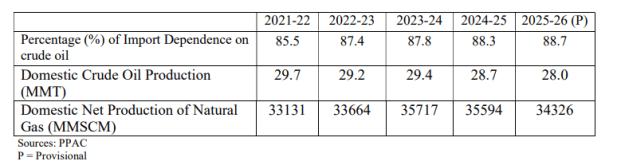
Data provided by the government revealed Indian dependence on imported crude oil had touched a record 88.7% in 2025-2026. The Oil Ministry told Rajya Sabha in July that domestic crude oil production had declined steadily over the past five years — citing a “natural decline in mature and ageing oil and gas fields”.
How then does the country consistently rank refined petroleum and petrochemical products among its biggest export products? Data released by the Commerce Ministry in August added that export of petroleum products had increased 67.64% from $ 4.13 billion in July 2025 to $6.92 billion in July 2026
Exports surge
India reported a sharp increase in exports (merchandise and services combined) between April 2026 and July 2027 — rising 13.16% year-on-year to $316.42 billion. Petroleum products led the list as the primary driver of merchandise exports. According to a PIB press note, the cumulative value of merchandise exports during this period was $173.78 billion.
“Major drivers of merchandise exports growth in July 2026 include petroleum products, electronic goods, engineering goods, organic and inorganic chemicals, and cotton yarn/fabs./made-ups, handloom products etc. Petroleum products exports increased by 67.64% from $4.13 billion in July 2025 to $ 6.92 billion in July 2026,” the release added.
India plugs Europe’s diesel gap
The Vortexa report gives another dimension to these numbers.
Russian diesel exports have been largely absent since July — with officials recently extending the ban till January 2027. The curbs were introduced to support the domestic fuel market after repeated Ukrainian drone attacks on oil refineries triggered fuel shortages and price spikes.
The West Asia conflict and Hormuz blockade has now crossed the six month mark while historically low US and ARA (Amsterdam-Rotterdam-Antwerp) gasoil inventories have forced Atlantic basin refiners into an aggressive operational stance.
Against this backdrop, the Bab-el-Mandeb route used by India to ferry diesel to Europe has remained largely unaffected.
Europe is also seeing its supply become increasingly precarious as US shares slip. Exports to the continent reportedly peaked near 540kbd in the first half of August before falling to 350kbd during the second half, a drop of 35% in just a few weeks. And while India holds a clear lead at present, experts predict a sharp drop as refineries run low on crude oil stocks.
“Europe’s next few months’ worth of diesel supply therefore depends on an array of unstable sources, while low inventories and an upcoming turnaround season just worsen the pressure,” the Vortexa analysis warned.
Diesel exports to fall?
According to the analytics platform, crude or condensate exports to India have “fallen for two consecutive months”. The figure dropped 3.8 mbd in August against 4.8 mbd a year ago.
“Refineries have kept running on crude bought earlier, so the export decrease has yet to reach their run rates, but a supply line contracting for the past two months leaves little room to hold diesel exports at the current pace through September and October,” analysis published by Vortexa said at the end of September.
Importing crude and exporting refined products
New Delhi has long been an importer of crude oil — emerging as a major exporter of refined petroleum products after economic liberalization in the 1990s. The system is currently driven by 23 world-class oil refineries that have a total processing capacity exceeding 258 million metric tonnes per annum.
“The current total refining capacity of the country is 258.1 million MMTPA which is projected to increase to 309.5 MMTPA by 2030. Alongside, the overall Petrochemical Intensity Index of the public sector oil refineries is anticipated to increase from 4.1 to approximately 9.3 upon completion of ongoing and planned refinery projects,” Union Minister Hardeep Singh Puri told Parliament in December 2025.
Geopolitical implications
The Indian system also gained additional scrutiny as multiple wars threatened global supply chains. Refiners in the country (as well as in the United States) have found themselves reaping a bonanza as widespread uncertainty drives prices higher and leaves importers scrambling for barrels at the height of summer driving season in the Northern Hemisphere. Both India and the US have ramped up exports to nations that previously relied on purchases from the Middle East and Russia — unhindered by attacks or shipping blockades.
It is pertinent to note that India has come under heavy criticism from the United States and Europe for its consistent purchase of Russian oil amid the war. The Donald Trump government has broached the possibility of 100% tariffs, while the European Union repeatedly criticised India for buying discounted Russian crude oil and reselling it to Europe as refined fuels such as diesel. Despite the criticism, Europe continues to remain reliant on refined fuel from India as it severely lacks domestic capacity to produce enough diesel.
“I buy oil based on cost and availability. So at that point of time, much of the oil available on the market was Russia because Europeans were essentially buying up the Middle East oil, which was our traditional supply. So circumstances pushed us in a certain direction…but since you spoke about moral ambiguity, I would say this, no European country has been attacked with Indian weapons. I wish I could say that for European weapons vis-a-vis India. So keep that in mind,” External Affairs Minister S Jaishankar retorted in July.
According to data from the International Energy Agency, global refining throughput fell to about 89 million barrels per day in July. Meanwhile IEA figures indicate the global oil demand is over 100 million bpd. Reports suggest India is also widely expected to be a key driver of global fuel demand for the foreseeable future — with consumption expected to rise through the next decade and likely keep more fuel within the country.