


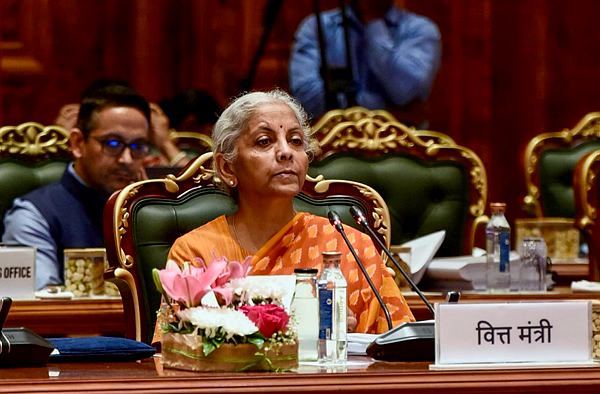

GST Council on Thursday scrapped arrest power of tax officers and raised the threshold for prosecution up from Rs 1 crore to Rs 5 crore, while leaving GST rates unchanged at its 57th meeting, Finance Minister Nirmala Sitharaman announced.
“The power of arrest is being removed from GST,” Sitharaman said at a press meet this evening.
The minimum punishment stands removed and the punishment- whether fine or imprisonment or both, is left to judicial discretion in every case, she added.
The Council also reduced the general penalty to Rs 10,000 from Rs 25,000, eased registration norms for small e-commerce sellers, and approved measures to expedite tax refunds and protect genuine buyers’ input tax credit (ITC) from being affected by supplier defaults.
Watch Live: Smt @nsitharaman addresses the media on the outcomes of 57th GST Council Meeting in New Delhi. @PIB_India @FinMinIndia @GST_Council https://t.co/7Tg1FsTefD
— Nirmala Sitharaman Office (@nsitharamanoffc) October 8, 2026
The Council also did not make any changes to GST rates, with the Finance Ministry stating that the existing rate structure was settled. The Council has decided to consider rate-related matters once a year at a meeting dedicated exclusively to such issues.
Here are key takeaways from the GST Council meeting:
Faster GST refunds approved
The Council reduced the time limit for acknowledgement of a refund claim from 15 days to 10. the claim is treated as acknowledged If neither an acknowledgement nor a deficiency memo is issued in ten days.
Under the new system, 90 percent of eligible claims will be sanctioned automatically following a risk assessment, with the order being issued within three working days of acknowledgement instead of the present seven.
Refund of an excess balance in the cash ledger becomes fully automatic, with no officer involvement at all.
Of all refund claims, 65 percent are on exports or on an inverted rate structure, and 55 percent of those are already rated low risk. A further 19 percent are balances lying in the cash ledger, which is money already with Government.
The claim form will carry its own details, with shipping particulars drawn from customs and payment particulars from the banking system.
Litigation
One common standard will govern how a notice is issued and served, how a pre notice intimation is given, when fraud may be alleged, how a hearing is conducted and how an order is written.
Below a monetary threshold of Rs.10,000, no notice will be issued at all.
Input Tax Credit related
Credit for the honest buyer
A Committee of Officers will be constituted to examine the issue of protecting a genuine buyer who holds a proper invoice, has received the goods and has paid his supplier in full.
The committee will complete its study within 3 months and an agenda will be placed before the next Council meeting.
Credit on ordinary business spending
Credit will now be available on health and life insurance taken for employees.
It will be available on telecommunication towers and on pipelines laid outside a factory, both of which are large items for those sectors.
It will be available on free samples, and on stock written off on expiry of shelf life where a law requires the goods to be destroyed.
No double taxation
A service bought and sold again in the same line of business will carry tax once rather than twice. Hotel accommodation up to Rs 7,500 a night booked through an agent, restaurant and catering services and passenger transport are the common instances.
Credit was denied on these because the rate is 5 percent without credit. The chain will now run through.
Ease of Living and Doing Business
Closing a business
Closure will be automated in stages, beginning with the smaller taxpayers. Around 90 percent of taxpayers seeking cancellation have never passed on credit above Rs 2.5 lakh in any month, so the revenue risk is low.
The final return will form part of the closure application instead of being a separate step afterwards.
Where the system has suspended or cancelled a registration for a missing return or missing bank details, it will restore the registration once the taxpayer makes that good.
Filing for the smallest taxpayers
An optional scheme has been approved in principle under which a taxpayer with turnover up to Rs 5 crore who supplies only to consumers files a return once a year and pays tax quarterly.
On average 16.85 lakh taxpayers out of 1.05 crore active tax payers, report only such supplies. Of them 16.66 lakh, or 99 percent, are below Rs 5 crore, and together they account for less than 1 percent of the tax liability reported under GST.
The detailed framework and the amendments needed will come to the Council at its next meeting.
The reforms announced on Thursday would be implemented from April 1, 2027, the beginning of the next financial year, the minister said.
Input Tax Credit related
Credit for the honest buyer
A Committee of Officers will be constituted to examine the issue of protecting a genuine buyer who holds a proper invoice, has received the goods and has paid his supplier in full.
The committee will complete its study within 3 months and an agenda will be placed before the next Council meeting.
Credit on ordinary business spending
Credit will now be available on health and life insurance taken for employees.
It will be available on telecommunication towers and on pipelines laid outside a factory, both of which are large items for those sectors.
It will be available on free samples, and on stock written off on expiry of shelf life where a law requires the goods to be destroyed.
No double taxation
A service bought and sold again in the same line of business will carry tax once rather than twice. Hotel accommodation up to Rs 7,500 a night booked through an agent, restaurant and catering services and passenger transport are the common instances.
Credit was denied on these because the rate is 5 percent without credit. The chain will now run through.
Ease of Living and Doing Business
Closing a business
Closure will be automated in stages, beginning with the smaller taxpayers. Around 90 percent of taxpayers seeking cancellation have never passed on credit above Rs 2.5 lakh in any month, so the revenue risk is low.
The final return will form part of the closure application instead of being a separate step afterwards.
Where the system has suspended or cancelled a registration for a missing return or missing bank details, it will restore the registration once the taxpayer makes that good.
Filing for the smallest taxpayers
An optional scheme has been approved in principle under which a taxpayer with turnover up to Rs 5 crore who supplies only to consumers files a return once a year and pays tax quarterly.
On average 16.85 lakh taxpayers out of 1.05 crore active tax payers, report only such supplies. Of them 16.66 lakh, or 99 percent, are below Rs 5 crore, and together they account for less than 1 percent of the tax liability reported under GST.
The detailed framework and the amendments needed will come to the Council at its next meeting.
The meeting, chaired by Finance Minister Nirmala Sitharaman and comprising state ministers, was rescheduled from Wednesday due to unavoidable circumstances, according to an office memorandum issued by the GST Council Secretariat.
In its last meeting, held a little over a year’s time, the Council approved a complete overhaul of the tax rates and slabs under Goods and Services Tax (GST).