


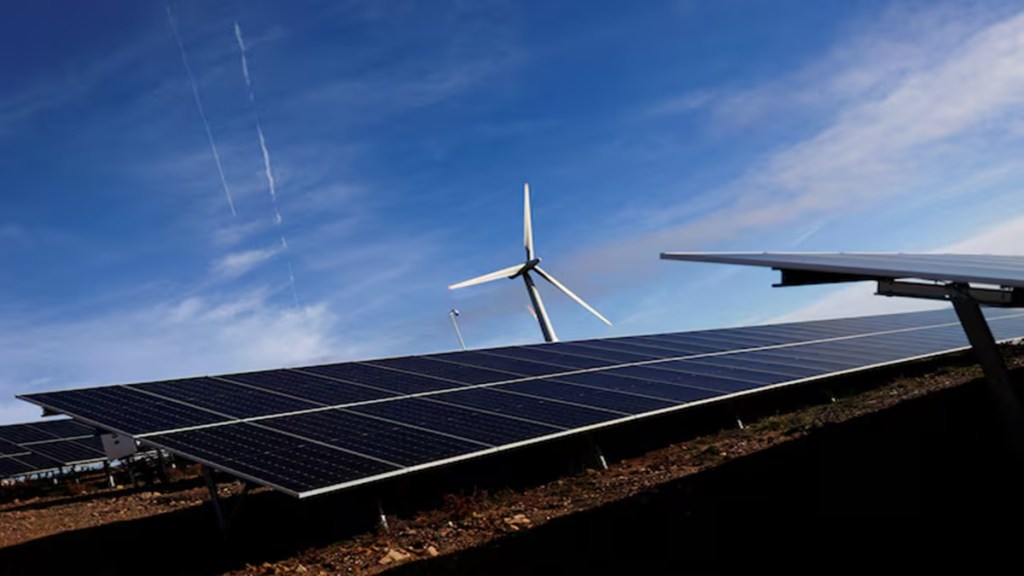

India will need to raise approximately $220 billion in investment over the next four years to reach its green energy targets. Renewable energy sources already account for 52% of power generation capacity as the country eyes 500 GW by 2030. A newly launched pilot project covering 10,000 acres is also testing the use of green ammonia as an alternative to conventional urea fertiliser — becoming a flexible shock absorber for surplus power.
“With 308 GW of installed non-fossil fuel capacity, we are firmly on course to reach our 500 GW target by 2030. Realising this ambition will require approximately USD 220 billion in investment between 2027 and 2030, alongside accelerated deployment of energy storage, stronger transmission networks and expanded domestic manufacturing capabilities,” Santosh Sarangi, Secretary, Ministry of New and Renewable Energy said on Wednesday.
A newly launched green ammonia pilot project adds a fresh dimension to the renewables story. Production has traditionally depended on fossil fuels since ammonia is manufactured using hydrogen derived largely from natural gas. The new project uses hydrogen generated through renewable-powered electrolysis to generate green ammonia that can be injected directly into the soil instead of being converted into urea beforehand. According to an official release it can help reduce emissions in sectors such as fertilizer production, petroleum refining, iron and steel manufacturing, heavy-duty road transport, and shipping.
“Currently India is also undertaking an experiment on 10,000 acres of land to apply ammonia directly in the soil…if you inject ammonia directly in the soil better efficiency can be achieved at almost one-third of the current cost. Because there is no volatilisation or irrigation loss,” Sarangi added.
$220B capital requirement and green hydrogen push
According to BloombergNEF data quoted by PIB, India invested $63.7 billion in its renewable energy sector between July 2024 and June 2026. The country presently ranks third globally in renewable energy and solar installed capacity, as well as fourth in wind power capacity. Sarangi added that the figure included $6.2 billion in foreign investment while the government invested an additional $6 billion.
The MNRE official explained that solar energy would account for $70 billion to $75 billion of the requirement, followed by transmission infrastructure at $40 billion to $45 billion and wind energy at $25 billion to $30 billion. Green hydrogen is expected to require about $20 billion to $25 billion while manufacturing requires another $15 billion to $20 billion.
But the increased clean energy push and the large number of project tenders awarded over recent years have left about 40 GW of clean energy projects yet to find customers. This creates a massive financial strain as billions of dollars in investment remain frozen without a guaranteed source of revenue. Sarangi added that the central government was working with its state counterparts to encourage them to take on clean power and ramp up battery storage.
Domestic offtake problem
Sarangi told reporters on Wednesday that Indian green hydrogen developers had secured orders to supply 5.5 lakh tons through 2026. The country has now emerged as the global leader in green hydrogen supply commitments — with Indian companies signing 18 deals covering over 4 lakh MTPA of green hydrogen equivalent this year. The National Green Hydrogen Mission was approved in January 2023 with an initial outlay of Rs 19,744 crore and targets annual production capacity of at least 5 million metric tonnes by 2030 with investments exceeding Rs 8 lakh crore.
“Till October 2026, Indian companies have signed the world’s largest Green Hydrogen offtake commitments – totalling over 5.5 lakh MTPA -positioning India as the global leader in Green Hydrogen supply commitments,” the ministry reiterated on Thursday.
Sarangi also predicted that “the future requirement is going to be fairly high” for both ammonia and methanol. He added that India was looking at the European Union, Japan, and Korea as key markets for additional sourcing. The government is eying $20 billion to $25 billion in green hydrogen investment requirements by 2030. An official release added that Indian companies had signed 23 supply contracts covering 5,55,610 MTPA of green hydrogen equivalent since the launch of the National Green Hydrogen Mission in 2023.
But the green hydrogen segment faces a massive demand challenge within the country. Much of the current interest comes from export deals since the production cost of green ammonia is higher than grey ammonia made from natural gas. Therefore fertiliser makers and other industries have no incentive to switch without subsidies or mandates.
“Look, in traditional urea, there is a huge government subsidy involved. If you factor that in…the cost incurred with the subsidy will be more than the cost incurred here,” Sarangi added briefly before moving away from the topic.
Can a 10,000-acre pilot project change things?
The Indian government had informed in late September that it was planning large-scale demonstrations of green ammonia across 10,000 acres in 37 districts during the upcoming rabi crop season. The pilot project spans 37 districts in six states and covers ten different crops. Sarangi noted during a presser on Wednesday that costs would be reduced significantly if ammonia was injected directly into the soil.
Multiple studies show that anhydro ammonia injected directly into the soil can replace solid urea as a direct source of nitrogen fertilizer. According to a 2022 study focusing on the Nile Delta region of Egypt, it is also a cheaper source of nitrogen fertilizer than granular urea for rice production. The study noted that the highest yields were achieved with the full anhydrous ammonia treatment that yielded 53% more grain than the zero nitrogen control while the full urea treatment yielded 22% more than the control.
The new pilot study is working to understand how effective such a treatment could be in the Indian context. Sarangi added that the quantum of green ammonia requirement could “multiply many times” once this was done. A PIB press note added that the process — unlike fossil-based routes — emits far less carbon.
“India’s abundant solar and wind resources make domestic production feasible. This diversifies the country’s energy sources and strengthens energy security. It also supports India’s goal of net-zero emissions by 2070,” the release added.
It also noted that green hydrogen mattered most in sectors where cutting emissions is difficult — with reasons including high-temperature heat needs, chemical processes and few alternatives to fossil fuels. These hard-to-abate sectors include fertiliser, petroleum refining, iron and steel, heavy-duty road transport and shipping. Fertiliser and refining plants already use hydrogen, so green hydrogen can replace the fossil-based supply. It can also support lower-emission steelmaking, selected transport uses and energy storage. It is especially useful where direct electrification is difficult or less practical.