


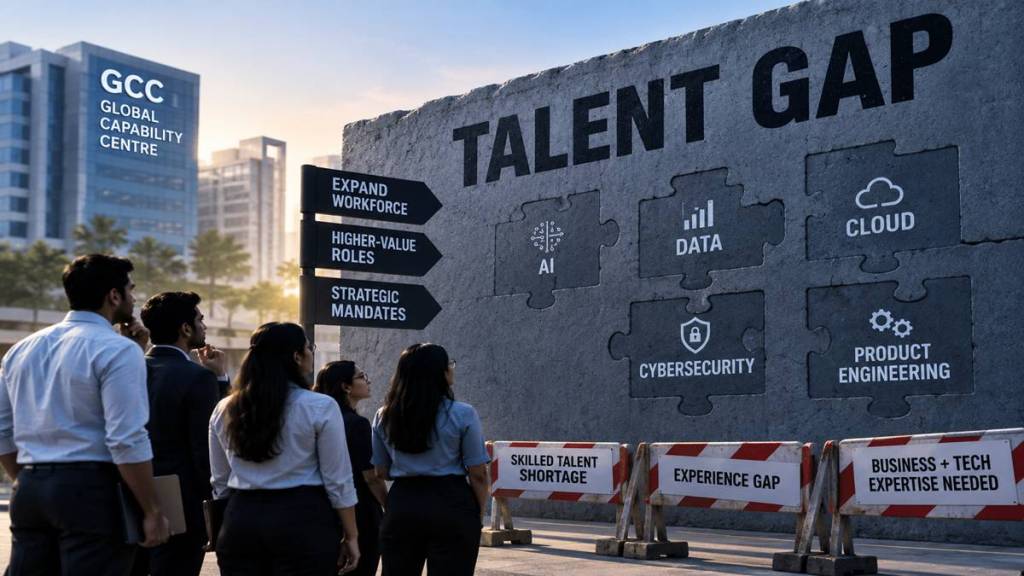

India’s more than 2,100 global capability centres (GCCs) face a growing talent problem: the more complex the work, the harder it is to find the right people. More than half plan to expand their workforce in FY27, but demand for skills in AI, data, cloud, cybersecurity and product engineering is outpacing the available talent. As GCCs take on bigger and more strategic roles, the hiring challenge is no longer about numbers – it is about finding professionals who combine technical depth with business understanding and experience.
The Taggd-CII GCC Talent Lab report puts the mismatch in sharp focus. While 52% of GCCs plan to expand their workforce, only 42.6% of graduates meet industry employability standards. Nearly half of critical roles take more than 60 days to fill, with almost one in five taking more than 90 days. Quality mismatch has emerged as the biggest hiring constraint, ahead of compensation and candidate availability. The gap is particularly significant for GCCs because many of the newer roles require experience that cannot be acquired through conventional classroom training alone.
Specialised skills in short supply
The toughest roles are increasingly specialised. Cybersecurity leads the list, particularly cloud security, application security and zero-trust architecture. Demand for these skills is growing 32% annually, while supply of professionals with three to eight years of relevant experience has not kept pace. AI governance, prompt engineering, generative AI and ML operations (MLOps), modern data engineering, and site reliability and platform engineering are also proving difficult to staff. These are fast-changing areas where employers increasingly want professionals who have worked on real enterprise deployments rather than simply completed courses or experimented with individual tools.
“The real requirement today is beyond technical proficiency,” says John Dawber, VP and MD, Novo Nordisk Global Business Services. “GCCs increasingly need people who can combine technology skills with domain knowledge, regulatory understanding, judgement and learning agility.”
AI governance and prompt engineering remain relatively new disciplines, with job definitions still evolving and limited pools of experienced candidates. Generative AI and MLOps pose a similar challenge because companies want professionals who have deployed and managed large language models and agentic AI systems, not just experimented with them. Modern data engineering and platform roles are also demanding expertise in areas such as Kubernetes, multi-cloud and cloud security.
“As enterprises look to GCCs to drive AI-led reinvention, the challenge is no longer access to talent alone,” says Arundhati Chakraborty, global finance and GCC lead, Accenture. “They need talent ready to operate at enterprise scale,” particularly across AI engineering, data science, cloud architecture, cybersecurity and product engineering.
That shift is being driven by the changing role of GCCs, which are moving beyond technology support to take on product development, engineering, analytics and business functions for global organisations. Jacob George, senior director and head of human resources, TransUnion GCC India, describes the challenge as “not simply talent availability, but talent readiness”. In areas such as advanced analytics, cloud, cybersecurity, data and product engineering, expertise changes so quickly that continuous learning is becoming as important as hiring.
Talent costs climb
Entry-level salaries in Tier-1 metros have climbed 25-33%, while senior compensation has crossed ₹50 lakh annually, up from about ₹40 lakh last year. For GCCs, this creates a double challenge: attracting specialised talent is becoming more expensive even as the supply of experienced professionals remains constrained.
There is another problem: much of the hiring is simply moving talent around. About 78% of GCC hiring is sourced externally, with IT services accounting for 41% of that pool, other GCCs 32%, and startups and product companies 27%. Hiring from another GCC may fill a vacancy, but it does little to expand the overall talent pool and can add to salary pressure. It also means that a new GCC entering an established market can find itself competing for the same experienced professionals as existing centres. That makes internal development increasingly important. Nearly eight in 10 GCCs now run internal GenAI upskilling programmes, while reskilling covers close to three-quarters of the workforce.
“AI strategy is increasingly a talent strategy,” says Madhulika Vedula, head of human resources, Providence India. Future roles, she says, will need to combine human strengths such as judgement, deep thinking and empathy with AI and technical capabilities. Domain knowledge is emerging as another differentiator. At pharma GCCs, for instance, regulatory and scientific understanding can be as valuable as technical expertise, while financial services centres increasingly need people who understand both technology and the business decisions it supports.
For the GCC sector, the talent problem will therefore not be solved by hiring more people alone. The next phase of growth will require stronger campus pipelines, internal mobility, reskilling and domain-led training. The winners may be those that can build the talent they need faster than they can hire it.