


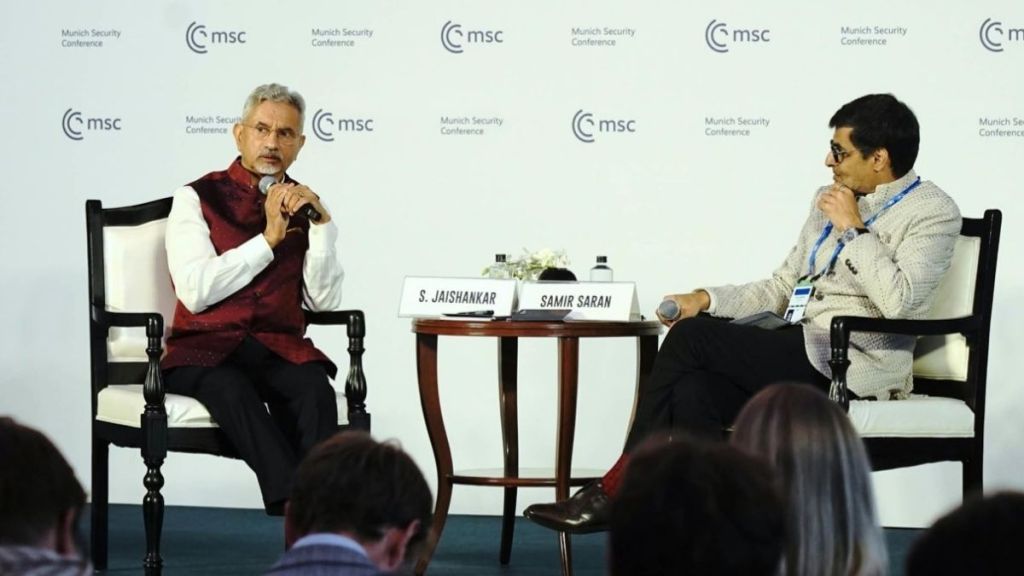

India and Europe can expand their partnership well beyond traditional trade and diplomatic ties, External Affairs Minister S Jaishankar said at the 62nd Munich Security Conference in Delhi on Sunday. He spoke about artificial intelligence, semiconductors, advanced manufacturing, life sciences, space and defence as areas where India and Europe can work more closely.
Jaishankar said the relationship should not remain limited to immediate economic gains. He said that India and Europe can also work together to shape the changing global order.
“If one looks, for example, at technology, innovation, emerging domains, not just emerging players, something like advanced manufacturing, semiconductors. These are areas where a partnership can increase,” Jaishankar said.
AI can bring India, Europe closer
Artificial intelligence is one of the areas where Jaishankar sees strong scope for India-Europe cooperation. He said there is already a degree of convergence between the two sides on AI. India and Europe can build on that common ground as the technology becomes more important across economies and governments.
“If you look at the AI debate, there is a considerable degree of convergence between the European thinking on AI and the Indian thinking on AI,” Jaishankar said.
India has also been pushing for an approach that focuses on making AI accessible and useful for society. Jaishankar said India’s experience with digital technology has shown how digital tools can support large-scale governance and social transformation.
At the same time, he said AI raises questions about safety and security. “This is too major an issue to leave it to the market, so to speak,” Jaishankar said while discussing AI.
For India and Europe, that creates room for cooperation on both technology and its governance.
Semiconductors offer another opening
Semiconductors are another area where Jaishankar sees potential for a deeper India-Europe partnership. He placed semiconductors alongside advanced manufacturing and other emerging technologies as sectors where both sides can develop stronger links.
The semiconductor industry has become a strategic issue because chips are essential for electronics, artificial intelligence, automobiles, communications and defence systems.
Jaishankar also referred to the Netherlands as an example of how a country can have an important role in one specialised area. “The Netherlands in semiconductors” was one example he gave while saying that countries should not be judged only by their overall economic size.
Space is becoming a key area
Space also has significant potential for India-Europe cooperation, according to Jaishankar.
He said Europe wants to strengthen its own space capabilities, while India has expanded its ability to launch satellites and build space infrastructure. “Europe today realizes that it must have its own space capabilities,” Jaishankar said.
He added that India has also had a long-standing ambition in this field. “When I look at many of the loads in our space launchers, we are today really expanding our capability to do space launches on a much more globally competitive and significant basis, and creating infrastructure for that,” he said.
This creates potential for cooperation in areas such as space technology, launches and related infrastructure. Jaishankar also spoke about the growing international partnerships of Indian companies and startups.
Defence ties can grow
Defence is another area where India and Europe can expand cooperation. Jaishankar said Europe has a growing determination to rebuild its defence industry. India, meanwhile, has been developing its own defence manufacturing and exports.
“Europe has a determination today to rebuild its defense industry,” he said.
He also spoke about India’s growing defence exports and partnerships between Indian startups and foreign companies. “We are finding it very interesting that many of our startups today have found partners abroad, but then so have many of our orthodox industries,” Jaishankar said.
He added that India’s defence exports are “growing very rapidly”. For India and Europe, this could create opportunities in defence production, technology and industrial partnerships.
Global Capability Centres build a bridge
Jaishankar also referred to Global Capability Centres (GCCs) as another link between India and Europe. GCCs allow multinational companies to operate technology, research, finance and other specialised functions from India.
Jaishankar said these centres have become a bridge between Indian and European economies without requiring the same level of physical movement of people. “The Global Capability Centers are also becoming a bridge today between our economies and our corporations without actually the physical mobility which is involved in this kind of knowledge-driven activity,” he said.
Instead of limiting cooperation to goods and conventional services, India and Europe can build ties through technology, knowledge and specialised skills.
Life sciences offer another opportunity
Jaishankar also included life sciences among the areas where India and Europe can work together. He said there is potential for greater cooperation in sectors linked to pharmaceuticals and healthcare.
India has a large pharmaceutical industry and plays an important role in the global supply of medicines and active pharmaceutical ingredients.
Jaishankar linked this opportunity to the wider need for resilient supply chains. He said health security requires “a much more diversified production of APIs and pharmaceuticals.”
India-Europe ties go beyond trade
Jaishankar said the relationship should not become too narrow or purely transactional. He said that India and Europe can work together on broader global issues while also pursuing their economic interests.
“Yes, absolutely, there is a wider agenda in terms of India-Europe, but there is a wider agenda also about how we shape the world because we limit it to a narrow benefit or make it too transactional,” he said.
He added, “Then we are missing out on what is actually going to affect all of us, which is the nature of the world.”
Jaishankar said the global landscape is moving towards greater multipolarity. Countries are increasingly building relationships with different powers instead of relying on a single bloc.
India backs multi-alignment
Jaishankar described this approach as multi-alignment. He said emerging and middle powers increasingly want to maintain relationships with countries that may not always have identical interests.
“The idea that countries will have relationships with players which may not always be easy to harmonize, but nevertheless are a reality, is a compulsion for countries,” he said. He described this as a strategy of “advancing by hedging”.
According to Jaishankar, countries are diversifying their relationships in the same way that businesses diversify supply chains and economic risks.
He said emerging and middle powers are focused on “diversifying and de-risking” across their economies, security arrangements and supply chains. “In this process of de-risking, diversifying, and hedging, slowly a new architecture is coming into place,” he said.
India sees Europe as a strategic partner
India has relationships with the US, China, Russia and several other major powers. At the same time, it works through groupings such as the Quad and BRICS.
Jaishankar cited the India-Middle East-Europe Economic Corridor and the International North-South Transport Corridor as examples of connectivity initiatives. He also mentioned the Northern Sea Route.
These arrangements, he said, show how countries can cooperate where their interests overlap without requiring complete agreement on every issue.
“Amongst the emerging and middle powers, to the extent that they don’t have direct clashes of interest, they have an interest in strengthening their interstate cooperation,” he said.
He added that these countries can also cooperate with both the US and China.
Supply chains remain a priority
Supply-chain resilience forms another major part of India’s approach. Jaishankar said countries are trying to reduce their exposure to disruptions by diversifying suppliers and developing alternative arrangements.
“Today, most of them are focused on diversifying and de-risking in every sense of the term, not just their economy or their security, but also building more resilient supply chains,” he said.
He also spoke about semiconductors, machine production, pharmaceuticals and advanced manufacturing as areas where countries can develop specialised capabilities.
He said that a country does not have to be the world’s largest economy to become important in a specific sector. “You don’t have to be the biggest country in the world to dominate the world of chips or to even dominate machine production,” he said.
Connectivity and climate also matter
The India-Europe agenda could also extend to connectivity, climate action and sustainability.
Jaishankar described connectivity as an important area for emerging and middle powers. He also said climate action and sustainability have become more urgent because of changing global circumstances.
He placed these issues alongside defence and space as areas where older models of international cooperation are changing. “The world is changing, its agenda is changing, the landscape is changing, the architecture is changing,” Jaishankar said.
Jaishankar calls for a stronger UN
Jaishankar also linked India’s approach to the future of global institutions. He said the United Nations faces visible gridlock and argued that the answer should not be to abandon the organisation.
“What we need is a better UN. The idea is not to throw away the UN, but to fix the UN,” he said. He added that the rise of smaller groups and issue-based partnerships reflects the changing global order.
India has itself promoted initiatives such as the International Solar Alliance and the Coalition for Disaster Resilient Infrastructure. Jaishankar said these examples show how countries can create working arrangements around shared interests.