


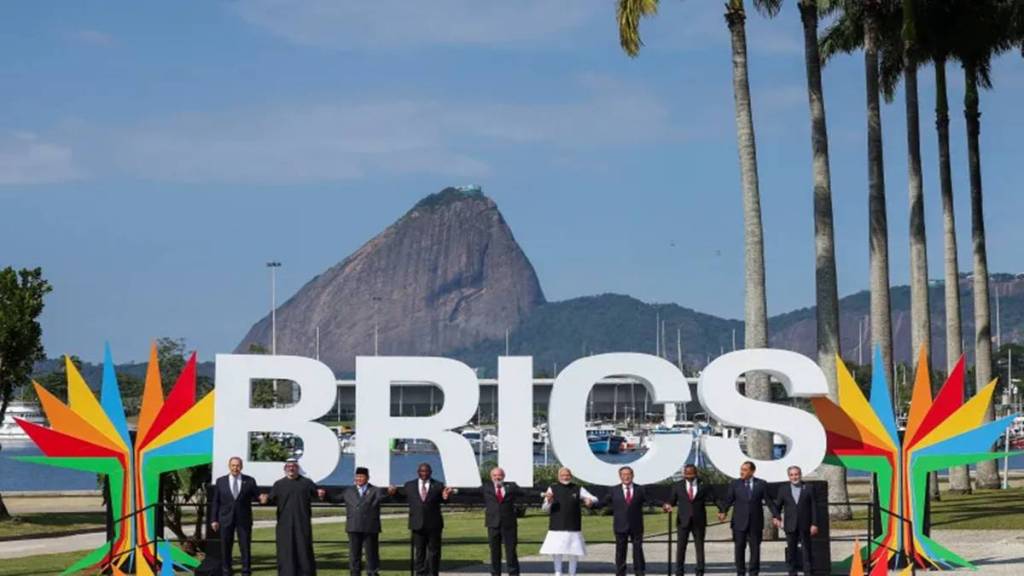

Leaders of BRICS countries on Saturday resolved to expand the membership of the New Development Bank (NDB), also known as BRICS Bank, and create new financing mechanisms to support infrastructure and development across the Global South.
As per the New Delhi Declaration adopted by the grouping, apart from reforming existing institutions for infrastructure and development financing, the NDB should be strengthened further with a facility for expedited consideration of applications from interested BRICS countries. “We encourage further efforts by the Bank (NDB) to expand steadily its capacity to mobilise resources, foster innovation, expand local currency financing, diversify funding sources, and support impactful projects that advance sustainable development, reduce inequality, and promote infrastructure investments and economic integration,” the declaration said.
The NDB, which operates under a mandate set in the BRICS Summit in 2014, currently focuses its financing on six primary sectors, including clean energy, transport infrastructure, water and sanitation, social infrastructure and bridging the digital divide. It is designed to support both public and private sector projects through customised financial tools. One objective of the bank is also to scale up local currency lending. Apart from India, China, Brazil, Russia and South Africa, the UAE, Colombia, Uzbekistan, Egypt, Algeria and Bangladesh are its members. Another set of countries– Uruguay, Ethiopia, Angola, and Zimbabwe — are listed as prospective members.
The grouping welcomed the launch of the BRICS-NDB knowledge portal to share development experiences, policy innovations and lessons from NDB-financed projects.
The declaration stated that any new quota formula at International Monetary Fund should reflect countries’ relative positions in the global economy and increase the quota and voting shares of emerging market and developing economies without reducing the shares of developing countries. It also stressed that the interests of the poorest members should be protected and that voluntary financial contributions should not determine quota allocation, governance representation or voting power. “We reiterate the urgent need to reform the Bretton Woods Institutions (BWI) to make them more agile, effective, credible, inclusive, fit for purpose, unbiased, accountable, and representative, to enhance their legitimacy,” according to the Declaration.
On the IMF, BRICS reiterated its support for quota and governance reforms, calling for the implementation of quota increases agreed under the 16th general review of quotas without further delay and for meaningful quota realignment under the 17th review at the earliest. The declaration stated that any new quota formula should reflect countries’ relative positions in the global economy and increase the quota and voting shares of EMDEs without reducing the shares of developing countries. It also stressed that the interests of the poorest members should be protected and that voluntary financial contributions should not determine quota allocation, governance representation or voting power.
The World Bank’s shareholding review was similarly identified as a key instrument to strengthen multilateralism and make the institution “better, bigger, and more effective”.
The declaration welcomed progress on the BRICS Multilateral Guarantees (BMG) initiative, which intends to improve the creditworthiness of development projects, lower financing costs and mobilise private investment. Members called for continued technical work and pilot transactions.
The bloc’s Contingent Reserve Arrangement, meanwhile, is being strengthened as a financial safety net, with amendments aimed at making it more flexible and responsive during crises.