


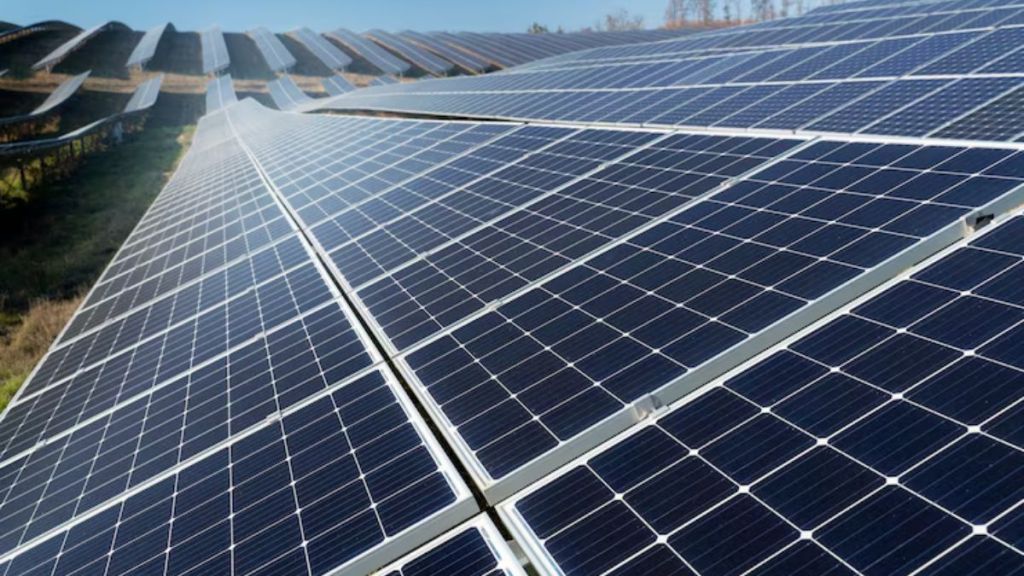

The Centre is exploring financial incentives to encourage agri-photovoltaics, a system that combines solar power generation with agricultural activity on the same land, as it seeks to expand renewable energy capacity without compromising food security, reported The Indian Express.
India has an estimated agri-photovoltaic potential of 1-2 terawatts (TW), equivalent to 1,000-2,000 gigawatts (GW), against its current installed solar capacity of 171 GW, Santosh Kumar Sarangi, Secretary, Ministry of New and Renewable Energy (MNRE), said, according to the report.
The ministry is discussing a possible central sector scheme with the Ministry of Finance to encourage states to adopt the technology. The government is assessing whether incentives can be offered through the existing PM-KUSUM scheme, which promotes solar energy in agriculture, or through a separate programme, Sarangi said on Monday.
He was speaking at a media briefing on the 7th Agrivoltaics World Conference 2026, scheduled to be held from October 21 to 23.
Higher costs pose challenge for agri-photovoltaic projects
Agri-photovoltaics involves installing solar panels on elevated structures over farmland, allowing crops to grow beneath them while electricity is generated above. Although the photovoltaic technology is similar to that used in conventional ground-mounted solar projects, the elevated structures require additional investment and must leave enough room for farming operations.
Sarangi said panels are generally installed around 3.5 to 4 metres above ground level to allow farmers to carry out routine agricultural activities and move machinery beneath them.
The additional civil and structural work makes these projects around 25-30% more expensive than conventional ground-mounted solar installations, he said. The proposed incentives are intended to bridge this cost difference.
“Our objective will be to meet this gap of 25% which will be there in putting up this kind of tilted structure,” he added, reported The Indian Express.
Initial government assessments suggest that agri-photovoltaics could be suitable for certain crops, including fruits and leafy vegetables. However, the studies have not found the technology suitable for crops such as rice and sugarcane.
Agri-photovoltaics may help spread solar capacity across states
The proposed push could also help distribute solar power generation more widely across the country. Sarangi said around 85% of India’s solar capacity is concentrated in five states, creating pressure on transmission infrastructure needed to transport electricity to other regions.
Expanding generation to more states could help reduce the burden on transmission networks and address challenges related to land acquisition and right-of-way clearances for new transmission lines.
“So we have seen that as more and more transmission lines come up in a certain pocket. There are local resistances, there are Right of Way (RoW) related issues, there are land acquisition related issues. So this is definitely causing some degree of concern as to how we can supplement transmission infrastructure to support our enabled capacity. So the solution lies in expanding it to other states where they will also be able to generate it within the state and consume it within the state,” he said, reported The Indian Express.
Sarangi said agri-photovoltaics could be particularly useful for states with limited non-agricultural land. By enabling solar installations alongside cultivation, the model could support large-scale renewable energy deployment without diverting agricultural land entirely from food production.
The approach could therefore serve two purposes: expanding solar generation while allowing farmers to continue cultivating suitable crops on the same land. However, its wider adoption will depend on addressing the higher project costs and identifying crop varieties compatible with elevated solar installations.